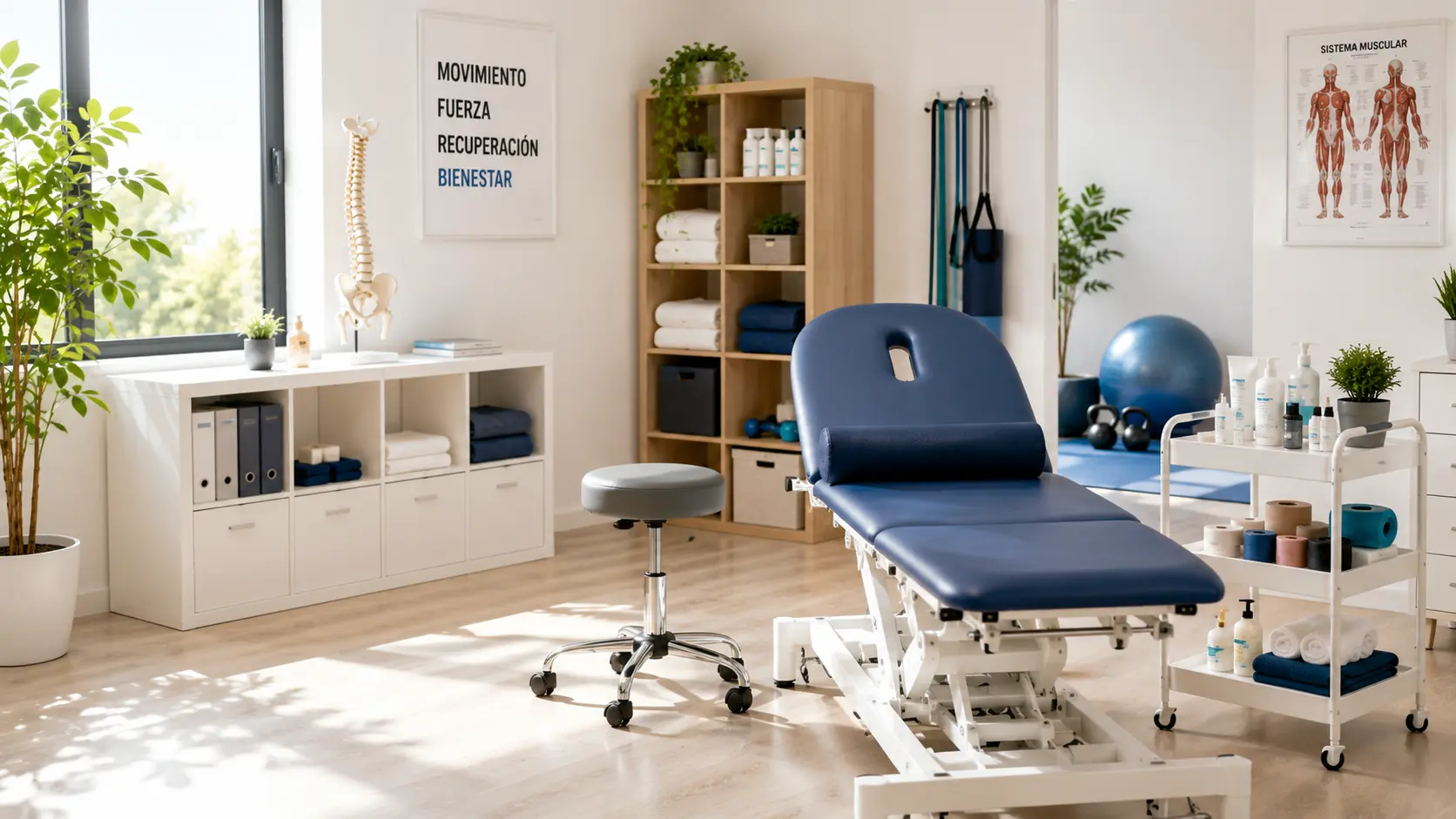
The core kit for opening a physiotherapy clinic comes down to eight categories, drawn from the eleven this guide covers. Which of them you actually need depends on the services you intend to offer and on your scope of practice: a height-adjustable treatment couch, clinical furniture, consumables and hygiene, creams and gels, basic assessment equipment, taping and bandaging, basic exercise equipment and a first-aid kit. Everything else in the catalogue can wait until the practice asks for it. That is where many physiotherapists get stuck, overspending on equipment they will barely use in the first year and underspending on what they need every single day.
The useful question is more specific. What do you actually need to open the doors, and what can wait until the practice grows? The equipment for opening a physiotherapy clinic sorts itself out fairly well through that lens, and that is the lens we will use here.
We will go category by category, marking in each one what is essential to start and what is expandable later, always with a practice that is just opening in mind. Kinemarket sells many of the categories named here, so this guide separates the minimum equipment needed to work safely from the optional purchases that depend on the services you intend to offer. This is about physical equipment. The paperwork, the licensing, the registration and the business steps are a separate conversation, and you have that one in our step-by-step guide to opening a physiotherapy clinic.
1. The treatment couch: the heart of the practice
If you get only one purchase right, make it this one. The treatment couch is the piece almost everything you do revolves around, and you will use it in every session for years, so it is worth choosing well from the start.
There are four main types, and each one suits a different practice profile:
- Fixed couch. The cheapest and most robust, but the height does not adjust, which limits your technique range and loads your back over the months.
- Hydraulic couch. Raises and lowers with a pedal or lever. A very solid middle ground for most practices that are starting out.
- Electric couch. Adjusts the height with a motor, comfortable when you see high volume or work with patients who have limited mobility, at a higher price.
- Folding couch. The lightweight option for home visits or a flexible second room.
Height adjustment is not a luxury. Working at the correct height protects your body and lets you apply more techniques without contorting, and it is the difference between finishing the day intact or with a loaded lower back. When you compare models, look also at the face hole for prone work, at the foam density, which sets patient comfort, and at the width, especially if you treat larger or athletic patients.
To start, a height-adjustable couch covers the bulk of the work. If you do home visits, add a lightweight folding one. Leave the high-end electric couch, and the second and third couches, for when the diary asks for them. Essential: a height-adjustable couch. Expandable: premium models and additional or specialised couches.

2. Clinical furniture and storage
Furniture is not the glamorous part of the catalogue, but it is what makes a session flow without you losing time hunting for things or forcing your posture.
These are the items you will genuinely use every day:
- Ergonomic stool with wheels. Lets you work seated and move around the couch without standing up. Your back appreciates it as much as it appreciates the couch height.
- Trolley with drawers. Keeps gels, electrodes, bandages and consumables within reach. It sounds minor, but it saves dozens of steps a day.
- Cabinets and shelving. For storing consumable stock, linen and equipment in an orderly, accessible way.
- Screen or divider. Necessary if you share a room or have no separate cubicles, to give the patient privacy while changing.
- Full-length mirror. Useful for movement and visual feedback during exercise.
Positioning cushions, rolls and wedges belong here too. They cost little and do a great deal for positioning the patient in prone, supine or side-lying. To open, the stool, the trolley, a cabinet and the positioning supports are enough. You add the rest as the space and the patient mix dictate.
3. Consumables, hygiene and waste management
This is the budget line almost nobody gets right, because it repeats week after week instead of closing with a single purchase. And in a practice that sees patients daily, that repetition shows up in the accounts.
The most basic consumable is couch roll, used as a clean patient-contact barrier where your procedure calls for one, alongside cleaning or disinfecting the couch between patients according to the practice protocol and the couch manufacturer's compatibility instructions. Beyond that, you choose between disposable non-woven sheets, convenient and single-use, and reusable fitted sheets or covers, more sustainable if you have a washing machine and a laundry routine. Many practices combine both.
Hygiene and protection are non-negotiable in a clinical setting:
- Nitrile gloves, for any technique that calls for them.
- Liquid handwash at the sink, with disposable drying materials, and an authorised alcohol-based hand rub for use when hands are visibly clean.
- A surface disinfectant whose authorised use, dilution and contact time match the couch and the other clinical surfaces you will be cleaning. Follow the product label and the practice's infection-control procedure.
- Disposable wipes and cloths, along with spray bottles for applying the disinfectant.
- Disposable clothing (gowns, shorts or single-use underwear) depending on the treatment.
Waste management closes the loop. A bin with liners for general waste, and if you do dry needling or any invasive technique, a rigid sharps container for clinical waste, which has its own collection route through a licensed contractor. Classification and storage rules differ across the UK nations, so confirm what applies to you before opening, starting from the HSE overview of healthcare waste management. Plan this cost from day one, because it is the part of your equipment that runs out on its own and without warning.

4. Creams, oils and gels
Cheap, used daily, and easy to forget on the opening shopping list. Which of these you need depends on the techniques and devices you actually use, so stock to your own service list rather than to a standard one.
The basics come down to four things. A neutral massage cream and a massage oil for manual work, choosing the texture to suit your technique and the patient's skin tolerance. A conductive gel, needed only for devices and reusable electrodes whose instructions call for one, such as therapeutic or diagnostic ultrasound and radiofrequency. Self-adhesive electrodes for TENS and EMS do not normally require it. And a massage cream with plant actives such as arnica, which the manufacturer presents for massage and topical use. Fisiocrem is the familiar example, widely used to prepare the muscles, to work as a massage medium and for the patient to use at home.
An instant cold spray is an option for acute management in the clinic or pitchside if you treat athletes, used according to its label and never sprayed at length directly on the skin. How much of this section you need depends on the services you offer; the large refill formats depend on your volume.

5. Assessment and diagnostic equipment
Without measuring there is no follow-up, and without follow-up it is hard to show the patient they are improving. It is curious that almost no equipment list for setting up a physiotherapy clinic includes this category, because it is among the cheapest and among the ones that do most to professionalise your work.
The basic assessment kit fits in a drawer:
- Goniometer. To measure joint range objectively and repeatably.
- Anthropometric tape measure. For girths, volume differences and oedema monitoring.
- Blood pressure monitor and stethoscope. Useful for basic screening if your service range, your training and your emergency plan justify them. They are not automatic red-flag detectors.
- Reflex hammer. For neurological screening.
From that minimum, you can expand with a dynamometer to quantify strength, which comes in a simple manual version or a digital one with Bluetooth logging, and with a pulse oximeter or scales depending on your patient type. Documenting progress is not bureaucracy. It is what underpins your clinical decisions and, if it comes to it, what lets you refer on in time. Start with the goniometer, the tape measure and the blood pressure kit, and grow from there.
6. Electrotherapy and equipment
You do not need to fill the room with machines to open. This is probably the category where the most money is wasted at the start, on expensive devices that then get used twice a month.
What equipment you start with depends on your service range. No passive device is universally essential. If a TENS/EMS stimulator fits indications that are frequent among your patients, your training and a measurable plan of use, it can form part of the initial kit. Check that the documentation covers what you need, and work out the consumables and the maintenance.
The rest of the equipment is expandable and depends entirely on your speciality and on the demand you actually have. Therapeutic laser, diathermy or radiofrequency, magnetotherapy, pressotherapy and cervical and lumbar traction are investments that make sense when a specific type of patient justifies them, and not before.
Whatever you buy, go through these professional purchase criteria:
- CE marking and instructions you fully understand.
- Fine parameter control, to adapt the dose to each case.
- Available spares and consumables, above all electrodes, which are a recurring cost.
- Accessible warranty and technical service, because a device out of action means turnover out of action.
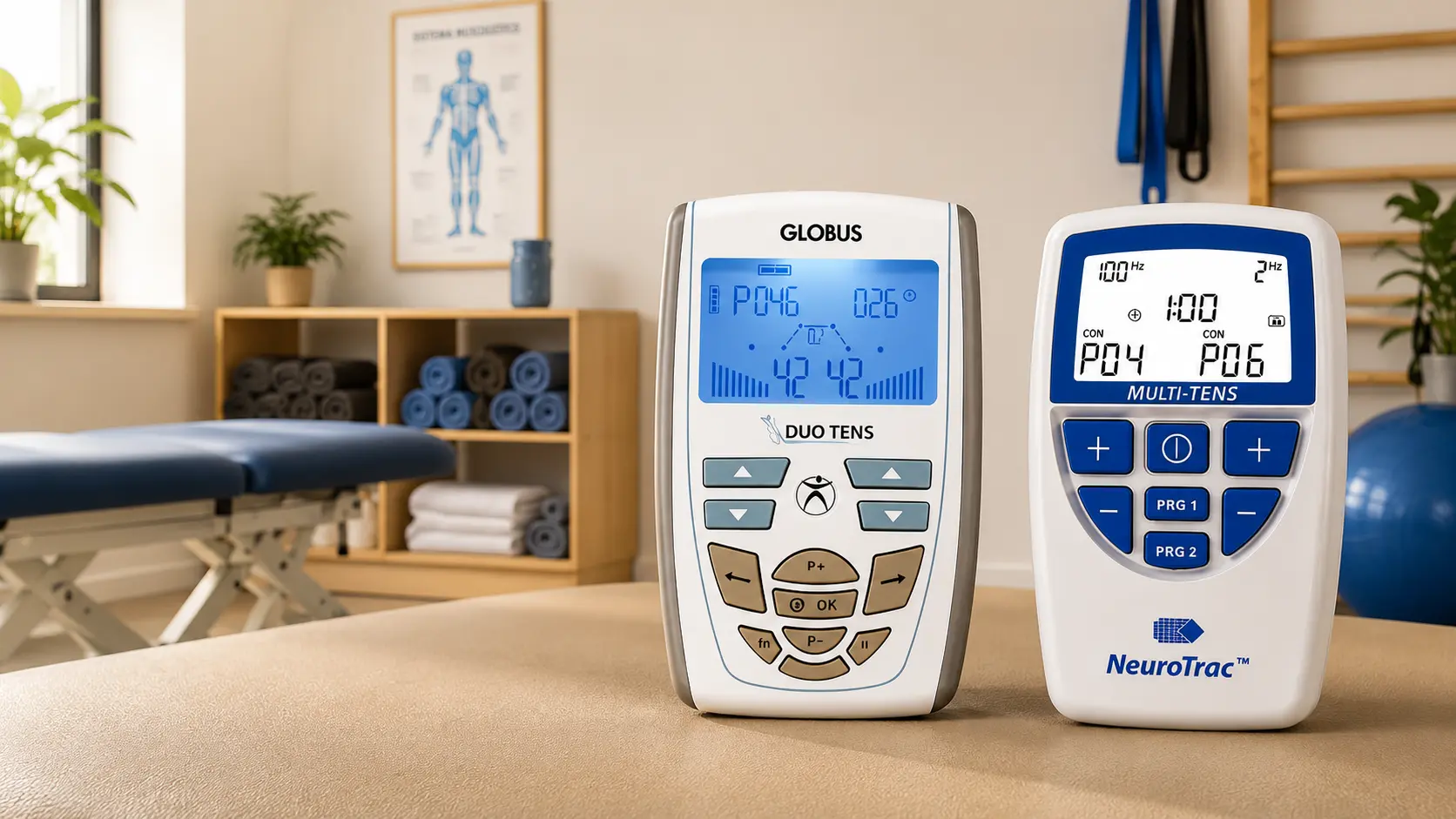
If you are unsure which electrical stimulation range to choose, our comparison of Globus and NeuroTrac explains which type of device fits which practice. The general rule is simple. Start with a versatile, well-supported device, and expand the equipment when the diary tells you it is needed.
7. Thermotherapy and cryotherapy
Heat and cold are among the least expensive items in the clinic, and even so they barely appear on the usual lists. They sit alongside manual therapy and exercise, and whether either is worth using depends on the indication.
For heat, hot packs with their heater unit, of the hydrocollator type, keep the compresses ready to apply. For cold, cold packs kept in a small freezer may give temporary symptom relief in selected acute presentations. An infrared lamp gives superficial heat to prepare the area before manual work.
If you work the hand or the wrist a lot, a paraffin bath is an optional warming modality used in some hand-therapy services, depending on the indication and your protocol. Within this category, one heat route and one cold route is enough to open with. You add the rest when your service range calls for it.

8. Exercise and active rehabilitation equipment
Therapeutic exercise is now at the centre of a large part of physiotherapy, and the good news is that you can start with very little investment. A basic exercise corner costs a fraction of a single piece of equipment, and it earns its keep from day one.
The base that already lets you work with almost any patient is modest:
- Elastic bands in several resistances, which you will use most in progressive strength work.
- Minibands or hip bands, for glute activation and lower-chain work.
- Mats, for floor work.
- A light medicine ball, 2 to 4 kg, and a gym ball for core and proprioception.
- A foam roller and myofascial release balls, for the self-treatment side.
When you want to scale towards a fuller rehabilitation space, the next level includes graduated dumbbells and kettlebells, ankle weights, an adjustable step, a plyometric box, a BOSU or balance board for proprioception, a suspension system such as TRX and, if the premises allow, wall bars and parallel bars.
On the recovery side, a percussion massage gun and, depending on your profile, a set of pressotherapy boots are useful extras you can leave for later, once the practice is up and running. Start with bands, a mat and a ball, which cover the bulk of therapeutic exercise, and build the gym gradually according to the space and the type of patient you see most.
9. Functional taping and kinesiology tape
For practices that routinely tape, it is a recurring consumable and worth stocking to actual use.
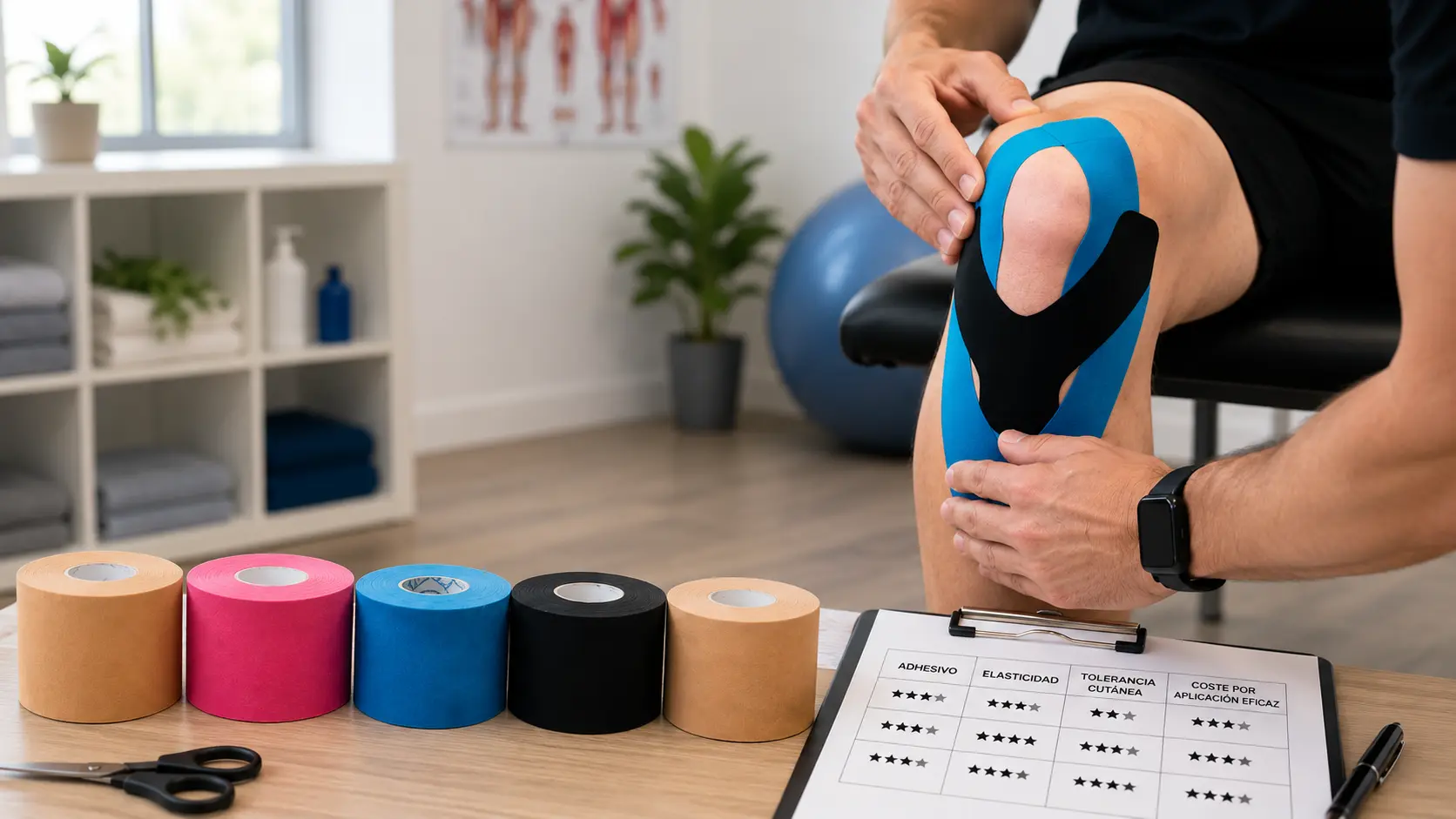
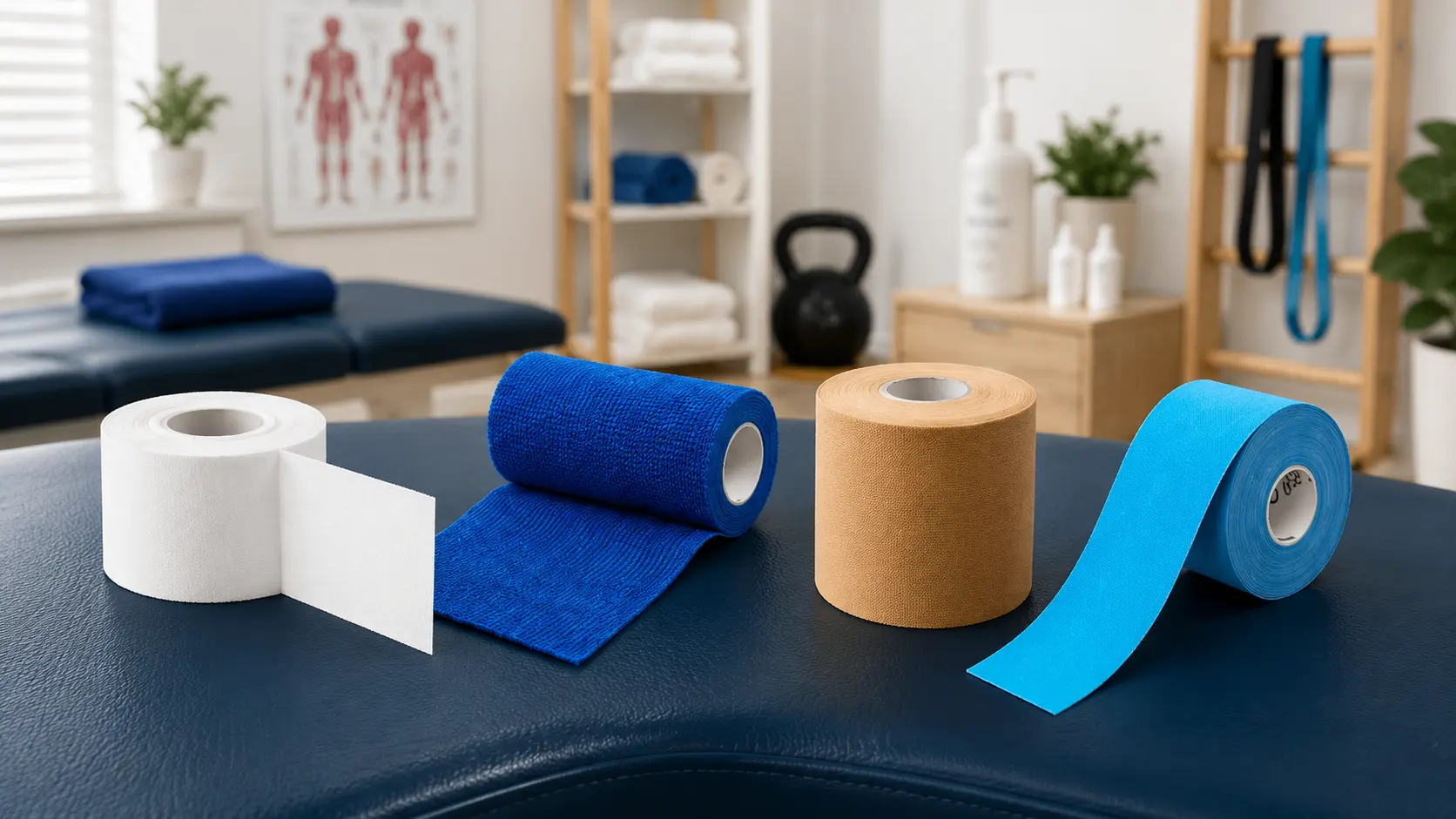
The basic assortment covers the main families. Kinesiology tape or neuromuscular taping for offloading and facilitation techniques, where the sensible approach is to keep a standard cotton roll for day-to-day work and a reinforced one for sport and sweating. Underwrap to protect the skin under rigid strapping. Cohesive bandage for support without adhesive directly on the skin. Rigid strapping tape for partial immobilisations, and crepe or cotton bandages for compression and fixation.
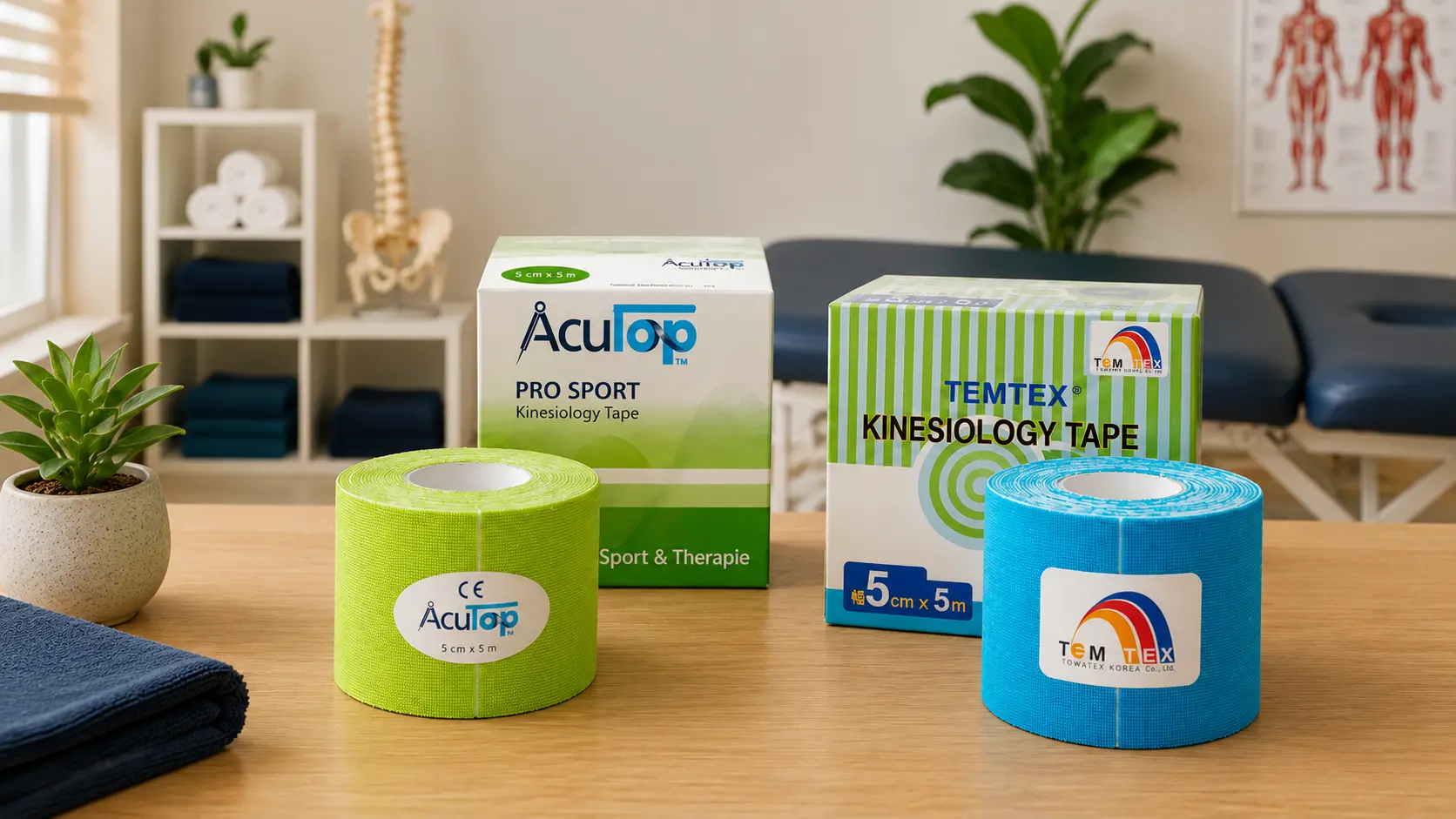
There is no need to over-complicate the brand choice to start. If you want to choose kinesiology tape with proper criteria, we go into it in depth in our guide to choosing kinesiology tape, and if you are torn between two options that are very common in the clinic, there is the AcuTop versus Temtex comparison. To open, keep a reliable kinesiology tape, underwrap, cohesive bandage and bandages. You fine-tune the rest with use.

10. Dry needling and invasive techniques
This category has a precondition none of the others has. It only enters your list if you are trained in the technique and genuinely intend to offer it, because equipment without the competence to use it is worth nothing.
If that is your case, the basics are affordable. Dry needling needles in the gauge and length you use, gloves and the rigid sharps container for clinical waste that we mentioned under hygiene. Managing that waste is mandatory and has its own route, so do not treat it as ordinary rubbish.
At the advanced end are percutaneous electrolysis (EPI or EPTE) and percutaneous neuromodulation, which combine needle and current and require specific training and a dedicated device. They are a very niche investment, clearly expandable and only justifiable when the technique is a stable part of your service range. If you are still weighing up whether to add it, the prudent move is to wait. We will cover the technique and its equipment in a dedicated article on dry needling later on.
11. Reception, waiting area and first-aid kit
Two things that get forgotten when the list is drawn up and that are indispensable. The patient sees the first before they see the couch, and the second you hope never to use, but it has to be there.
The reception and waiting area is equipment too, even though it treats no one. A counter, some comfortable seating and a coat stand make up the first impression of your clinic, and that impression shapes how the patient arrives at the session. It need not be expensive, but it should be cared for and consistent with your image.
The first-aid kit is the essential almost nobody lists. It has to be accessible and checked, with the basic materials for a minor incident in the clinic. In Great Britain it is also a legal duty rather than a preference. The Health and Safety (First-Aid) Regulations 1981 require an employer to assess first-aid needs and to provide equipment, facilities and personnel that are adequate and appropriate for those needs, which depends on the hazards, the workforce and how you work. A self-employed practitioner has to make the same judgement about their own circumstances. Northern Ireland has equivalent regulations of its own. A defibrillator (AED) is a separate question, because health and safety legislation does not require one, so whether you have it is a judgement for that same needs assessment. It is one of those things that give no visible return until the day they are needed, and that day justifies them entirely.
What should you buy to open, and what can wait?
Almost nobody buys everything at once, and there is no need to. This is the core provision that lets you open the doors and work safely. Creams and gels, and taping and bandaging, are service-dependent, so stock those only if you offer the techniques that use them:
- A height-adjustable couch, plus a folding one if you do home visits.
- Stool, trolley and positioning supports.
- Consumables and hygiene: couch roll, disposables, disinfection and waste management.
- Creams, oils and conductive gel.
- Basic assessment: whatever suits your scope and patient group, starting with a goniometer and a tape measure.
- A basic assortment of tapes and bandages.
- Basic exercise: bands, mat and ball.
- A first-aid kit and a well-kept reception.
And this is what makes sense to add once the practice grows and demand justifies it. A combined electrotherapy unit covering TENS and EMS, if it fits your service range from the start. Advanced equipment such as laser, diathermy, magnetotherapy or pressotherapy. A complete rehabilitation gym. Invasive techniques if you train in them. Recovery extras such as the massage gun or pressotherapy boots. And additional or high-end couches.
The criterion that works best is twofold. Prioritise the daily-use items and what protects your body, because you will handle those in every session for years. And leave the expensive equipment for when a specific type of patient asks for it regularly, not just in case.
At Kinemarket you have the equipment for each of these sections, chosen for a practice that is starting out, by type of use:
- For the treatment room: adjustable and folding couches, stools and clinical furniture.
- For electrotherapy: electrical stimulation units, including combined TENS and EMS models, from brands such as Globus or NeuroTrac, with their electrodes and spares.
- For manual therapy: creams, oils and gels, including Fisiocrem and cold sprays.
- For taping: cotton and reinforced kinesiology tape from AcuTop, Temtex or Kinefis, underwrap, cohesive bandage and bandages.
- For day-to-day: couch roll, sheets, disposables and all the refill consumables.
Frequently asked questions
How much does the equipment to open a physiotherapy clinic cost?
It depends above all on the equipment. What drives the budget up is advanced equipment and the rehabilitation gym, and those are best added gradually according to real demand rather than just in case.
Do I need a lot of equipment to open a physiotherapy practice?
There is no passive device that every practice needs. A TENS/EMS stimulator can make sense if it fits your patients, your training, the manufacturer's intended purpose and the total cost. The rest of the equipment is justified the same way, by real demand.
Which physiotherapy couch should I choose to start?
A height-adjustable couch, hydraulic or electric, because it protects your back and lets you apply more techniques. For home visits, add a lightweight folding couch as well. The fixed couch is cheaper but limits your work in the medium term, so it only pays off when the opening budget is genuinely constrained.
Which physiotherapy consumables need constant restocking?
Couch roll, sheets and disposable clothing, gloves, disinfection products and, if you do dry needling, needles and a sharps container. It is a recurring cost, not a one-off purchase, so it is worth budgeting for from day one and working with a supplier who can keep you stocked.