This guide covers twelve common sports injuries (ankle sprain, hamstring tear, patellofemoral pain, Achilles tendinopathy, plantar fasciitis, shin splints, meniscus, anterior cruciate ligament, epicondylitis, painful shoulder, stress fracture and dislocation), how to recognise each one, which warning signs to watch for, which principles apply at the start and when an assessment is needed.
How to read the alerts. A red flag needs attention the same day, and where you go depends on the sign. Go to A&E if you heard a crack at the time, the limb has changed shape or points at an odd angle, it is numb or tingling, the skin around it looks blue or grey or feels cold, the pain is severe, or there is heavy bleeding or exposed bone. Call 999 instead if the head, neck or spine is involved, or if the person cannot be moved safely. Call NHS 111 for any other red flag, including being unable to bear weight, a joint you cannot straighten, swelling that keeps getting worse, or fever alongside the injury. A yellow flag means asking for an assessment if the pain prevents walking or normal function, gets worse, appears at rest, becomes very sharply localised over a bone, or does not improve within a few days (within a few weeks for load-related problems).
Important note: this guide is for information only and does not replace the diagnosis or individual assessment of a doctor or physiotherapist. If any of the signs above apply, or you are in any doubt about how serious the injury is, seek professional care.
1. Ankle sprain: the injury everyone underestimates until it comes back
You roll your ankle, grit your teeth and, two weeks later, you are running again. Three months on, the same ankle gives way on a wet paving slab. The ankle sprain is one of the most common sports injuries and one of the most poorly rehabilitated.
What it is and how it happens. A sprain is an overstretch or partial tear of the ankle ligaments. It happens when the foot rolls inwards sharply: a bad landing, a change of direction, stepping on another player, an uneven surface.
Typical signs. Immediate swelling, bruising on the outer side of the ankle and pain on weight-bearing. Red flag: visible deformity, or pain that is severe rather than merely bad → 999 or A&E. If you cannot bear weight and take four steps in a row → NHS 111 the same day, because an X-ray may be needed to rule out a fracture.
Treatment and recovery. Acute phase (48 to 72 hours): protection, gentle and well-tolerated loading, compression and elevation, and ice only if it eases the pain (the PRICE approach, now oriented towards early loading). Recovery phase: it is not enough for the pain to stop. You need joint mobility, ankle and foot strength and proprioception (balance exercises on unstable surfaces), a key component in reducing the risk of recurrence (Vuurberg et al., 2018). Rigid strapping can provide support during the return to activity.
Prevention: suitable footwear, gradual load progression and ankle exercises.
Right now: relative rest, compression if there is swelling and gentle mobility; if you cannot bear weight → NHS 111.
2. Hamstring tear: the sudden stop that leaves you rooted to the spot
You are accelerating and, all of a sudden, you feel a whip-crack at the back of your thigh. You pull up dead and know something has torn. A hamstring tear is one of the most feared muscle injuries in running sports because, badly managed, it follows you all season.
What it is and why it happens. The hamstrings brake your leg as you run. Every stride asks them to contract while they lengthen (eccentric work). The usual triggers are accumulated overload, sprints without a warm-up, sharp decelerations, fatigue and an eccentric-strength deficit. Hamstring injuries commonly affect the long head of the biceps femoris, though the precise site needs assessment.
How to recognise it. Localised, stabbing pain, a sense of a pull or of being struck by a stone, and possible bruising. Red flag: a palpable gap, a clear loss of strength or extensive bruising with sudden pain → urgent assessment. Yellow flag: if it stops you walking normally, ask for an assessment without waiting; the same applies if it does not improve within a few days.
Treatment. Acute phase: protection and gentle, well-tolerated loading (the PRICE approach, now moving towards early loading). A common mistake: stretching aggressively. Do not do it. Progression: gentle mobility → eccentric strength (Nordic curls, Romanian deadlift) → technical running → sport-specific movements. Skipping stages increases the risk of recurrence.
Prevention: a dynamic warm-up, glute and hamstring strength with Nordic-type eccentric work (Al Attar et al., 2017) and respecting rest.
Right now: protection, gentle loading and no aggressive stretching; if there is a palpable gap or loss of strength → urgent assessment.

3. Patellofemoral pain syndrome: when the knee complains on every staircase
You go down the stairs and the knee grumbles. You stand up after sitting for a while and feel stiffness around the kneecap. Patellofemoral pain syndrome is a common cause of anterior knee pain in runners and jumping athletes.
What it is. The pain sits around or behind the kneecap and gets worse with activities loading the joint in flexion, such as stairs, squats and running downhill. It is not destroyed cartilage and does not require surgery in most cases. It is a knee that cannot cope with the load you are asking of it.
Typical triggers. Sudden increases in volume, changes of surface or footwear, weakness of the gluteus medius and quadriceps, and limited mobility at the ankle or hip.
Treatment. Load adjustment does not mean stopping for weeks, but finding the volume your knee tolerates now and progressing from there. Strength: gluteus medius, quadriceps with control, core. Combined hip and knee exercise tends to be a central intervention, alongside education and load management, rather than an optional add-on (Collins et al., 2018). Mobility: if your ankle does not bend well or your hip is stiff, the knee compensates.
Prevention: strength, load progression and a biomechanical assessment if it recurs.
Right now: reduce load, activate the glutes and work ankle mobility; if it gets progressively worse → assessment.
4. Achilles tendinopathy: the silent injury that gets worse if you ignore it
The Achilles tendon often gives warning before it ruptures, though not always. The problem is that its signals are easy to mistake for normal runner's niggles, so people carry on training as before.
What it is and typical signs. A load-related disorder of the tendon connecting the calf muscles and soleus to the heel, involving pain and reduced tolerance to load rather than a simple acute inflammation. Signs: morning stiffness that eases as you walk, pain that gets worse with jumping or hills, tenderness when you press on the tendon.
Common mistakes. Taking painkillers or anti-inflammatories to mask the symptoms and carrying on training as before. They ease the symptom, they do not repair the tendon, and their choice, dose and duration depend on the injury and your clinical situation, so discuss them with a professional. Complete rest does not work either. The tendon needs load to adapt.
Treatment. Load adjustment: reduce the peaks of stress (hills, intervals, plyometrics) without complete inactivity. Progressive strength: tendon-loading exercises (heel raises, isometric work in irritable phases and progression towards concentric-eccentric work as tolerated), one of the most strongly supported foundations of conservative treatment (Arnal-Gómez et al., 2020).
Prevention: sensible progression, suitable footwear and calf-soleus strength twice a week.
Right now: reduce impact and progressively load the calf-soleus with an individualised plan, because the response to isometrics is heterogeneous and there is no universal dose (Clifford et al., 2020).
Yellow flag: if it does not improve within 2 to 3 weeks → professional assessment.
5. Plantar fasciitis: the heel pain that shapes every step
You get up and the first few steps feel like nails in the heel. It eases afterwards, but comes back once you have been sitting. Plantar fasciitis responds badly to the rest-and-wait approach.
What it is. The plantar fascia connects the heel to the toes. When the load exceeds its capacity, the tissue becomes irritated. Pain in the heel or arch, more intense when you get up or after a spell of inactivity.
What makes it worse. Sudden increases in load, worn footwear, stiffness in the calves, weakness of the foot.
Treatment. Load modification: find the volume you tolerate without the pain increasing. Calf and soleus mobility: sustained stretches and joint-mobility work. Strengthening: toe-gripping exercises, heel raises, glute work. Combining exercise, stretching and, where needed, orthoses tends to give better results than any single measure on its own (Díaz López and Guzmán Carrasco, 2014). Low-Dye or kinesiology taping can complement this programme in the short term; we cover it in our plantar fasciitis taping guide.
Prevention: strength, sensible progression and alternating impact activities.
Right now: calf and fascia stretching as tolerated, toe-gripping exercises and reduced impact.

6. Shin splints (medial tibial stress syndrome): the shin pain that warns you before it gets worse
A diffuse ache along the shin bone after running. You carry on because it is not that bad. Three weeks later, it is constant.
What it is. A load-related condition along the inner border of the tibia. The familiar label "periostitis" does not describe a single mechanism well, and the evidence does not reduce it to a simple inflammation of the periosteum (Moen et al., 2009). A diffuse pain linked to repeated impact, improving with rest and worsening with load.
Causes. Volume or intensity raised too quickly, a switch to a hard surface, a technique with a lot of impact, unsuitable footwear, weakness in the leg and foot.
Treatment. Load adjustment: reduce impact and alternate with cycling or swimming. Strength: calf, soleus, hip and foot to improve impact absorption. Red flag: if the pain becomes very localised to one point and persists at rest → urgent assessment to rule out a stress fracture.
Prevention: progress the load gradually according to tolerance and response, with softer surfaces and regular strength work.
Right now: less impact (bike or cross-trainer), foot and ankle strength; if the pain is pinpoint → urgent assessment.
7. Meniscus injury: not all pain deep in the knee is serious
You twist and feel a click. The next day, swelling and a sense that something does not quite fit.
What it is. The menisci are cartilage pads cushioning the knee. They are damaged by sharp twists with the foot fixed, loading in deep flexion or degeneration. Some are stable fissures, others tears that displace tissue.
Signs. Pain along the joint line, clicking, a sense of locking, instability when turning. Red flag: a locked knee you cannot straighten → NHS 111 the same day.
Treatment. Many improve with conservative management: quadriceps and hip strength, neuromuscular control, progressive mobility. If locking does not settle, an orthopaedic specialist assesses whether to intervene.
Prevention: technique on changes of direction, and hip and quadriceps strength.
Right now: avoid twisting and deep loading, quadriceps in a pain-free range; if it locks → NHS 111.
8. Anterior cruciate ligament rupture: the injury that changes the season
You land from a jump, the knee caves inwards and you hear a pop. An anterior cruciate ligament (ACL) rupture is the most feared injury in pivoting sports.
What it is. The ACL stabilises the knee by preventing the tibia from sliding forward and by controlling rotation. It ruptures with combined rotation, valgus and sharp deceleration.
Symptoms. An audible pop, rapid swelling, instability, difficulty straightening the knee. Red flag: these symptoms after a twist or a landing → urgent assessment.
Treatment. It depends on the instability, any associated injuries, your own goals and a shared decision with the team treating you. It is not an automatic choice based on your sport or your age. Progressive rehabilitation is decisive whether or not you have surgery. Phased rehabilitation: mobility → strength → controlled jumping → changes of direction. Return based on functional testing.
Prevention: strength, landing technique, control of valgus and fatigue management. Neuromuscular programmes that combine strength, plyometrics and landing work are associated with lower risk, particularly in women (Gómez-Tomás et al., 2021).
Right now: relative immobilisation, ice and urgent professional assessment.
9. Lateral epicondylitis: you do not need a racket to suffer from it
Tennis elbow that shows up without any tennis. Any overload of the forearm extensors can set it off.
What it is. Overload of the wrist extensor tendons at the epicondyle. Persistent cases involve load-related changes in the tendon and cannot be reduced to a simple acute inflammation.
Triggers. A hard grip in the gym, manual work, prolonged computer use with poor ergonomics.
Treatment. The tendon needs load to adapt, not endless rest. Load adjustment: reduce what triggers pain, but do not cut out all activity. Progressive strength: wrist extensors with a light load, increasing gradually. Ergonomics: wrist position at work and in the gym. An elbow support can reduce the strain during specific tasks.
Prevention: wrist warm-up, sensible progression and ergonomics.
Right now: reduce hard gripping, do light-load wrist extension and review your ergonomics.

10. Painful shoulder: the signal you should not push through on every press
A twinge as you lift the bar. An arm that will not go up as it did. Trouble sleeping on the affected side.
What it usually is. Overload of the rotator cuff, subacromial irritation or strain from excessive volume. You do not always need a diagnostic label to start improving.
Signs. Pain when lifting the arm above the horizontal, discomfort when getting dressed, loss of range. Red flag: severe pain after trauma → 999 or A&E; marked weakness or pain that does not settle → urgent assessment.
Treatment. Reduce exercises that trigger pain. Restore thoracic mobility, strengthen the external rotators and train scapular control.
Prevention: correct technique, measured volume and a specific warm-up.
Right now: avoid painful movements, do external rotations and thoracic mobility; if there is marked weakness → urgent assessment.
11. Stress fracture: the bone that warns you before it breaks
Pain always in the same spot, so localised you could point to it with one finger. It eases when you stop and comes back with impact. There was no blow.
What it is. Bony micro-cracks from repeated load without enough recovery. The metatarsals and tibia are the most affected in runners.
How to suspect it. Pinpoint pain that increases with impact and barely improves with a short rest. Unlike shin splints, the pain is concentrated, not diffuse.
What to do. Red flag: stop impact completely. The initial X-ray can be normal. An MRI scan tends to detect bone stress injuries earlier. Once the injury has been assessed and the clinician has said how the area may be loaded, the return is very gradual: no impact (bike, swimming) → controlled loading → strength → gradual running. Review nutrition (calcium, vitamin D) and rest.
Prevention: do not raise volume suddenly, alternate surfaces and do regular strength work.
Right now: stop impact loading and see a professional today or tomorrow, before substituting any other activity.
12. Dislocation or subluxation: when the joint comes out of place
The shoulder goes in a fall. The finger ends up in an impossible position. This is the moment to stay calm and act sensibly.
What it is. A dislocation is the complete loss of contact between the joint surfaces; a subluxation, a partial or temporary loss of that alignment. At the shoulder: a fall with the arm in abduction or rotation. In the fingers: axial impact or hyperextension.
Warning signs. Red flag (any of these → 999 or A&E): visible deformity, pain that prevents movement, loss of function, tingling or numbness.
Immediate action. Immobilise it in the current position. Do not try to put it back. Shoulder: an improvised sling. Finger: immobilise it as it lies, without manipulating it or taping it to the neighbouring finger. Then A&E.
Rehabilitation. Shoulder: rotator-cuff stability and scapular control. Hand: grip strength and mobility. Without this phase, the risk of recurrence can increase.
Prevention: falling technique, strength of the stabilisers and protection in contact sports.
Right now: immobilise, do not manipulate it, go to A&E.

Your recovery plan: from injury to returning to sport
What follows are general principles, not a plan that fits all twelve injuries. What you actually do depends on the diagnosis and on how serious the injury is. Use the section that matches your own injury and the instructions of the professional who assessed it, and do not apply any of this to a red flag or to an injury that has not been assessed.
1. Initial principles after an assessed injury. The first few days (moving from the classic PRICE towards early loading):
- Protection: avoid movements that reproduce pain.
- Relative rest: reduce the load while keeping gentle mobility if it does not trigger symptoms.
- Cold (optional, only if it helps you): in an acute injury already assessed it can be used with a cloth barrier, never directly on the skin. Follow the plan you have been given and stop it if it irritates or numbs the skin. It eases pain but does not speed up healing, so it is not essential.
- Compression: an elastic bandage that supports the area without compromising circulation.
- Elevation: above heart level.
Cold and compression help you manage the first few days, but recovery comes mostly with movement. The current approach, summed up in the acronym PEACE & LOVE, prioritises early protection and an early return to gentle, well-tolerated loading rather than prolonged rest (Dubois and Esculier, 2020). Do not use painkillers to mask the symptoms and carry on training. Their choice, dose and duration depend on the injury, any other medication and your clinical situation, so discuss them with a doctor or pharmacist. Yellow flag: apply the criteria from the introduction and ask for an assessment if any are met.
2. From rest to intelligent loading. In a load-related injury already assessed, use your response during the activity and the next day as your reference, within the margin agreed with the professional. If you are worse tomorrow, you loaded too much.
A common progression, adapted to the diagnosis and to how you respond:
- Gentle mobility
- Basic strength
- Coordination and proprioception
- Sport-specific movements at progressive intensity
Progressing too quickly can increase the risk of recurrence, depending on the injury and the phase.
3. Return criteria. Do not go back just because it no longer hurts. Check:
- Range of movement almost complete versus the healthy side
- Comparable strength in relevant tasks
- Running, jumping and turning without pain or apprehension
- Criteria of function, symptoms and confidence before competing
If you fail on any of these, you are not ready.
4. When to progress more conservatively
- A longer warm-up
- More strength (your best insurance)
- More recovery (respect rest, progress conservatively)
| Phase | When | What to do | Criterion to progress |
|---|---|---|---|
| Initial principles | After an assessed injury, during the first few days | Protection, relative rest (keeping gentle mobility if it does not trigger pain), optional cold if it helps you, with a cloth barrier and following the plan indicated, compression and elevation. Discuss any painkiller with a doctor or pharmacist. | The pain starts to settle. Yellow flag: if any of the alert criteria are met, seek an assessment. |
| Intelligent loading | In a load-related injury already assessed, when the pain is tolerable and does not get worse the next day | Progress through the phases without skipping them: gentle mobility → basic strength → coordination and proprioception → sport-specific movements at progressive intensity. | You tolerate the current phase without the pain getting worse the next day. |
| Return to sport | Before training flat out or competing again | Check for near-complete range of movement versus the healthy side, comparable strength, and running, jumping and turning without pain or apprehension. Current consensus statements recommend deciding on criteria of function, symptoms, context and confidence, not on a fixed number of sessions or the calendar (Meredith et al., 2020). | You meet every point. If you fail on any, you are not ready yet. |
| Over 50 or after a long lay-off | An adjustment that applies to every phase | A longer warm-up, more strength work and more recovery (respect rest). | Progress more conservatively in each phase. |
Equipment for recovery and prevention: what can help you
No accessory replaces good load progression or a professional's assessment, but the right equipment makes the early phases and prevention work easier. Kinemarket sells the categories named below, so treat this as buying guidance rather than a clinical recommendation. This is what to look at depending on what you need:
For the acute phase (cold and compression): reusable hot-and-cold packs and compression bandages, if the professional assessing you recommends them.
For supporting the area: ankle, knee and elbow supports and bandages and strapping tape, which add stability during the return to activity.
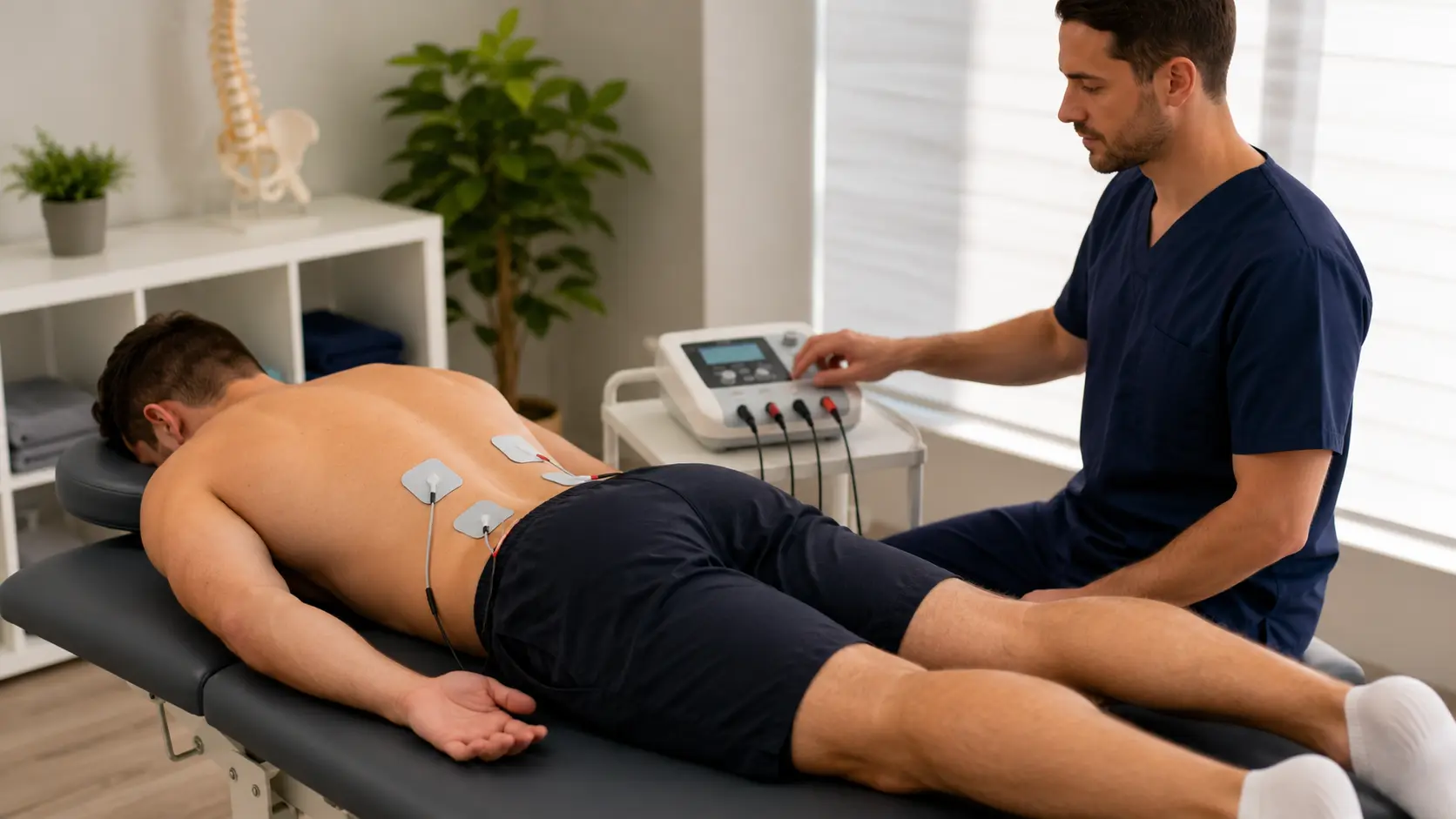
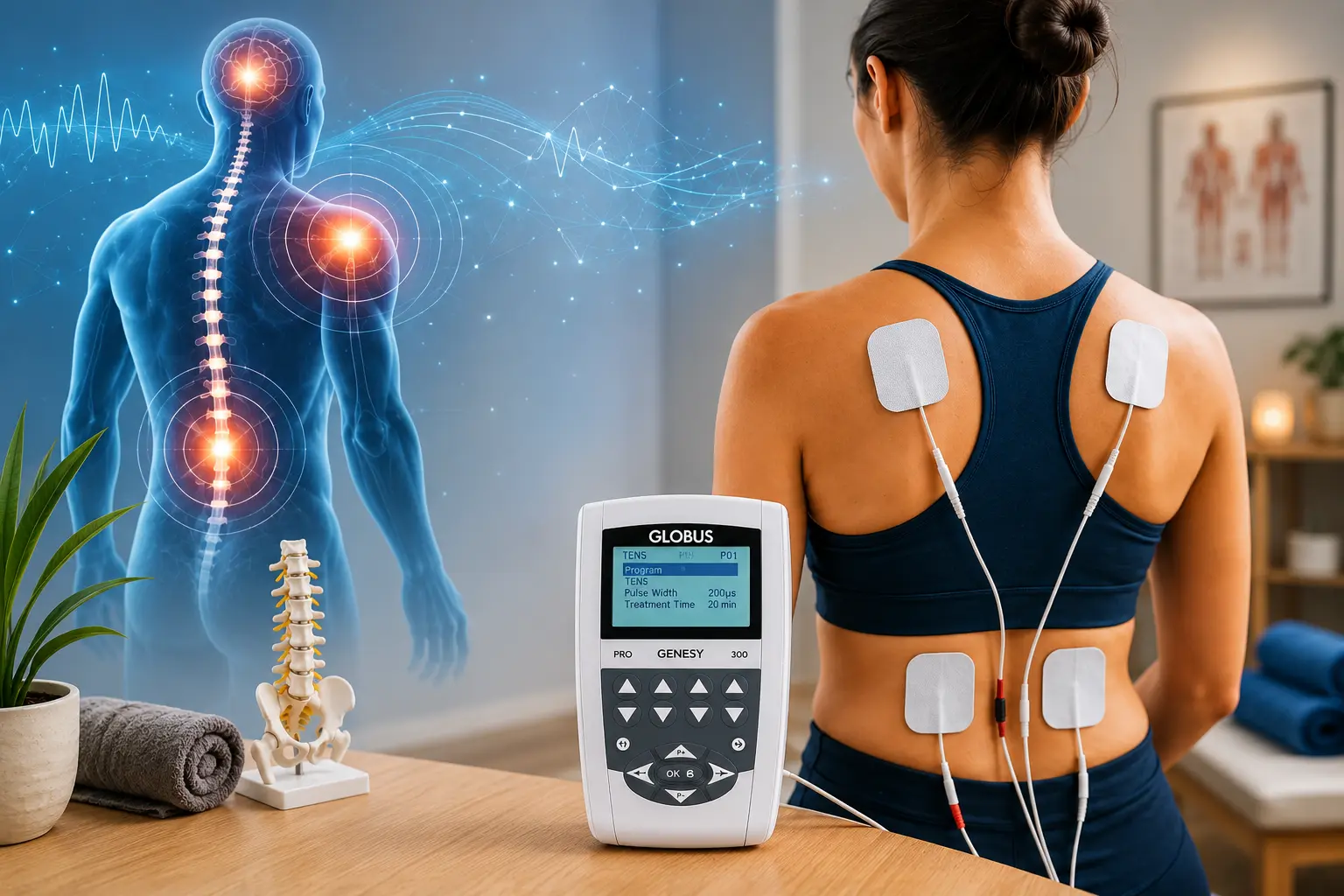
For pain relief (TENS): portable electrical stimulators, useful as symptomatic support while you regain movement.
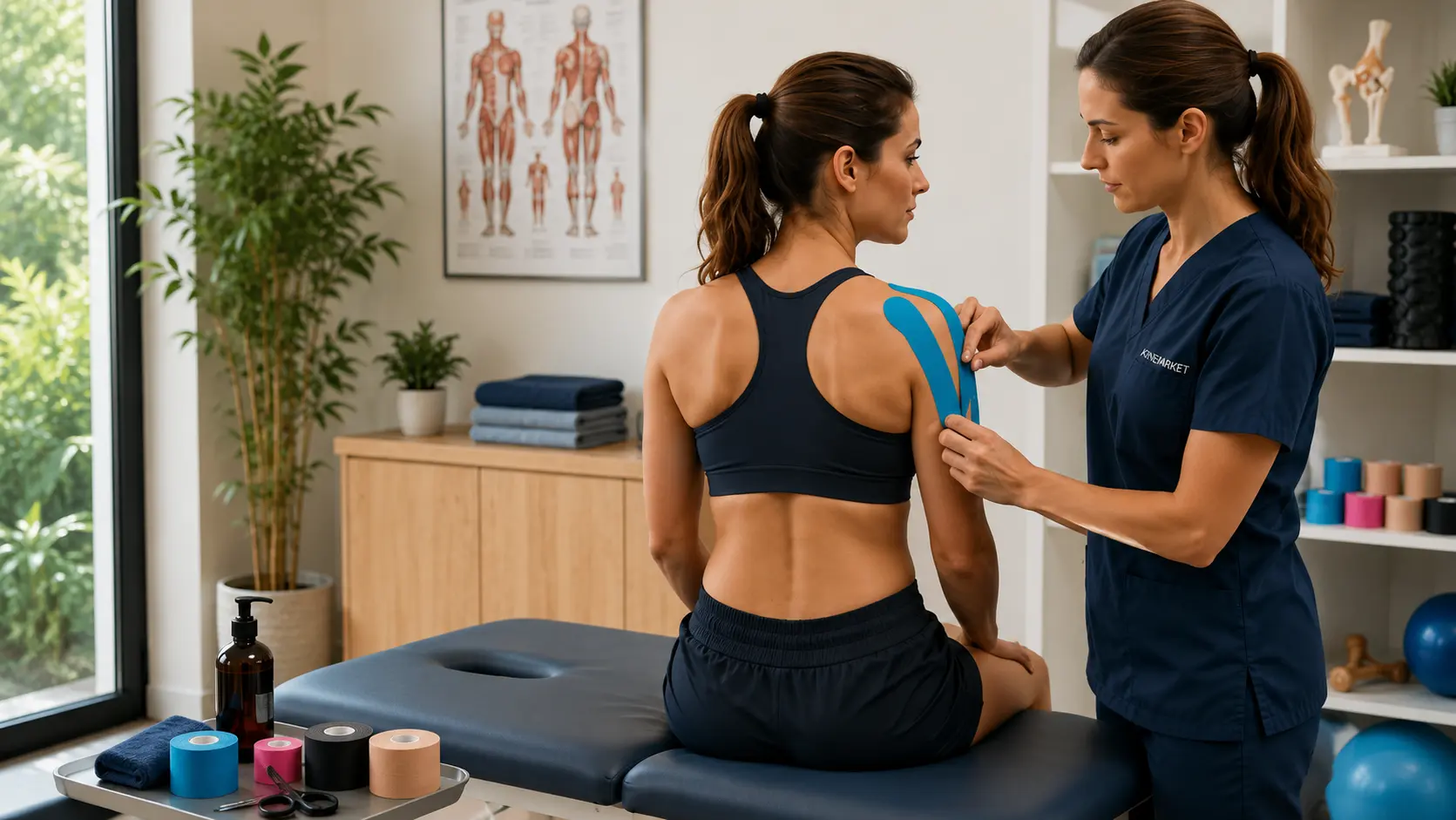
For choosing kinesiology tape: elastic kinesiology tape (AcuTop or Temtex, for example) as a proprioceptive complement, never as a standalone treatment.
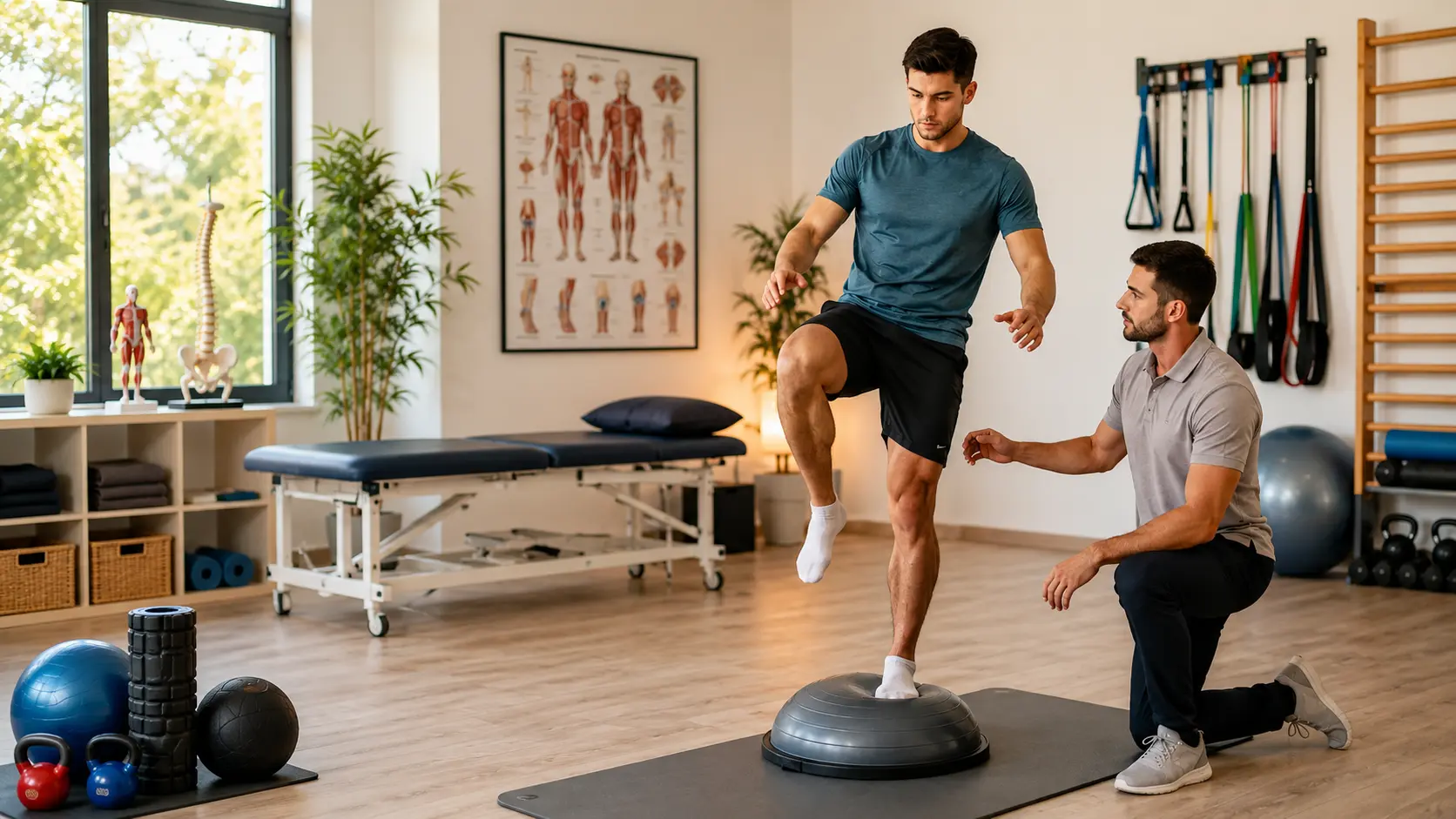
For strengthening and prevention (active work): resistance bands, balance boards and proprioception equipment for the strength and control exercises that prevent recurrences.
If you are buying for a practice or club, we set out the purchasing criteria (conformity, consumables, warranty and service) in our comparison of Globus and NeuroTrac and in our list of essential equipment.
Before using any support or device, go back over the red flags in this article and, if in doubt, let a physiotherapist assess your case.
Frequently asked questions about sports injuries
When should you go to A&E, and when should you call NHS 111? The full split is under the alerts at the top of this guide. In short: 999 or A&E for deformity, a heard crack, numbness, discoloured or cold skin, severe pain, heavy bleeding, or head, neck or spine trauma. NHS 111 the same day for every other red flag.
Ice or heat? Cold can temporarily ease some acute injuries, but it is not compulsory and does not speed up healing on its own. If you use it, protect the skin with a barrier and follow the product's or the professional's instructions. Heat should not be applied as a general rule over an area that is newly injured, markedly swollen or has altered sensation. Once the acute phase has passed, controlled movement usually wins.
Do you always need a scan? No. Imaging follows the clinical assessment: an X-ray where a fracture is suspected, and MRI or ultrasound where the result would change management. MRI or ultrasound if the pain persists, there is instability, or an injury is suspected whose diagnosis could change the treatment. Many injuries are managed with clinical examination alone.
Can you train through pain? In a load-related injury already assessed, mild pain that does not get worse the next day lets you train with adjustments. If it increases, forces you to change your technique or becomes more intense at 24 hours, you are overloading. Do not apply this rule where a fracture, dislocation, acute ligament injury, joint locking, deformity or neurological or vascular symptoms are suspected. Those are assessed before you train.
Does taping really help? It can help as support, with proprioceptive feedback and by modulating symptoms. It does not replace active work. A complementary tool, not a magic fix.
Sources and references
These are some of the reviews and studies we drew on to write this article:
- Moen MH, Tol JL, Weir A, Steunebrink M, De Winter TC (2009). Medial tibial stress syndrome: a critical review. Sports Medicine, 39(7), 523-546. The histological evidence does not support traction periostitis as a single mechanism.
- Clifford C, Challoumas D, Paul L, Syme G, Millar NL (2020). Effectiveness of isometric exercise in the management of tendinopathy: a systematic review and meta-analysis of randomised trials. BMJ Open Sport & Exercise Medicine, 6(1). Heterogeneous response; it does not support a universal dose.
- Meredith SJ, Rauer T, Chmielewski TL, et al. (2020). Return to sport after anterior cruciate ligament injury: Panther Symposium ACL Injury Return to Sport Consensus Group. Knee Surgery, Sports Traumatology, Arthroscopy, 28(8), 2403-2414. Return to sport is decided on criteria, not on time.
- Vuurberg G, Hoorntje A, Wink LM, et al. (2018). Diagnosis, treatment and prevention of ankle sprains: update of an evidence-based clinical guideline. British Journal of Sports Medicine, 52(15), 956.
- Al Attar WSA, Soomro N, Sinclair PJ, Pappas E, Sanders RH (2017). Effect of injury prevention programs that include the Nordic hamstring exercise on hamstring injury rates in soccer players: a systematic review and meta-analysis. Sports Medicine, 47(5), 907–916.
- Collins NJ, Barton CJ, van Middelkoop M, et al. (2018). 2018 Consensus statement on exercise therapy and physical interventions (orthoses, taping and manual therapy) to treat patellofemoral pain. British Journal of Sports Medicine, 52(18), 1170–1178.
- NHS. Sprains and strains and Broken ankle. Used for the emergency and urgent-advice criteria in this guide.
- Dubois B, Esculier JF (2020). Soft-tissue injuries simply need PEACE and LOVE. British Journal of Sports Medicine, 54(2), 72–73.
- Díaz López AM, Guzmán Carrasco P (2014). Efectividad de distintas terapias físicas en el tratamiento conservador de la fascitis plantar: revisión sistemática. Revista Española de Salud Pública, 88(1).
- Arnal-Gómez A, Espí-López GV, Cano Heras D, et al. (2020). Revisión bibliográfica sobre la eficacia del ejercicio excéntrico como tratamiento para la tendinopatía del tendón de Aquiles. Archivos de Prevención de Riesgos Laborales, 23(2).
- Gómez-Tomás C, Rial Rebullido T, Chulvi-Medrano I (2021). Estrategias de prevención neuromuscular para las lesiones de ligamento cruzado anterior sin contacto en jugadoras de baloncesto. Revisión narrativa. MHSalud, 18(2).