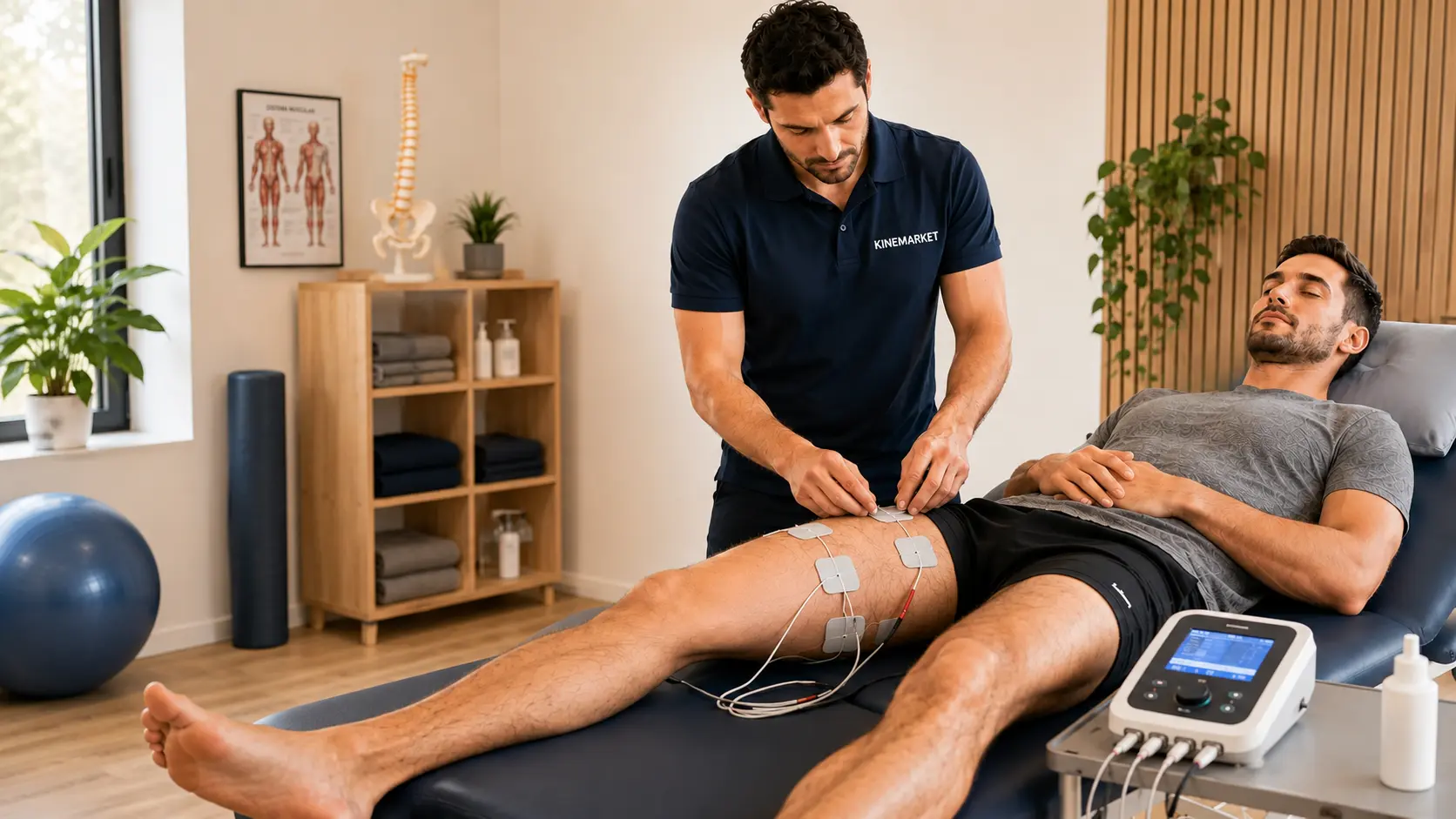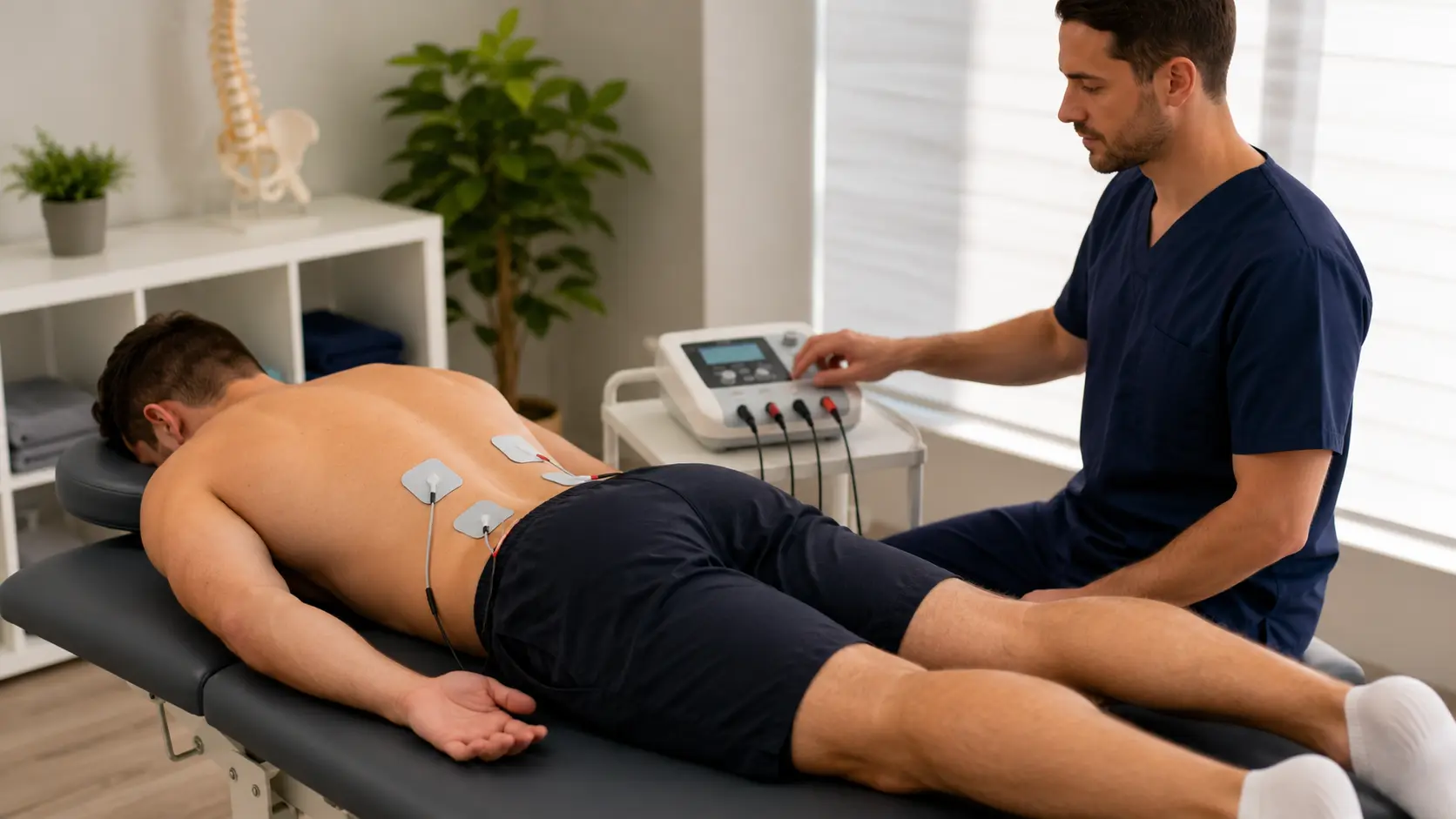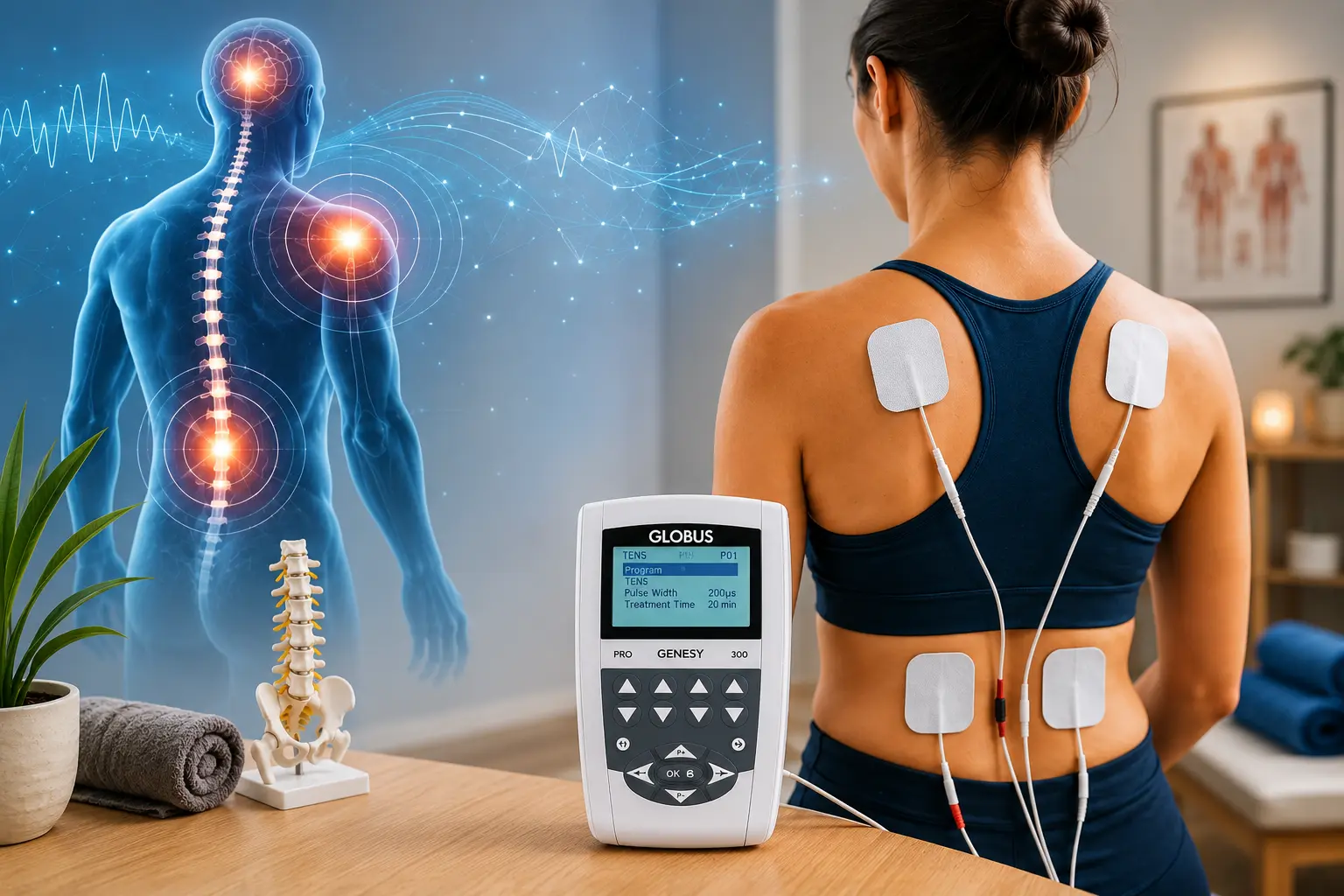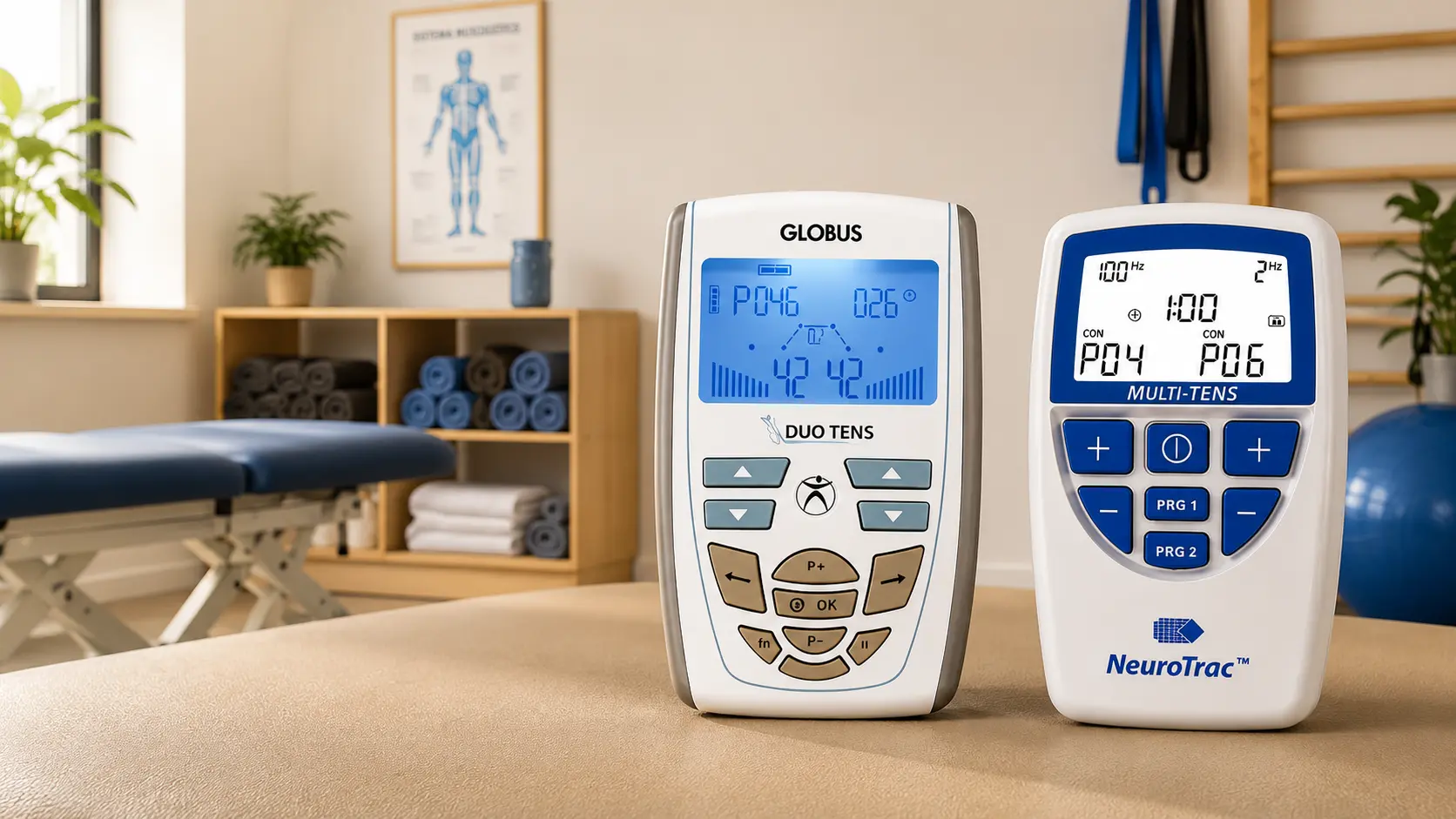
Globus and NeuroTrac are two established brands of TENS and EMS units in physiotherapy, each with a distinct range philosophy. Globus is an Italian electrical stimulation brand that emphasises breadth, with units of up to 4 channels and up to 271 programmes at the top of the range, spanning sport, aesthetics and general rehabilitation. NeuroTrac, the brand under which the Irish manufacturer Verity Medical markets its devices, takes a clinically focused approach. The two TENS+EMS models compared here, the Multi-TENS and the Rehab, have 2 channels, while the wider NeuroTrac range includes MyoPlus configurations with other channel counts. The range is built around phase-based customisable programmes, pelvic floor work and biofeedback.
If you are equipping your practice with electrical stimulation, this Globus vs NeuroTrac comparison covers the two ranges and the purchasing criteria that decide between them.
Two notes before we start. Kinemarket distributes both brands, and this is a desk-based comparison of specifications and catalogue prices, built from the product data sheets and the information published by the manufacturers. It is not a clinical trial or a performance test of our own. And the CE marking on the models reviewed means the manufacturer declares conformity with the applicable European requirements. It is not EU approval, a seal of quality or proof of clinical superiority.
Globus vs NeuroTrac: quick verdict
Globus is the better fit for a practice that wants a single versatile unit, with up to 4 channels and from 20 to 271 programmes depending on the model. NeuroTrac is the better fit for a practice centred on clinical TENS work and neuromuscular re-education, with the 2 channels of the models compared here, preconfigured TENS and NMES programmes, phase-based customisation and usage logging for home treatment.
- Choose Globus if you want a single device that covers sports EMS, aesthetics and general rehabilitation, with up to 4 channels and the broadest programme catalogue of the range (271 on the Activa 700), and you work with a varied patient mix.
- Choose NeuroTrac if your priority is clinical TENS work and neuromuscular re-education, pelvic floor or biofeedback, and you value phase-based customisation and adherence tracking.
For a practice that does TENS and electrical muscle stimulation (EMS) in equal measure, a multichannel Globus gives more versatility in a single device and a NeuroTrac offers more specific treatment-control features. The decision comes down to your patient mix.
Comparison at a glance
| Globus | NeuroTrac | |
|---|---|---|
| Type of brand | Italian brand with a broad range (medical, sport, aesthetics, veterinary) | Verity Medical's brand (Ireland/UK), specialising in rehabilitation and biofeedback |
| Channels (by range) | 2 to 4 channels | 2 channels on the TENS+EMS models compared here; the NeuroTrac range also includes MyoPlus configurations with more channels |
| Programmes and customisation | From 20 (Duo TENS) to 271 (Activa 700) depending on the model | Multi-TENS: 13 TENS + 4 NMES + 3 customisable (1 to 5 phases); Rehab: 10 TENS + 10 NMES + 2 customisable TENS + 1 remote-controlled STIM (manufacturer documentation) |
| TENS / EMS | Yes, both, plus MENS, iontophoresis, currents for denervated muscle, incontinence | Yes, both (TENS + NMES) |
| Specialities | Sport and performance, aesthetics, general rehabilitation | Pelvic floor and continence, neuromuscular re-education, EMG biofeedback (in its wider range) |
| Customisation | Extensive catalogue of preset protocols | Fewer preconfigured programmes, but multi-phase customisation and a remote control |
| Adherence tracking | Stim Lock and Work Time functions on several models; no detailed daily log in the documentation we reviewed | Lock plus a log of up to 5 daily sessions over 60 days (Multi-TENS, according to its documentation); the Rehab also has a lock function |
| Marking / class | CE-marked medical devices (models reviewed); the distribution data sheets we checked declare Class IIa for the Activa 700, Genesy 600, Genesy 300 Pro and Duo TENS | CE-marked medical devices (models reviewed) |
| Warranty (according to the data sheets) | 2 years for the unit, 6 months for accessories | 2 years for the unit, 6 months for accessories |
| Indicative price* | Around €129 to €599 depending on the model | Around €169 to €199 depending on the model |
*Indicative prices from Kinemarket's Spain/EU catalogue, checked in July 2026, shown in euros with Spanish VAT included; tax treatment and delivery costs vary by destination. The catalogue and promotions change, and depending on the season there may be special offers on products from either brand.
Globus: profile and range
Globus is an Italian brand with a very broad range of therapeutic technology. Its official documentation identifies Domino S.r.l. (Codognè, in the Veneto) as the manufacturer. Domino also produces shockwave, TECAR therapy, laser, ultrasound and magnetotherapy equipment as well as rehabilitation systems, and it runs dedicated lines for sport, aesthetics and veterinary use. In electrical stimulation, the hallmark of the range is the portable multichannel unit with a broad programme catalogue, built to cover many indications with a single device.
The stimulation range runs from a simple TENS unit to a four-channel device with aesthetic protocols. From the most complete to the most basic, with the programme counts published in the official sources and technical data sheets cited under Sources:
- Globus Activa 700: 4 channels and 271 programmes (EMS, TENS, MENS, incontinence, co-contraction and the 3S sequences), spread across sport, aesthetics and rehabilitation. Of the models compared here it is the most complete, particularly if you also want aesthetic protocols.
- Globus Genesy 600: 4 channels and 149 programmes (EMS, TENS, MENS, currents for denervated muscle, incontinence, iontophoresis), Class IIa according to its distribution data sheet, with features such as 2+2 working, which runs two programmes over two treatment areas at once. A versatile clinical option.
- Globus Genesy 300 Pro: the mid-range model in the Genesy line, clinically oriented, with 91 programmes and the same 2+2 function, for practices that do not need the full upper range. If you are weighing up these two models, we compare them in detail in Genesy 600 versus Genesy 300 Pro.
- Globus Elite (4 channels): a versatile, more affordable four-channel unit with 98 programmes across rehabilitation, TENS, EMS and aesthetics. A good way into multichannel work.
- Globus Duo TENS (2 channels): a simple, economical unit with 20 programmes (16 for TENS and pain, 3 for sport and 1 for fitness, beauty and wellbeing), useful as a second device or for basic symptomatic relief.
Taken together, Globus covers everything from basic TENS to four-channel units with aesthetic protocols included, which makes it straightforward to standardise a practice around a single brand.

NeuroTrac: profile and range
Verity Medical, a manufacturer established in 1998, based in Ireland with an office in the United Kingdom, designs and manufactures the devices it markets under the NeuroTrac brand. Rather than a generalist catalogue, it concentrates on clinical use: TENS, NMES and, in its wider range, EMG biofeedback and pelvic floor and continence rehabilitation. The brand's emphasis is on protocol-based treatment and patient follow-up, and the models reviewed here are CE-marked.
Two units in the range combine TENS and EMS:
- NeuroTrac Multi-TENS: 2 channels with 13 TENS programmes (continuous, burst and modulated), 4 EMS/NMES programmes and 3 customisable programmes of 1 to 5 phases. It can run two different TENS programmes at the same time, and it can lock the settings while logging up to 5 daily sessions over 60 days to monitor adherence.
- NeuroTrac Rehab TENS+EMS: 2 channels aimed at rehabilitation, with 10 preconfigured TENS and 10 preconfigured NMES programmes, 2 customisable TENS programmes and 1 remote-controlled stimulation programme, so you can adjust treatment during the session. It also includes a lock function to record usage.
Beyond these two models, the brand rounds out its catalogue with dedicated TENS units and the EMG biofeedback line (MyoPlus). If your work goes in that direction, it is worth bearing in mind even if you start with a Multi-TENS or a Rehab.

What they share and where they fundamentally differ
Before choosing, it is worth separating what is common from what genuinely changes in the clinic.
What they share. The Globus range and the NeuroTrac units made by Verity Medical carry CE marking on the models reviewed and cover TENS for pain relief and EMS/NMES (muscle contraction and strengthening), two of the most widely used currents within electrotherapy in physiotherapy. Both work with standard self-adhesive electrodes, offer the usual TENS modes (continuous, burst, modulated) and allow a degree of customisation. For routine TENS or muscle stimulation, both cover the modes used day to day, and we have not identified independent comparative studies showing that either brand delivers better clinical results than the other.
Where they differ. The underlying difference is range philosophy. The Globus range is the generalist one and emphasises breadth, with more channels (up to 4), a catalogue reaching 271 preset protocols at the top of the range, and applications running from sports performance to aesthetics in a single device. The NeuroTrac range, made by Verity Medical, keeps a clinical focus. The two TENS+EMS models compared here have 2 channels and fewer preconfigured programmes, but those programmes are customisable in phases and come with adherence tracking. Neither range is "more complete" in the abstract; they are complete in different ways.
How do you choose a stimulator for your practice?
Choosing a stimulator comes down to nine criteria: the clinical goal, the number of channels, breadth of programmes versus customisation, manual parameter control, the speciality, adherence tracking, conformity documentation, consumables and supply. Each one tips the balance towards one brand or the other.
The clinical goal, before the model. TENS and EMS are not after the same thing. The first modulates pain, the second produces muscle contraction. Almost every unit compared here combines both modes, but it is worth checking the data sheet to confirm that the programme you intend to use is on that specific model and not merely somewhere in the range. If you work in neurorehabilitation aimed at restoring a function, such as gait or hand opening, what you need is functional electrical stimulation (FES), a different category from the ones compared in this article.
Number of channels. Each channel feeds a pair of electrodes, so the number of channels sets how many areas you can treat at once. If you need to treat several areas simultaneously, the 4 channels of the Globus upper range (Activa 700, Genesy 600, Elite) give you room. On compatible models the 2+2 function runs two different programmes over two treatment areas, within the model's instructions, channel configuration and supplied accessories. Having four channels is not enough on its own. If your work is more a matter of one area per session, the 2 channels of the Multi-TENS or the Rehab, or of a Globus Duo, are enough. If the number of channels is your main criterion, Globus gives you more headroom, with up to four on the models named against the two of the Multi-TENS and the Rehab.
Breadth of programmes versus customisation. Globus offers a large catalogue of ready-to-use protocols, convenient when you want to select a protocol and apply it. NeuroTrac offers fewer preconfigured programmes, but they are customisable in phases and come with a remote control, useful when you tailor treatment to the patient and to the session.
Manual parameter control. Preconfigured programmes save time, but being able to adjust intensity, frequency and pulse width by hand makes the difference when you adapt the session to a particular patient, or when you want to work close to the parameters described in published protocols. The clinically oriented units in both ranges allow that adjustment; the more basic models, such as the Duo TENS, rely mainly on their factory programmes. Check the data sheet to see how far manual control goes on the model you are considering.
Clinical speciality. The speciality is one of the decisive criteria. For pelvic floor, continence, neuromuscular re-education or EMG biofeedback, NeuroTrac has a dedicated line (MyoPlus). For sports EMS, aesthetics or a broad and varied general rehabilitation caseload, the Globus range covers more ground.
Follow-up and supervised home use. If you prescribe home treatment and want to check adherence, the Multi-TENS offers, according to its documentation, a settings lock and a history of up to 5 daily sessions over 60 days, and the Rehab also includes a lock function. Some Globus models carry functions such as Stim Lock and Work Time, although the documentation we reviewed does not describe a daily log equivalent to the Multi-TENS's. For detailed adherence tracking, NeuroTrac offers the more specific feature.
Conformity and documentation. Check the declaration of conformity for the specific model and the class it declares, because the class follows from the intended purpose the manufacturer has established and it sets the conformity assessment procedure the device had to go through. Where that procedure requires third-party assessment, it is carried out by an EU notified body for CE marking, and the body's identification number must appear on the label (MHRA). Make sure the instructions for use reach you in a language you fully understand, because safe use depends on them. And if a data sheet names a regulatory framework, check that it is the one currently in force.
Consumables, restocking and service. Both use standard self-adhesive electrodes, so restocking does not usually tie you to the equipment brand, provided the connector type and the device specifications match. Work out the cost of the consumable before deciding. A cheap unit with expensive or hard-to-find spares works out expensive over two years. Check the availability of spares and the technical service as well. At Kinemarket you have replacement electrodes suitable for units from both brands, such as the disposable TENS electrodes with cables.
Standardisation and supply. Both brands have an ongoing presence in our catalogue, although availability varies by model, so check stock before equipping the practice. The breadth of the Globus range makes it straightforward to standardise a whole practice on one brand, whereas NeuroTrac fits better as a specialised unit within a practice with a defined clinical profile.
Which practice does each brand suit?
There is no universal answer; it depends on your patients and how you work. Four typical scenarios:
- Sports and performance practice. If you use EMS for strength, endurance or recovery and also want aesthetic protocols, the Globus range is the better fit; the Activa 700 for the breadth of its programme catalogue, or the Elite as a more contained four-channel option.
- Pelvic floor, continence and neuromuscular re-education. For this profile, NeuroTrac is the range with the most specific features. The Rehab TENS+EMS covers re-education with a remote control and, if you need EMG biofeedback, its MyoPlus line.
- Treatment prescribed for home. If you send the patient home with a device and want to monitor adherence, the NeuroTrac Multi-TENS, with a settings lock and session logging, is built for supervised home use.
- Clinical all-rounder for TENS and EMS. If you want a single device that does almost everything in the clinic, the Globus Genesy 600 (4 channels, 149 programmes, Class IIa according to its data sheet) is the versatile option in this selection; the Multi-TENS is the more focused, lower-cost alternative in this selection.
Frequently asked questions
Which has more programmes, Globus or NeuroTrac?
Globus, by a clear margin. Its range runs from the 20 programmes of the Duo TENS to the 271 of the Activa 700, while the NeuroTrac TENS+EMS units work with a smaller set of preconfigured programmes (13 TENS and 4 NMES on the Multi-TENS; 10 and 10 on the Rehab) plus the customisable ones. The useful question is not how many there are, but whether you prefer choosing from many preconfigured options or building your own in phases.
What warranty do Globus and NeuroTrac units come with?
According to the distribution data sheets, both brands offer a two-year warranty on the unit and 6 months on accessories such as cables, batteries or chargers. Those same data sheets give no warranty on consumables such as electrodes or conductive gel. Confirm the seller's specific terms before buying.
Can I combine a Globus and a NeuroTrac in the same practice?
Yes. In a mixed-profile practice, a multichannel Globus can cover the general EMS and TENS work on the treatment couch, while a NeuroTrac is kept for pelvic floor, biofeedback or supervised home treatments.
Can I use the same electrodes with both brands?
In many cases, yes. Both brands work with standard self-adhesive electrodes, but compatibility depends on the connector type (snap or 2 mm pin) and on each unit's specifications. Check them before ordering a large batch.
Is a 4-channel unit worth it if I only treat one area per session?
Not necessarily. Four channels earn their place when you treat several areas at once, or on the models whose 2+2 function is described above. If your practice is one area per session, a 2-channel unit does the job and lowers the outlay. Size the equipment to your real volume, not to the theoretical maximum.
Does CE marking guarantee a better stimulator?
No. CE marking shows that the product has followed the conformity assessment procedure that applies to it according to its class. It does not compare one unit with another and it does not certify clinical performance. To judge a specific model, its declaration of conformity tells you considerably more than the symbol printed on the casing.
Sources
- Globus Corporation (the brand's official site, Codognè, Italy): the official brand site and the official English product page for the Genesy 300 Pro (91 programmes), together with the official English technical data sheets for the Activa 700 (4 channels, 271 programmes), Genesy 600 (149 programmes), Elite (98 programmes) and Duo TENS (20 programmes). Checked in July 2026.
- Verity Medical (manufacturer, Ireland/UK): the official pages for the NeuroTrac Multi-TENS and the NeuroTrac Rehab, with the programme breakdowns and the lock functions. Checked in July 2026.
- Medicines and Healthcare products Regulatory Agency (MHRA): Regulating medical devices in the UK. Used for the declaration of conformity and the technical documentation a manufacturer must have drawn up, for the conformity assessment procedure that must have been carried out where it applies, for mandatory third-party assessment for CE marking being carried out by an EU notified body, and for the requirement that the body's number appears on the label where relevant. Checked in August 2026.
- Distribution product data sheets for the models discussed: checked in July 2026. Source split: Globus's official pages and technical data sheets provided the channels, the programme counts and the functions for the Activa 700, Genesy 600, Genesy 300 Pro, Elite and Duo TENS; Verity Medical's official pages provided the programme breakdowns and the functions for the Multi-TENS and Rehab; the distribution data sheets provided the declared class, the warranties and the prices. Where a current primary source publishes an exact figure, it prevails over distribution documentation.