Protecting an ankle without putting it in a cast means controlling pain while keeping movement. Functional taping is a selective immobilisation technique that restricts only the harmful movement and preserves function. We stock the materials mentioned here in our Spain/EU catalogue; this guide is based on published sources, not on a trial of our own.
What is functional taping?
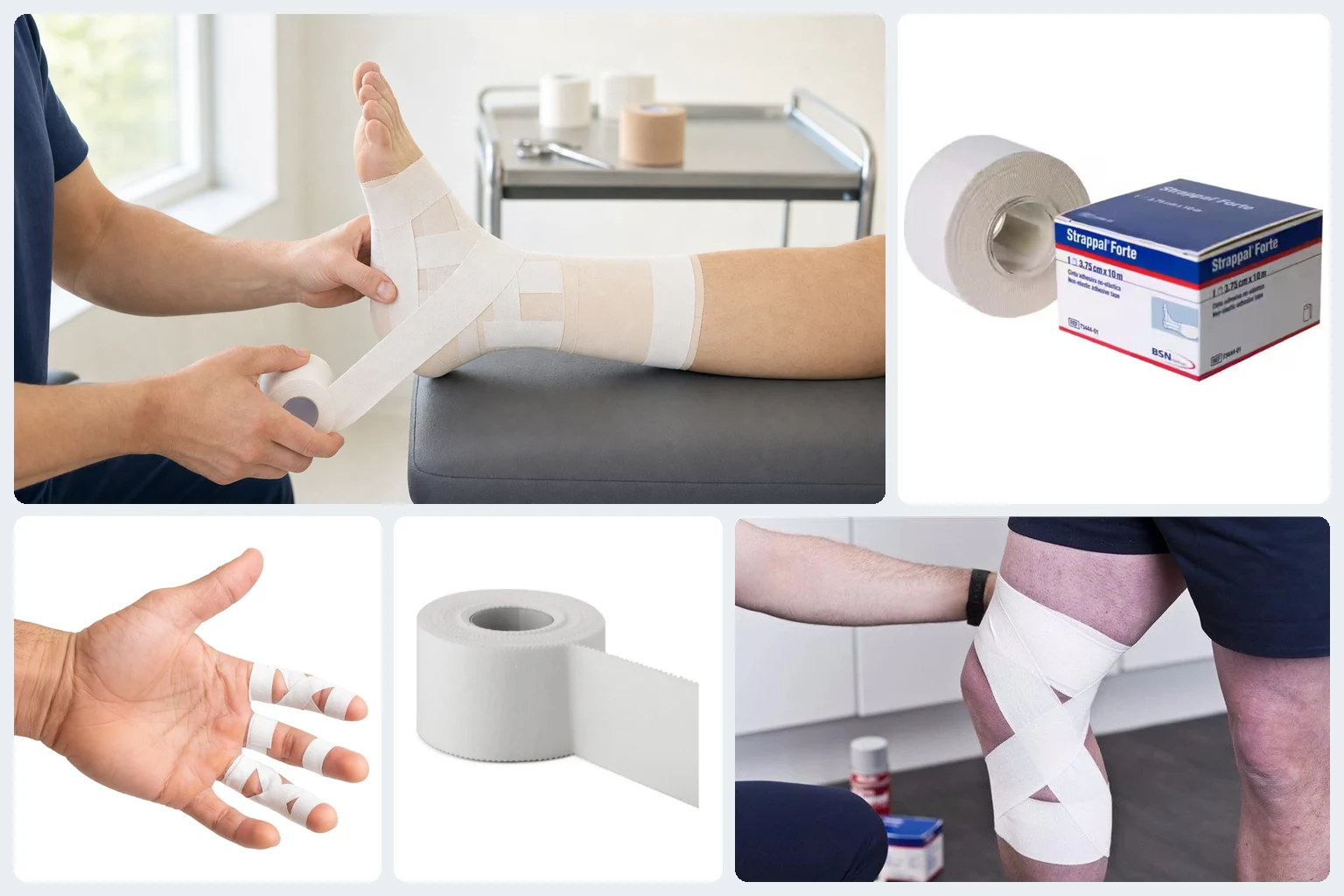
Functional taping is a partial, selective immobilisation technique that blocks the range of movement that stresses the injured structure and leaves the rest of the joint free.
The Spanish primary-care training material 1aria describes it as a very selective type of immobilisation technique with specific indications.
Total immobilisation with a cast or splint removes movement from the whole joint; functional taping preserves function. Kinesiology tape is elastic, moves with the joint and does not restrict range. Mo et al. (2026) included 128 systematic reviews (73 published and 55 registered but unpublished), covering 310 unique trials and 15,812 participants, and concluded that the evidence on its clinical effects is of very low certainty. Our guide to kinesiology taping and what it is used for covers that contrast in more depth.
According to the history of physiotherapy compiled on history.physio, Virgil Gibney described using adhesive strapping to stabilise the sprained ankle in 1893.
When is functional taping used?
Functional taping is used for three purposes that vary with the clinical context, set out in the table below. It is applied in certain ligament, muscle, tendon or fascia injuries when the aim is to limit a harmful movement.
Preventive, therapeutic and adjunctive taping
1aria classifies functional taping as therapeutic, preventive or adjunctive. The Type column follows that classification; the timing and the mobility sought are our description of usual practice.
| Type | When it is applied | Mobility sought |
|---|---|---|
| Preventive | Before activity | Optimal mobility with the movement protected |
| Therapeutic | During treatment | Minimal, selective mobility of the harmful range |
| Adjunctive | Alongside another intervention | Partial support that complements the plan |
Indications by structure
- Ligament. Lateral ankle sprain, an injury to the outer ankle ligaments caused by forced inversion, is the classic indication. Van Rijn et al. (2008) report that 5% to 33% of patients still had pain at one year and that 36% to 85% reported full recovery within three years. Our practical guide to sports injuries and recovery goes further on management.
- Muscle. Muscle injuries where the aim is to limit stretch and protect the tissue under load.
- Tendon and fascia. Tendinopathies and plantar fasciitis. In plantar fasciitis, the 2023 JOSPT guideline recommends rigid or elastic taping together with other physiotherapy treatment to improve pain and function in the short term (Koc et al., 2023), and we cover it in our plantar fasciitis taping guide.
What does the evidence say about functional taping?
The evidence on functional taping is uneven. It supports functional treatment as a reasonable option and the prevention of recurrence in previously injured athletes; it does not support clear superiority over immobilisation, or an improvement in proprioceptive acuity in people with recurrent sprain or functional ankle instability.
Functional treatment versus immobilisation. In these reviews, "functional treatment" is a broader strategy than tape and can include external support, progressive loading and exercise. Kerkhoffs et al. (2002), a Cochrane review of 21 trials and 2,184 participants, concluded that functional treatment appeared to be the favourable strategy compared with immobilisation. The authors cautioned that most of the differences were no longer significant once the low-quality trials were excluded. The review is listed as WITHDRAWN in 2013 (PMID 23543522).
Vilchez-Cavazos et al. (2025), a meta-analysis of 10 trials and 1,133 patients, found no significant difference in pain (SMD −0.15; 95% CI −0.71 to 0.41) or in function (SMD 0.05; 95% CI −0.39 to 0.49). The 2002 Cochrane caveat already pointed in that direction. Heterogeneity between trials is very high (I² of 92% for pain and 90% for function), so the result does not show that the two strategies are equivalent.
Here, a brace means an external ankle support. The table below summarises one clinical guideline and three reviews.
| Study | What it measures | Finding | What it does not support |
|---|---|---|---|
| Martin et al. (2021), JOSPT clinical practice guideline | treatment and prevention of lateral ankle sprain | in acute sprain, external support with a brace or tape and progressive weight bearing; its evidence synthesis finds strong evidence for bracing, taping and balance exercise in preventing recurrence | external support on its own to improve balance in chronic instability |
| Dizon and Reyes (2010), review of seven trials | prevention with external support in athletes with a previous sprain | OR 0.31 (95% CI 0.18 to 0.51) with a brace and OR 0.29 (95% CI 0.14 to 0.57) with tape | no support superior to the other; figures not transferable to people without a previous sprain |
| Raymond et al. (2012), review and meta-analysis | proprioception in functional ankle instability | mean difference of 0.08° (95% CI −0.39 to 0.55) | no effect on proprioceptive acuity; this is evidence against that argument |
| Mejías-Gil et al. (2016), Spanish review of 15 studies | pain in patellofemoral pain syndrome | pain benefits after functional taping | not transferable to the ankle or to functional taping in general |
When should functional taping not be applied?
Functional taping is contraindicated when the injury, the skin or the circulation cannot tolerate mechanical restriction. The full list comes from 1aria; professional assessment rules out each case before the tape goes on.
According to 1aria, the contraindications are:
- Fractures.
- Significant oedema in the injured area.
- Major ruptures of tendon, ligament or muscle.
- Skin conditions, such as wounds, trophic changes or dermatitis.
- Vascular disorders, arterial disease or venous insufficiency.
- Reduced skin sensation (hypoaesthesia).
- Allergy to the adhesive.
In a severe lateral ankle sprain, the major-rupture contraindication does not rule out tape for the whole course of recovery. The 2021 JOSPT guideline recommends external support with progressive weight bearing and notes that, in more severe injuries, immobilisation may be indicated.
At product level, the Strappal data sheet declares a latex-free formula that contains colophony, and the Leukotape Classic data sheet declares natural rubber latex and also colophony. Check the data sheet for each product. This article is not a self-treatment guide.
How long does functional taping stay on?
The available sources do not agree on a single time frame. 1aria recommends a first review at 48 hours and renewing the tape every 4 to 5 days after a clinical check, with a maximum of five days per application. Essity describes Strappal as for short-term use and Leukotape Classic as short-term, up to several days; neither data sheet gives a number of days. 1aria asks the patient to watch for warning signs of vascular compromise until the review. If they appear, the tape comes off and the patient is reassessed before continuing.
What does HCPC regulation say about functional taping in physiotherapy?
In the UK, the Health and Care Professions Council (HCPC) regulates physiotherapists, and the title "physiotherapist" is protected by law. The HCPC defines your scope of practice as the limit of your knowledge, skills and experience, and expects you to keep within it at all times. Neither HCPC source names taping specifically. For an HCPC-registered physiotherapist, its use therefore sits within the practitioner's individual scope of practice rather than under a taping-specific HCPC rule.
Which material should you choose for each clinical goal?
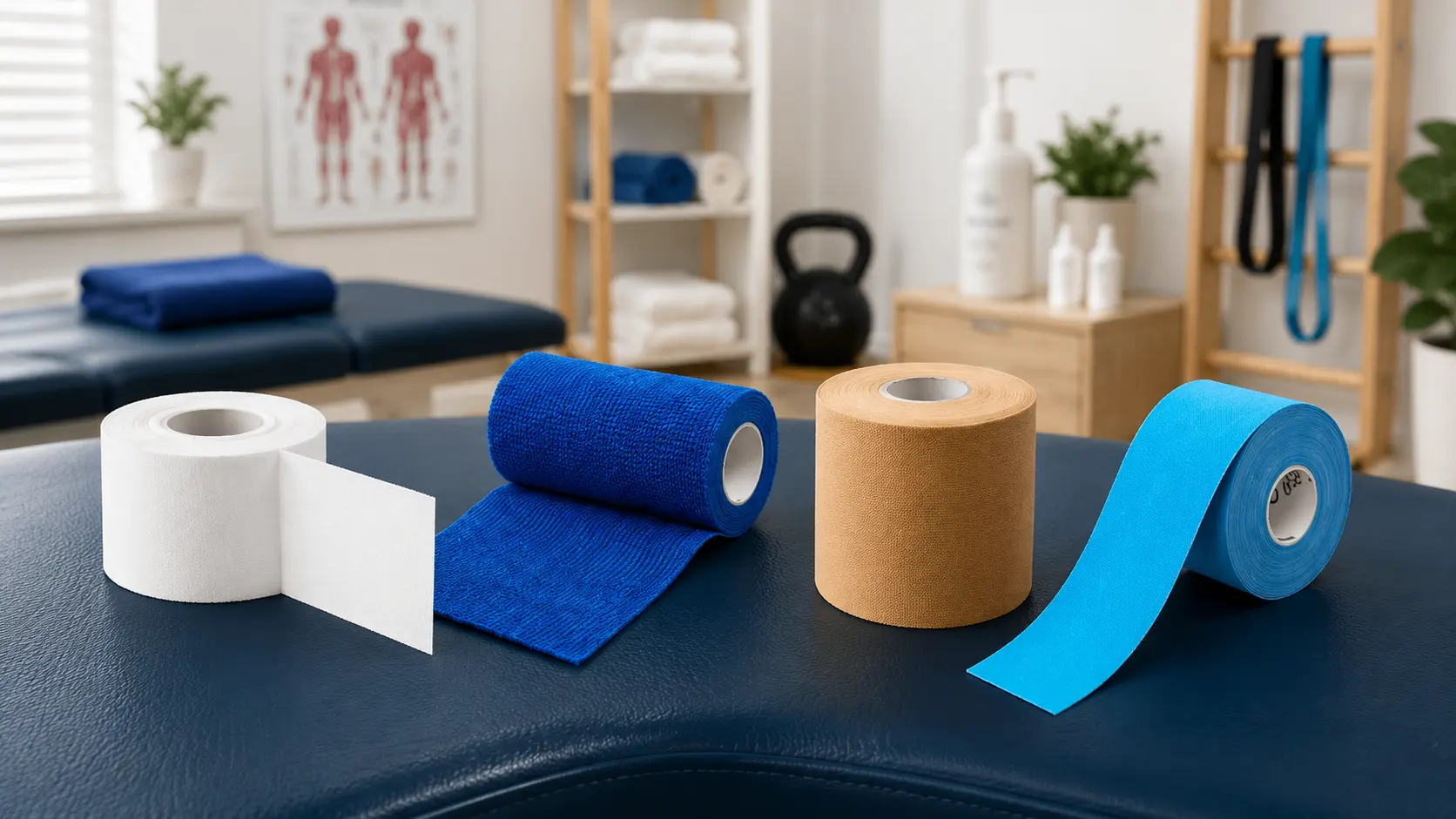
Material is chosen by clinical goal. To restrict a range of movement, use rigid strapping tape; to protect the skin, underwrap; to compress or secure without immobilising, a cohesive bandage; to move with the joint, kinesiology tape.
| Clinical goal | Material |
|---|---|
| Restrict a range of movement | Rigid strapping tape, 3.8 cm Sporttape; Strappal as the long-established option |
| Protect the skin under the tape | Underwrap |
| Compress or secure without immobilising | Cohesive bandage |
| Move with the joint without restricting it | Kinesiology tape |
Adhesive elastic bandage is a mixed class, elastic and adhesive to the skin, and is not part of this guide's routing table. Our comparison of underwrap, cohesive bandage and rigid strapping covers each material in detail.
The product links below go to our Spain/EU catalogue, and we do not currently deliver to the UK.
- Rigid strapping tape: Functional Sporttape 3.8cm x 10m and the Functional Sporttape 3.8cm x 10m (32-Pack).
- Skin protection: Pretape Beige 7cm x 27m and the Pretape Beige 7cm x 27m (48-Pack).
- Combined pack: Sporttape 3.8 cm x 10 m (32-pack) + Pretape (48-pack).
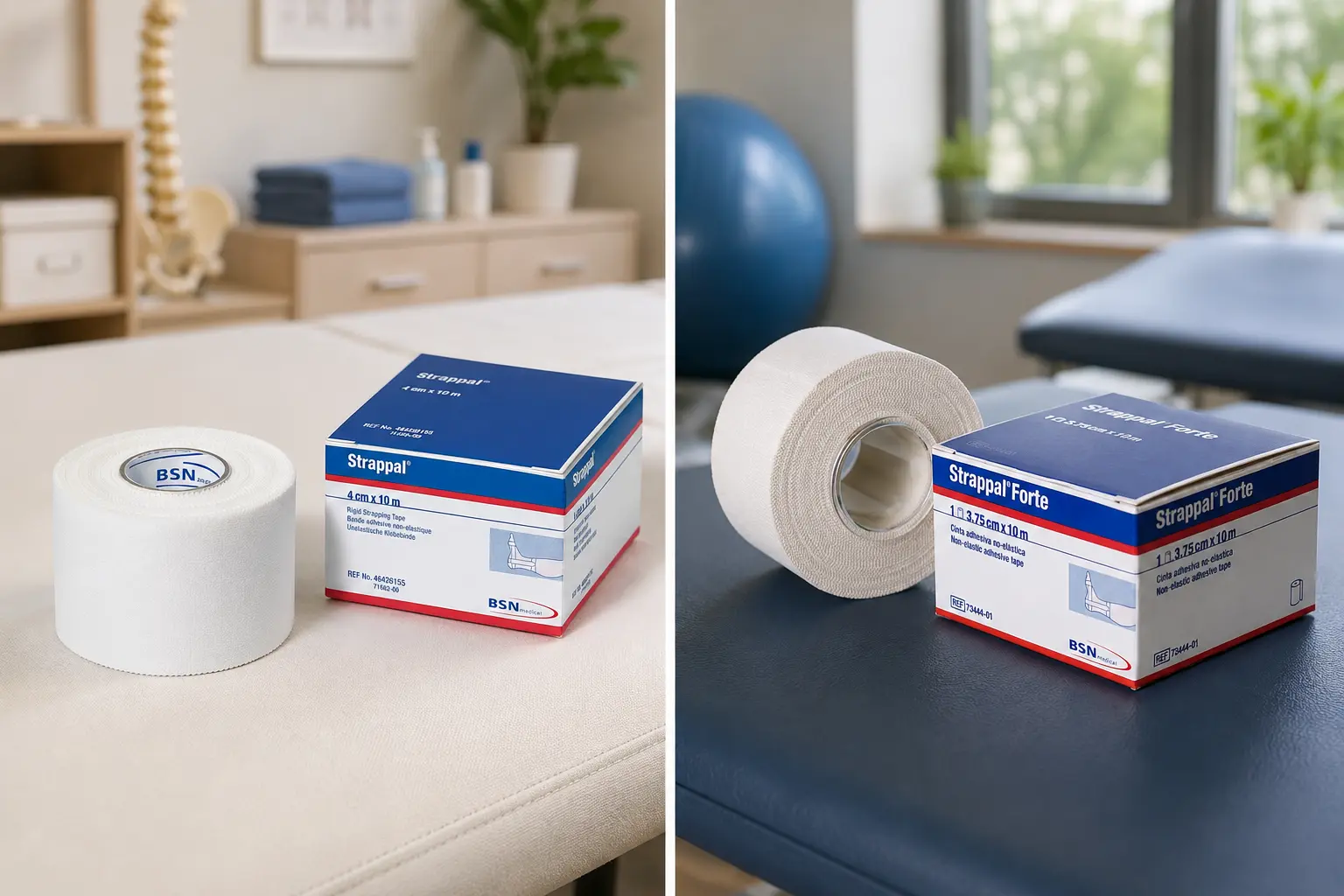
- Long-established option: Strappal Tape 4cm x 10m and the Strappal Tape 4cm x 10m (24-Pack).
- Everything else is in our strapping and underwrap collection.
Conclusion
Functional taping restricts the harmful range and leaves the rest of the joint free. The evidence supports functional treatment as part of a plan that includes exercise, not as a substitute for it. Material is chosen by clinical goal, and every product needs its data sheet checked. Professional assessment decides first whether the injury tolerates that selective restriction.
Frequently asked questions about functional taping
Is functional taping the same as strapping or Sporttape?
Functional taping is the clinical technique. Strapping, or sports taping, is the everyday name for the same technique in UK practice. Sporttape is the product name of the rigid tape we sell for it. Technique, everyday name and product are three different things.
Can functional taping replace a brace to prevent recurrence?
Not automatically. After a first sprain, the 2021 JOSPT guideline (Martin et al.) recommends a prophylactic brace combined with balance and proprioception exercise. Its evidence synthesis also recognises strong evidence for tape and considers the brace more cost-effective. Dizon and Reyes (2010) found no support superior to the other in athletes with a previous sprain.
Can functional taping be used for a grade III sprain?
It can be part of management, but the timing depends on severity. The 2021 JOSPT guideline (Martin et al.) recommends a brace or tape, with weight bearing built up progressively. In more severe lateral ankle sprains, immobilisation may be indicated for up to 10 days. The support and its timing are chosen by injury severity, healing phase, pain and the protection needed. According to Vuurberg et al. (2018), ligament damage is assessed most reliably at a delayed physical examination 4 to 5 days after the injury.
Sources and references
These are the references and manufacturer data sheets we relied on for this guide:
- Kerkhoffs GM, Rowe BH, Assendelft WJ, Kelly K, Struijs PA, van Dijk CN (2002). Immobilisation and functional treatment for acute lateral ankle ligament injuries in adults. The Cochrane Database of Systematic Reviews. DOI 10.1002/14651858.cd003762. Listed as WITHDRAWN in the 2013 edition, PMID 23543522.
- Vilchez-Cavazos F, Quiroga-Garza A, Acosta-Olivo CA, Rodríguez-Corpus LA, Espinosa-Uribe AG, Peña-Martínez VM, Simental-Mendía M (2025). Functional treatment versus immobilization for the management of acute ankle sprains: a systematic review and meta-analysis. Journal of Bodywork and Movement Therapies, 44:48-55. DOI 10.1016/j.jbmt.2025.05.035.
- Vuurberg G, Hoorntje A, Wink LM, et al. (2018). Diagnosis, treatment and prevention of ankle sprains: update of an evidence-based clinical guideline. British Journal of Sports Medicine, 52(15):956. DOI 10.1136/bjsports-2017-098106.
- Martin RL, Davenport TE, Fraser JJ, Sawdon-Bea J, Carcia CR, Carroll LA, Kivlan BR, Carreira D (2021). Ankle Stability and Movement Coordination Impairments: Lateral Ankle Ligament Sprains Revision 2021. Journal of Orthopaedic & Sports Physical Therapy, 51(4):CPG1-CPG80. DOI 10.2519/jospt.2021.0302.
- Koc TA Jr, Bise CG, Neville C, Carreira D, Martin RL, McDonough CM (2023). Heel Pain – Plantar Fasciitis: Revision 2023. Journal of Orthopaedic & Sports Physical Therapy, 53(12):CPG1-CPG39. DOI 10.2519/jospt.2023.0303.
- Dizon JM, Reyes JJ (2010). A systematic review on the effectiveness of external ankle supports in the prevention of inversion ankle sprains among elite and recreational players. Journal of Science and Medicine in Sport, 13(3):309-317. DOI 10.1016/j.jsams.2009.05.002.
- Raymond J, Nicholson LL, Hiller CE, Refshauge KM (2012). The effect of ankle taping or bracing on proprioception in functional ankle instability: a systematic review and meta-analysis. Journal of Science and Medicine in Sport, 15(5):386-392. DOI 10.1016/j.jsams.2012.03.008.
- van Rijn RM, van Os AG, Bernsen RM, Luijsterburg PA, Koes BW, Bierma-Zeinstra SM (2008). What is the clinical course of acute ankle sprains? A systematic literature review. The American Journal of Medicine, 121(4):324-331.e6. DOI 10.1016/j.amjmed.2007.11.018.
- Mo Q, Deng Z, Zheng J, Wu T, Hu F, Xu S, Zou J, Zheng X (2026). Effectiveness and clinical relevance of kinesio taping in musculoskeletal disorders: an overview of systematic reviews and evidence mapping. BMJ Evidence-Based Medicine. DOI 10.1136/bmjebm-2025-114067.
- Mejías-Gil E, Rodríguez-Mansilla J, Sosa-Hurtado M, Espejo-Antúnez L (2016). Revisión sistemática sobre los efectos del vendaje funcional en el síndrome de dolor femoropatelar. Fisioterapia, 38(1):45-54. DOI 10.1016/j.ft.2015.03.004.
- Talleres 1aria. Vendajes funcionales (updated May 2022, in Spanish). Primary-care training material; the source of the definition, the three-type classification, the contraindications and the review and renewal intervals.
- Ruscoe G. Strapping Tape. history.physio. Secondary source for the description of Gibney (1893).
- Health and Care Professions Council. Professions and protected titles.
- Health and Care Professions Council. Scope of practice.
- Essity. Manufacturer data sheets (in German) for Strappal and Leukotape Classic. The source of the declared allergens and the short-term duration of use.