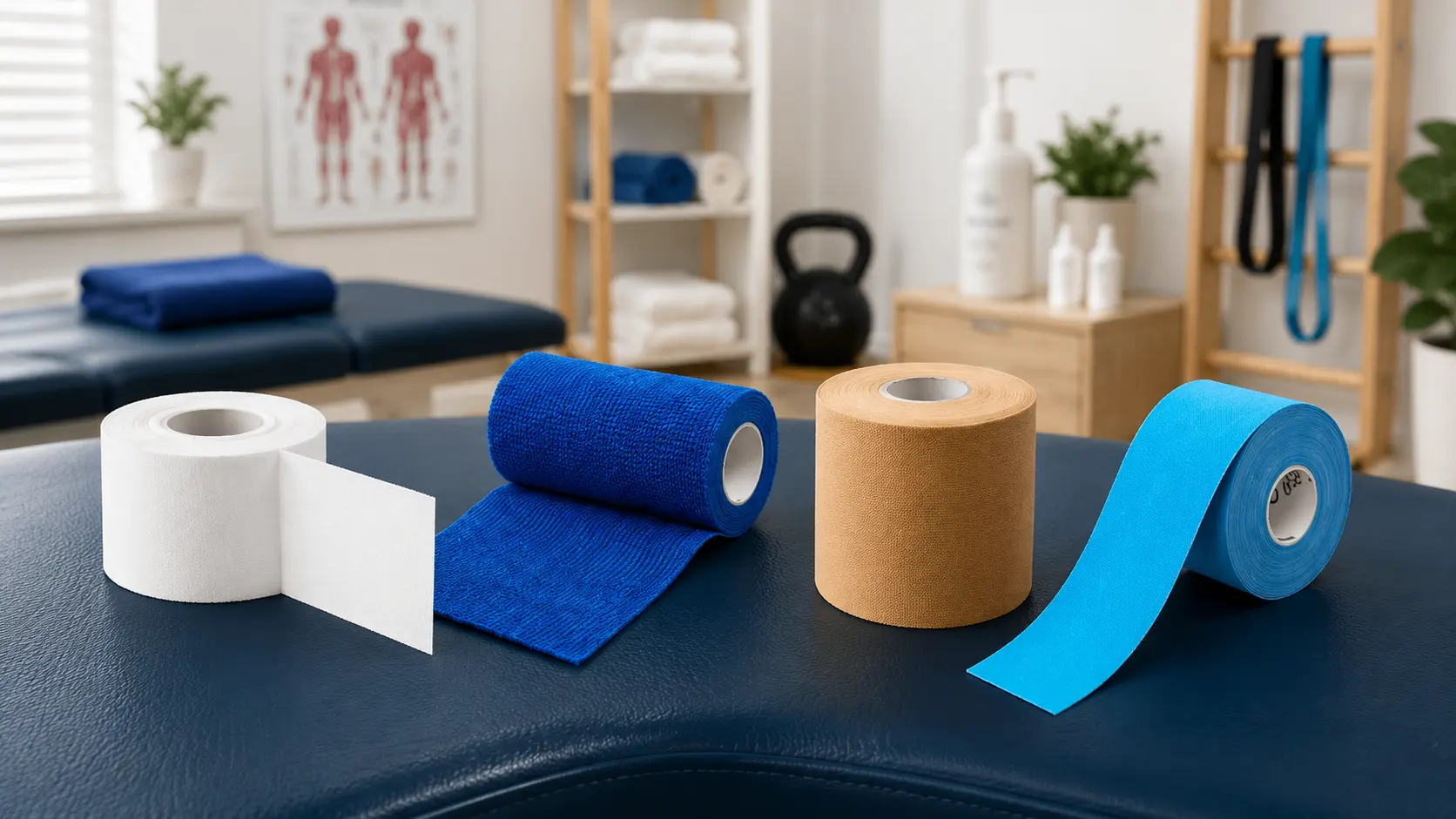
Underwrap, cohesive bandage and rigid strapping tape solve three different problems. Underwrap protects the skin, cohesive bandage compresses, secures and supports, and rigid strapping tape provides the greatest and most targeted mechanical restriction. How much any of them restricts depends on the product, the number of layers, the area and the technique. All three can appear in the same taping and all three end up on the same ankle, but they do not adhere in the same way (underwrap and cohesive bandage stick to themselves, not to the skin) and they do not do the same job, so it is easy to treat them as interchangeable.
They are not. A functional taping may combine all three, each in its own role, but every layer is optional and the choice depends on the technique.
Here we run through what each material is, when it is the primary choice, and how they fit together in a single taping, so that restocking and selection stop being a matter of habit. One note before we start: Kinemarket stocks products in all three categories, and this comparison is built from product function and manufacturer documentation, not from an adhesion, support or clinical test of our own.
Quick verdict
If you have ten seconds, here is the rule.
- Underwrap (pretape). A protective foam base. It goes on the skin to reduce friction and protect bony prominences under rigid tape. It holds nothing on its own, and it does not guarantee that the taping will last longer.
- Cohesive bandage. Compresses and secures with no adhesive on the skin, because it sticks to itself. It leaves more range of movement than rigid tape, although how much it restricts depends on how it is applied.
- Rigid strapping tape (sporttape). An inextensible tape that selectively restricts the harmful arc of movement. It is the one used when the goal is firm, selective restriction.
In practice the choice depends on the role you need in each case, and you will often end up combining several in the same taping.
At-a-glance comparison
| Material | Elasticity | Adheres to | Primary function | Typical format | |
|---|---|---|---|---|---|
| Underwrap | Polyurethane foam | High, conforms to the contour | Itself, not the skin | Protect the skin under tape | 7 cm × 27 m |
| Cohesive bandage | Woven or non-woven elastic construction; fibre and latex content vary by product | Medium | Itself, not the skin | Compress, secure and support | 2.5 to 10 cm × 4.5 m |
| Sporttape / rigid strapping tape | Viscose or cotton with zinc oxide | None, inextensible | The skin | Restrict the harmful arc of movement | 1.25 to 5 cm × 10 m |
| Kinesio tape | Cotton or viscose backing with elastic fibres and an acrylic adhesive; product-dependent | High, longitudinal | The skin | Accompany movement, offloading, proprioception | 5 cm × 5 m |
Elasticity is one of the main differences. The less stretch, the more a material can limit movement; the more stretch, the more range it allows. Comfort depends on the tension, the number of layers, the skin and the technique rather than on stretch alone. Kinesio tape appears here as a contrast because it aims for the opposite of rigid tape, and further down we look at when each one makes sense.
What is underwrap for?
Underwrap is used as a protective layer between the skin and rigid tape, above all on sensitive skin and over bony prominences. On its own it does not guarantee less chafing, less maceration or longer wear, since that depends on the product, the skin and the technique. Nor does it hold anything by itself.
Underwrap (pretape) is a thin polyurethane foam bandage, light and breathable, that adheres slightly to itself but not to the skin. The standard format is 7 cm × 27 m. Its job is not to hold anything, but to create an intermediate layer between the skin and the adhesive tape.
That layer is there to do three things. It lets the skin breathe and aims to reduce maceration in prolonged tapings. It protects bony prominences, such as the malleoli, from pressure and friction. And its elasticity absorbs part of the movement mismatch between the skin and a tape that does not stretch at all.
When do you use it? It is worth considering whenever rigid tape goes over sensitive skin, over bony landmarks, or in tapings that will stay on for more than a day. It also works as protection under thermoplastic splinting. For very short applications on healthy skin, you can do without it.
It is worth being honest about its limit. The foam provides no structural support and slightly reduces the raw grip of the tape above it, which is why some physiotherapists use an adhesive spray over the underwrap. In return, it is the cheapest of the three materials, so the cost per taping is barely noticeable. At Kinemarket we stock this foam underwrap as a single roll and in a box of 48 for restocking your practice.
What is cohesive bandage for?
Cohesive bandage compresses, secures and supports without sticking to the skin. It is the option when you need to hold something in place, whether a dressing, a set of electrodes or a taping already applied.
It adheres to itself, but not to the skin, to clothing or to other surfaces. It carries no conventional adhesive, so it leaves no residue on removal. On reuse, follow the instructions for the specific product, since some cohesive bandages are expressly declared single-use by the manufacturer. Construction varies from product to product, from woven cotton to non-woven fabrics carrying elastic fibres, and versions both with and without natural rubber latex are on the market, so check the composition of the reference you buy rather than assuming it. Widths run from 2.5 to 10 cm, in 4.5 m rolls.
Its value lies in dynamic support and clean fixation. Use it for light compression, for securing electrical stimulation electrodes, cryotherapy packs or dressings, for closing off a taping on the outside, and for clinician-directed finger support such as buddy taping, once deformity, fracture or dislocation has been ruled out. Oedema control and venous return depend on the compression dose and on the patient, so in the acute phase they require prior screening and a prescribed technique.
Cohesive bandage is designed to secure, compress or support while generally leaving more range than rigid tape, although some products and applications restrict considerably more than others, so it does not replace rigid tape when you need to stop a movement, such as inversion in a lateral ankle sprain.
One important precaution. Applied with too much tension it can act as a tourniquet and compromise circulation, so after a compressive turn it is worth checking distal colour and sensation. At Kinemarket you will find it in a range of widths and colours within the bandages collection.
What is rigid strapping tape (sporttape) for?
Of the three materials, rigid tape is the one designed to limit a specific movement while leaving the rest of the joint free. That is its reason for being.
Sporttape, functional taping or rigid strapping tape is an inextensible tape with no stretch. The backing is usually viscose or cotton and the adhesive contains zinc oxide. It is worth reading each brand's own documentation before assuming a composition. The manufacturer of Strappal, for example, declares a latex-free adhesive and states that the product is not made with natural rubber latex, but also declares that it contains colophony (rosin), which can itself provoke contact reactions. "Latex-free" is not the same as "free of allergens", and the composition of one product does not describe the whole category. It tears by hand both lengthways and across, which speeds up application, and it comes in widths from 1.25 to 5 cm. The 3.8 cm width is the standard choice for the ankle.
Its function is selective restriction. Rather than locking everything, it limits the dangerous arc, for example inversion in a lateral ankle sprain, while preserving more of the remaining functional range. On top of that mechanical effect comes a proprioceptive and exteroceptive component, since the tape pulls on the skin and warns as the risky movement approaches, plus a psychological sense of protection. That is why, once the injury has been assessed, it is selected for short-term support or selective restriction in some sprain and return-to-sport programmes. Its role depends on the diagnosis, the stage of recovery, the sport and the technique.
Two practical details. How long it stays on, and how well it resists sweat or water, depend on the specific product, the technique, the skin and the site; some manufacturers, such as Essity for Strappal, describe the application only as short-duration. Follow the product documentation. And on sensitive skin, or in tapings lasting more than a day, it is worth putting underwrap underneath. It is not a substitute for assessment where a severe sprain, a fracture, significant swelling or a skin injury is suspected. Whether taping has a role after that depends on the diagnosis, the plan and the product instructions. For everyday rigid tapings, Kinemarket stocks the functional sporttape and the classic Strappal rigid tape.

How do they combine in a single taping?
The question "underwrap, cohesive bandage or rigid strapping?" is a bit of a trick, because in many tapings the answer is "all three". In a functional ankle taping each material occupies a layer. Another rigid-tape example is low-Dye taping for plantar fasciitis. Underwrap forms the base and protects the skin, rigid tape forms the active restricting layers, and a turn of cohesive bandage can close the whole thing off on the outside, consolidating it and adding gentle compression.
Reduced to a decision, it comes down to three questions:
- Do you need to limit an arc of movement? Rigid tape.
- Do you need to compress, secure or support something? Cohesive bandage.
- Is the tape going over sensitive skin, over bony landmarks, or staying on for more than a day? Underwrap as a base.
Seen this way, restocking gets simpler. It makes sense to keep underwrap and sporttape always to hand, which is why we offer a combined underwrap and sporttape pack and clinic formats such as boxes of 32 sporttape rolls.
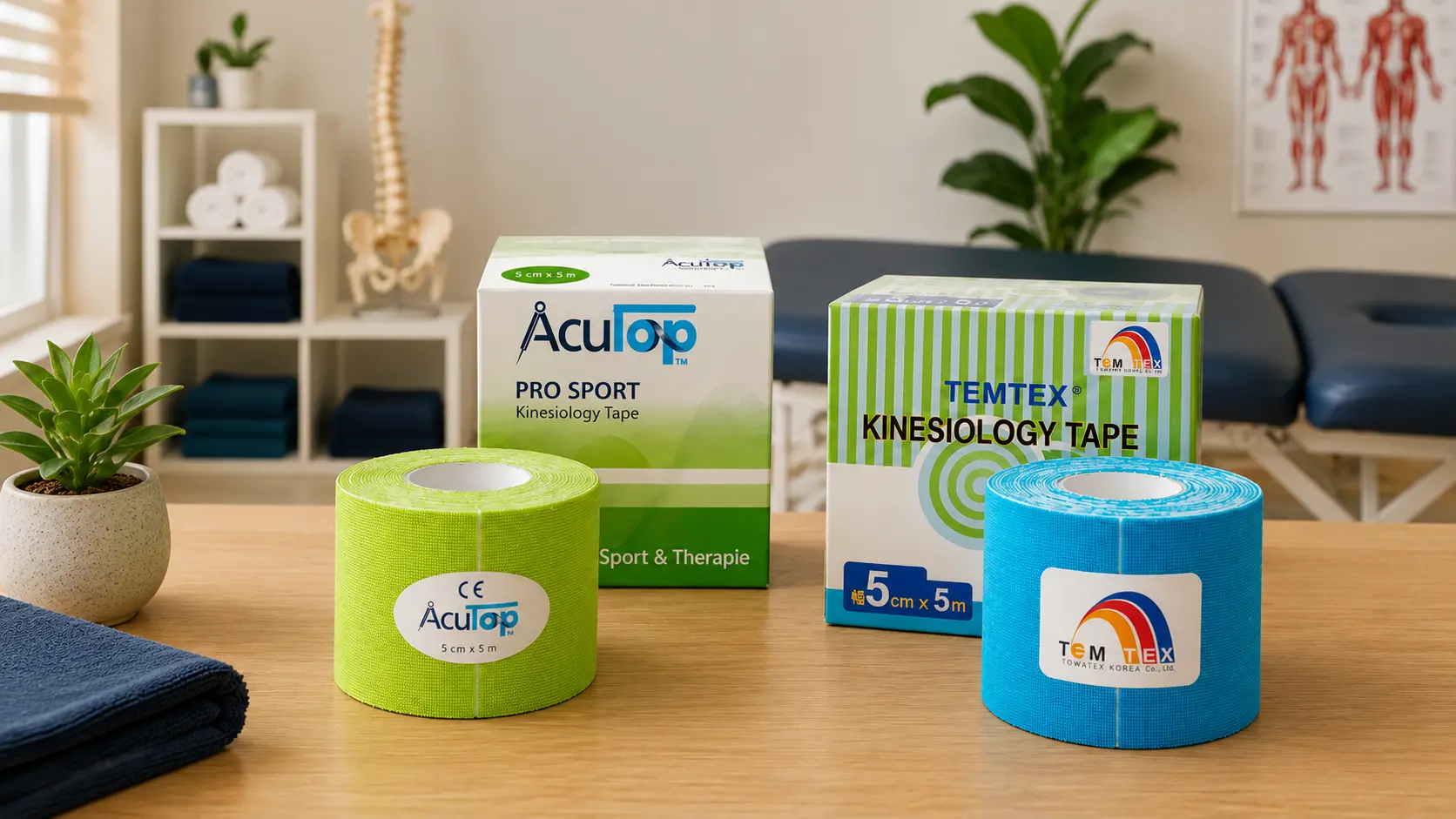
There is a fourth tool that does not fall into this category, kinesio tape. It is elastic and works in the opposite direction to functional taping. Instead of limiting an arc it accompanies the movement, and it is used without seeking rigid restriction; its clinical effect depends on the presentation and the evidence is mixed. When the aim is to facilitate or offload rather than restrict, that is its territory. If that is where you are working, we stock professional-grade kinesio tape, and to fine-tune your choice our guide to choosing kinesiology tape and our AcuTop versus Temtex comparison can help.
Frequently asked questions about taping materials
Does underwrap replace sporttape or rigid strapping tape?
No. Underwrap is a protective foam base that provides no structural support. Its role is to look after the skin, not to stabilise the joint or to make the taping last longer. If you need to restrict a movement, sporttape does that job, with underwrap underneath as protection.
How long does a functional taping with rigid tape stay on?
There is no single wear time that covers every rigid tape or every taping, and some manufacturers describe the application only as short-duration. How long it stays on, and when it is renewed, depend on the specific product, the technique, the skin, the circulation, the site and the goal, so follow the product documentation and the instructions of whoever applies it. Remove it sooner if oedema increases, if it lifts, if it becomes painful, or if distal colour or sensation change.
Does sporttape resist water and sweat?
Resistance to sweat and to water depends on the specific product, so check its documentation. If the patient will wet the area daily or needs taping for swimming, kinesio tape with its acrylic adhesive is usually declared water-resistant, but check the resistance and the wear time declared for that particular product rather than extrapolating a property to the whole category.