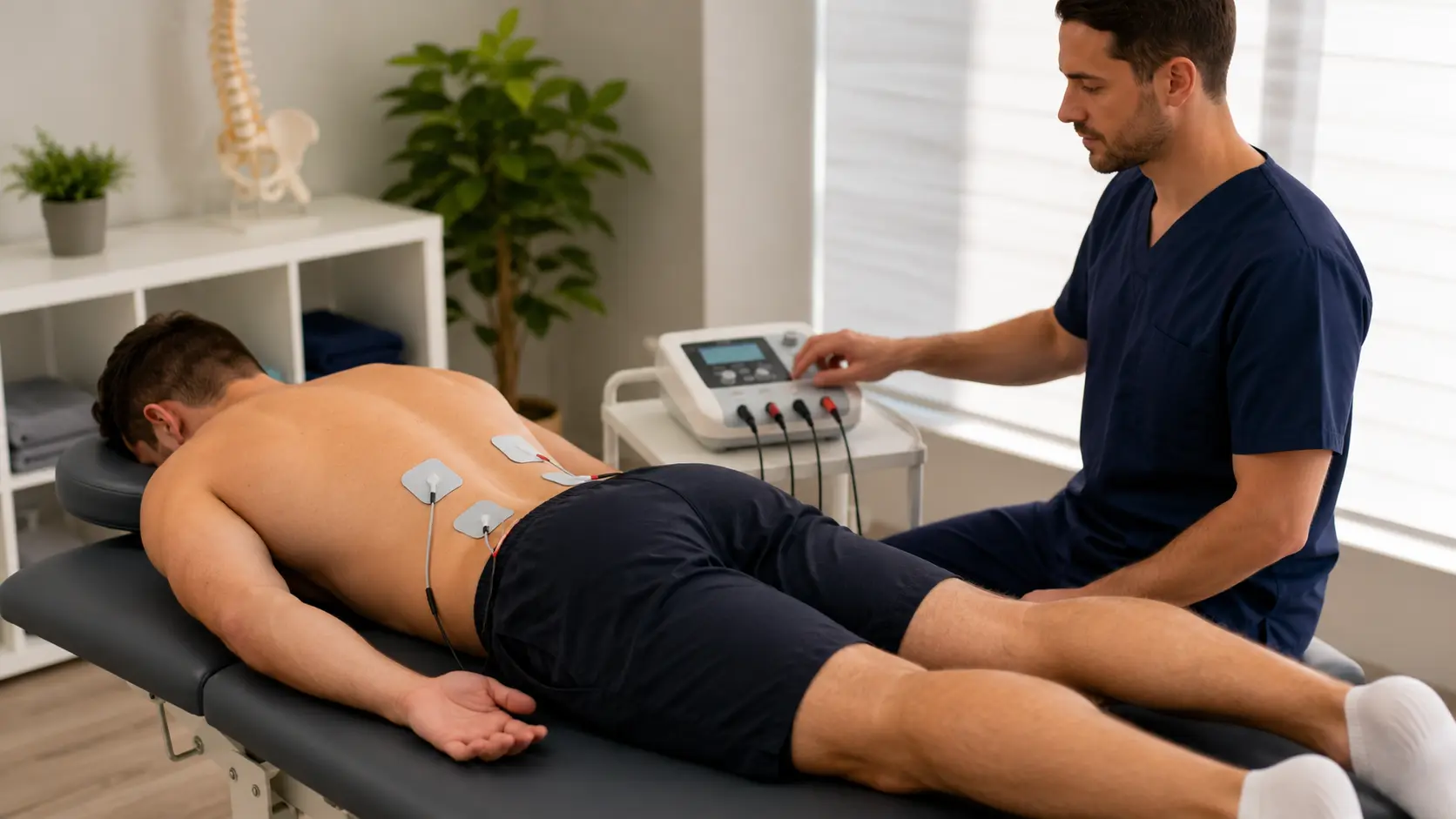
Gel and cream are restocked so often in a physiotherapy practice that they end up being ordered out of habit, the same product every time. Conductive gel is a coupling medium for equipment or applicators that need one, such as therapeutic ultrasound; massage cream or oil is the glide medium for manual therapy.
At Kinemarket we sell all eight products mentioned here. This is a desk-based guide built from the brands' product documentation, catalogue prices and published literature, not a product test of our own.
Quick verdict
Choose the medium by what it does in the session. For equipment, use the coupling medium indicated by its manufacturer; for the hands, use a neutral base; everything else is secondary.
- Ultrasound: a conductive gel; in electrotherapy, only when the equipment or electrodes require a conductive medium.
- Diathermy or TECAR therapy: the medium indicated by the equipment manual; conductive creams exist for that use.
- Manual therapy: neutral cream or oil, depending on the glide your technique requires.
- Creams with active ingredients, and warming or cooling creams: they do not replace the coupling medium indicated by the equipment manufacturer.
What is the difference between conductive gel, massage cream and oil?
The central difference is one of function, because conductive gel couples a piece of equipment to the skin and cream or oil lets the hand glide. The base and texture follow from that function, as does the place each one occupies in the practice.
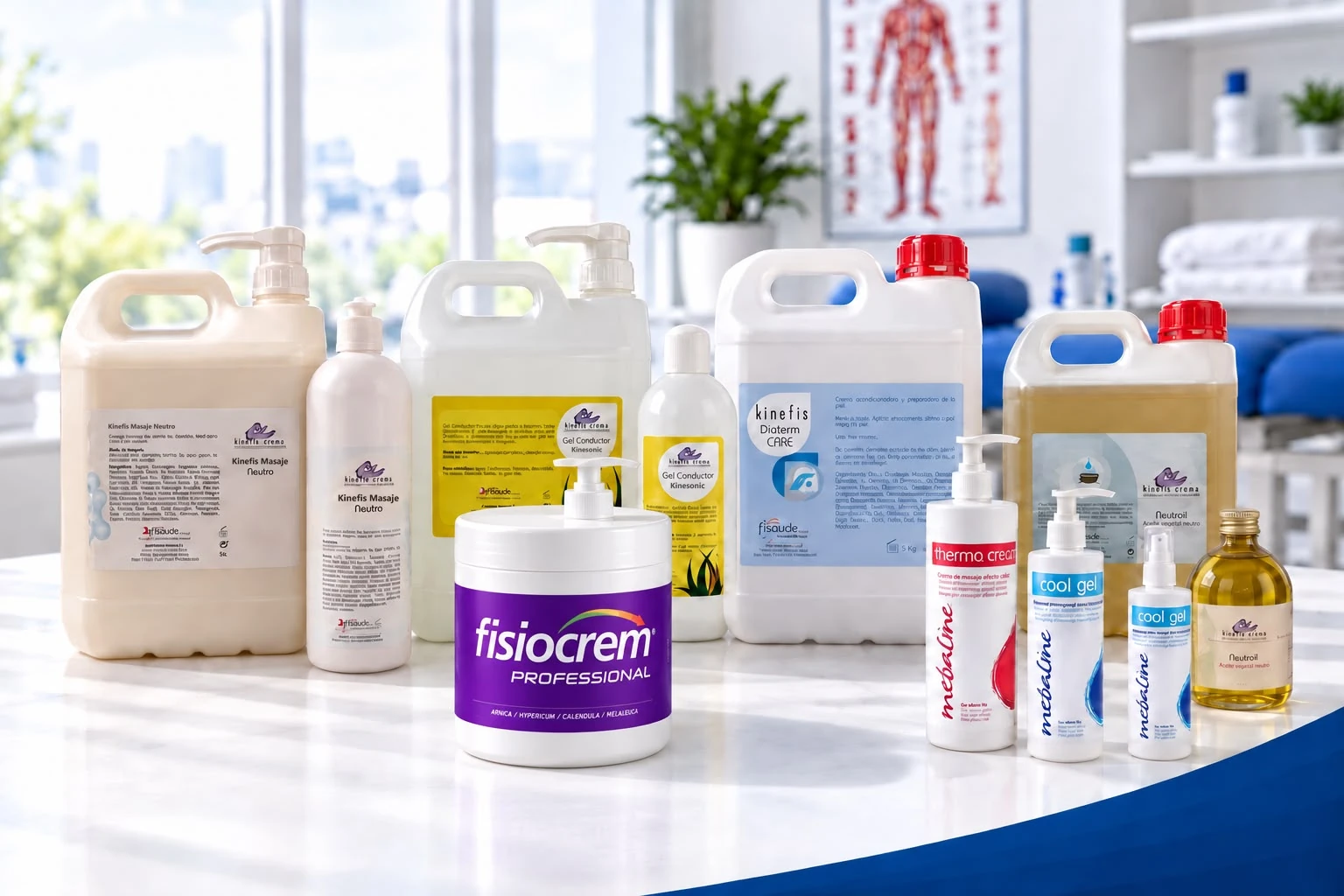
Four of the products in the table belong to Kinefis, the own-brand range marketed by Fisaude, which we cover in our article on Kinefis and its range. The table shows each type with what its product documentation declares.
| Type of medium | What it is used for | What the brand declares | Product in our catalogue |
|---|---|---|---|
| Conductive gel | Ultrasound; electrotherapy if the equipment requires it | Transparent, neutral and salt-free, according to Fisaude | Kinesonic |
| Conductive cream | Diathermy or TECAR therapy | Conductive and skin-conditioning | Diaterm Care |
| Neutral massage cream | Manual therapy | Neutral base for long massages | Kinefis neutral massage cream |
| Massage oil | Manual therapy | Soy, sweet almond and jojoba oils; unscented | Kinefis neutral massage oil |
| Cream with botanical ingredients | Massage | Arnica, calendula, hypericum and melaleuca | Fisiocrem Professional |
| Warming or cooling cream or gel | Massage | Warming or cooling sensation | Mebaline Therma Cream and Cool Gel |
Why does ultrasound need a conductive gel?
The transducer head needs a medium that ensures acoustic contact with the tissue, and that medium attenuates part of the beam's power. As the effect depends on the dose, this can influence treatment (Poltawski and Watson, 2007).
The gels commonly used among UK physiotherapists that Poltawski and Watson measured transmitted 95 to 108% as much ultrasound as degassed water, with no clinically relevant differences between them (Poltawski and Watson, 2007). In media used for phonophoresis, transmission split into two groups, above 80% or below 40% of water (Cameron and Monroe, 1992).
So use a product designed as a coupling medium, and do not improvise with a massage cream or a warming or cooling cream. What ultrasound is for and what the evidence says about its effectiveness is covered in our guide to electrotherapy in physiotherapy; here we cover only the medium.
Fisaude also describes Kinesonic as suitable for electrotherapy. If the equipment or electrodes need a conductive medium, the manual states it.
Which medium is used for diathermy or TECAR therapy?
Diaterm Care is marketed as a conductive cream for diathermy or TECAR therapy, and its product documentation describes it as conductive and skin conditioning, with cosmetic active ingredients. Which medium each piece of equipment needs, if any, is indicated by its manufacturer; follow the manual.
How do you keep conductive gel from being contaminated in the practice?
Three practices reduce the risk: do not refill bottles, keep the nozzle from touching the skin or the transducer head, and clean and disinfect the transducer head after each patient.
The most contaminated part was the bottle nozzle, ahead of the transducer head and the gel itself. In nine outpatient physiotherapy clinics in the United States, 52.7% of bottle nozzles had bacteria and 3.6% MRSA; 14.5% of bottles had contaminated gel and 35.5% of transducer heads had bacteria. Disinfecting the transducer head eliminated 90.9% of that contamination (Spratt et al., 2014). The study measured contamination of nozzles, gel and transducer heads without recording infections.
The European guidance considers the overall risk to be low, although outbreaks have been published with medical gels, and recommends single-use bottles rather than bottles refilled from large containers (Nyhsen et al., 2017). Multi-dose containers are discarded when empty and are not refilled (AIUM, 2025). The Australasian Sonographers Association states that refilling bottles from a 5-litre reservoir is no longer recommended (ASA, 2021).
These guidelines come from diagnostic ultrasound (sonography). Physiotherapy ultrasound on intact skin falls within their lower-risk category, where a non-sterile gel is sufficient (Nyhsen et al., 2017). If you work with a 5 kg container, dispense directly from the pump and do not use the container to refill bottles. The bundled 500 ml bottle is not refilled either; when empty, it is discarded (AIUM, 2025).
In practice:
- Close the container and store it upright at room temperature.
- Note the opening date of the bottle; the European guidance advises, ideally, discarding it at the end of the working day even if it has not been emptied (Nyhsen et al., 2017).
Neutral massage cream or oil: which suits your practice?
Both are used as glide bases. The choice depends on your technique, how much glide you need and how the patient's skin tolerates each product.
Fisaude presents the Kinefis neutral massage cream as a base designed for long massages.
The Kinefis neutral massage oil, according to its product documentation, has a vegetable base, contains tocopherol and is unscented.
Packaging also matters. In a real-use test with a preservative-free lotion, the screw-cap container was contaminated in 71% of cases and the pump-top container in 10% (Brannan and Dille, 1990). The study does not allow those percentages to be transferred to a modern cream used in practice, but it does illustrate why a pump dispenser reduces direct contact with the contents.
What should you know about creams with botanical ingredients?
These are massage creams with plant extracts, chosen according to use and personal preference. Compared with a neutral base, they add a variable worth keeping an eye on: skin tolerance, yours and the patient's.
Fisiocrem is a Uriach brand. Uriach lists arnica, calendula, hypericum and melaleuca (tea tree) in the formula of Fisiocrem Professional and supplies it in a 1-litre bottle with a dispenser. Our catalogue has the 1-litre bottle and a 3-litre pack. We do not attribute any action to it and describe it by its use as a massage medium.
Arnica and calendula are Compositae (the daisy family). Sensitisation seems relatively frequent with arnica, while calendula is among the species suspected of causing sensitisation (Paulsen, 2002). Tea tree oil is the essential oil with the most published allergic reactions; most of the reactions are due to the pure oil and cosmetics cause a minority, and oxidation increases its allergenic potency, so a well-closed container matters (de Groot and Schmidt, 2016). Ask about known plant allergies before using it.
Your hands are also exposed. In a survey of 350 massage therapists, hand dermatitis affected 15% in one year, and using aromatherapy products in massage oils or creams was associated with more hand dermatitis, with an odds ratio of 3.27 (Crawford et al., 2004). The study measures an association. If you customise a neutral base with essential oils, that exposure also counts.
What are warming and cooling creams?
Mebaline Therma Cream is described in its product sheet as a cream that provides a strong sensation of heat. Mebaline Cool Gel is described as a gel with a cold effect and a relaxing sensation, both in 500 ml containers. They are not coupling media. When to apply cold or heat is a clinical decision that we do not cover in this guide.
How much does each format cost per kilo or per litre?
Products in 5 kg and 5-litre containers cost a few cents per 10 g or 10 ml, while creams with active ingredients and warming or cooling creams cost between 36 and 44 cents. The saving from the large formats is in the neutral bases and the conductive products.
| Product | Format | Price* | Per kg or litre | Per 10 g or 10 ml |
|---|---|---|---|---|
| Kinesonic conductive gel | 5 kg container with pump dispenser + 500 ml bottle | €19.90 | Under €4 per kilo counting only the container (€3.98/kg) | About 4 cents |
| Diaterm Care | 5 kg container with pump dispenser | €49.90 | €9.98/kg | About 10 cents |
| Neutral massage cream | 5 kg container with pump dispenser + 1 extra litre | €47.90 | Under €10 per kilo counting only the container (€9.58/kg) | About 10 cents |
| Neutral massage oil | 5-litre container | €31.90 | €6.38/L | About 6 cents |
| Fisiocrem Professional | 1 litre | €43.90 | €43.90/L | About 44 cents |
| Fisiocrem Professional | 3 litres (3 × 1-litre bottles) | €130.50 | €43.50/L | About 44 cents |
| Mebaline Therma Cream | 500 ml | €17.90 | €35.80/L | About 36 cents |
| Mebaline Cool Gel | 500 ml | €17.90 | €35.80/L | About 36 cents |
*Indicative prices from Kinemarket's Spain/EU catalogue, checked in September 2026, shown in euros with Spanish VAT included; tax treatment and delivery costs may vary by destination. Catalogue prices change, and some products may be on offer.
The Kinesonic and neutral cream figures only count the container, so the actual price per kilo is somewhat lower. The 3-litre Fisiocrem pack costs €130.50, compared with €131.70 for three 1-litre bottles; it saves €1.20, under 1%; its main advantage is simpler stockholding. Multiply the 10 g or 10 ml column by what you use in a session and you have your cost.
Which product should you choose for each use in your practice?
By use:
- Ultrasound, and electrotherapy if the equipment requires it. The Kinesonic conductive gel in a 5 kg container.
- Diathermy or TECAR therapy. The Diaterm Care conductive cream.
- Manual therapy with cream. The neutral massage cream in a container with pump dispenser.
- Manual therapy with oil. The neutral massage oil in a 5-litre container.
- Cream with botanical ingredients. Fisiocrem Professional 1 litre or, if you use it daily, the 3-litre pack.
- Heat or cold sensation. Mebaline Therma Cream and Mebaline Cool Gel.
You can find all the products in the creams and gels collection. If you are equipping the practice from scratch, the guide to essential equipment for opening a physiotherapy clinic helps you decide the basic inventory.
Conclusion
The conductive gel is chosen for the equipment, and the cream or oil for the technique and the skin in front of you. Before restocking, check in each device's manual which medium it requires and organise stock so that bottles are not refilled.
Frequently asked questions
Is conductive gel a medical device or a cosmetic?
Status depends on the manufacturer's intended purpose and mode of action. In Great Britain, the MHRA uses those factors when deciding whether a borderline product is a medical device (MHRA, 2026a); Northern Ireland follows separate medical-device rules (MHRA, 2026b). We give no verdict on any product. Check the labelling and the manufacturer's documentation.
Can you warm conductive gel before applying it?
The American Institute of Ultrasound in Medicine guidance says only with dry heat (AIUM, 2025). The European guidance warns that keeping bottles warm multiplies microorganisms and turns the warmer into an incubator; it recommends warming only the bottle for immediate use (Nyhsen et al., 2017).
When do you need sterile conductive gel?
Sterile gel, preferably in a single-use sachet, is recommended when infection is a concern: invasive procedures that pass through tissue, non-intact skin, or areas close to recent surgical wounds (AIUM, 2025). A gel is only sterile if its label says so (Nyhsen et al., 2017). On intact skin, a non-sterile gel is sufficient.
Sources and references
For this guide we consulted the brands' product documentation, the ultrasound gel recommendations of the American, European and Australasian bodies, the UK regulator's guidance, and the studies on transmission, contamination and skin tolerance listed below.
- American Institute of Ultrasound in Medicine (2025). Guidelines for Cleaning and Preparing External- and Internal-Use Ultrasound Transducers and Equipment Between Patients as Well as Safe Handling and Use of Ultrasound Coupling Gel, 2025 Revision. Approved 2 July 2025.
- Australasian Sonographers Association (2021). ASA Clinical Statement: Safe use and storage of ultrasound gel. Revised February 2021.
- Brannan DK, Dille JC (1990). Type of closure prevents microbial contamination of cosmetics during consumer use. Appl Environ Microbiol 56(5):1476-1479. doi:10.1128/aem.56.5.1476-1479.1990
- Cameron MH, Monroe LG (1992). Relative transmission of ultrasound by media customarily used for phonophoresis. Phys Ther 72(2):142-148. doi:10.1093/ptj/72.2.142
- Crawford GH, Katz KA, Ellis E, James WD (2004). Use of aromatherapy products and increased risk of hand dermatitis in massage therapists. Arch Dermatol 140(8):991-996. doi:10.1001/archderm.140.8.991
- de Groot AC, Schmidt E (2016). Tea tree oil: contact allergy and chemical composition. Contact Dermatitis 75(3):129-143. doi:10.1111/cod.12591
- Medicines and Healthcare products Regulatory Agency (2026a). Borderlines with medical devices and other products in Great Britain. GOV.UK guidance, updated 29 June 2026, accessed 24 September 2026.
- Medicines and Healthcare products Regulatory Agency (2026b). Regulation of medical devices in Northern Ireland. GOV.UK guidance, updated 11 June 2026, accessed 24 September 2026.
- Nyhsen CM, Humphreys H, Koerner RJ, Grenier N, Brady A, Sidhu P, Nicolau C, Mostbeck G, D'Onofrio M, Gangi A, Claudon M (2017). Infection prevention and control in ultrasound: best practice recommendations from the European Society of Radiology Ultrasound Working Group. Insights Imaging 8(6):523-535. doi:10.1007/s13244-017-0580-3
- Paulsen E (2002). Contact sensitization from Compositae-containing herbal remedies and cosmetics. Contact Dermatitis 47(4):189-198. doi:10.1034/j.1600-0536.2002.470401.x
- Poltawski L, Watson T (2007). Relative transmissivity of ultrasound coupling agents commonly used by therapists in the UK. Ultrasound Med Biol 33(1):120-128. doi:10.1016/j.ultrasmedbio.2006.07.026
- Spratt HG, Levine D, Tillman L (2014). Physical therapy clinic therapeutic ultrasound equipment as a source for bacterial contamination. Physiother Theory Pract 30(7):507-511. doi:10.3109/09593985.2014.900836
- Uriach. Fisiocrem Professional, manufacturer's product page, accessed 23 September 2026.
- Distribution product sheets for Kinefis Kinesonic, Diaterm Care, neutral massage cream and neutral massage oil, published by Fisaude, accessed 23 September 2026.
- Distribution product sheets for Mebaline Therma Cream and Mebaline Cool Gel, accessed 23 September 2026.