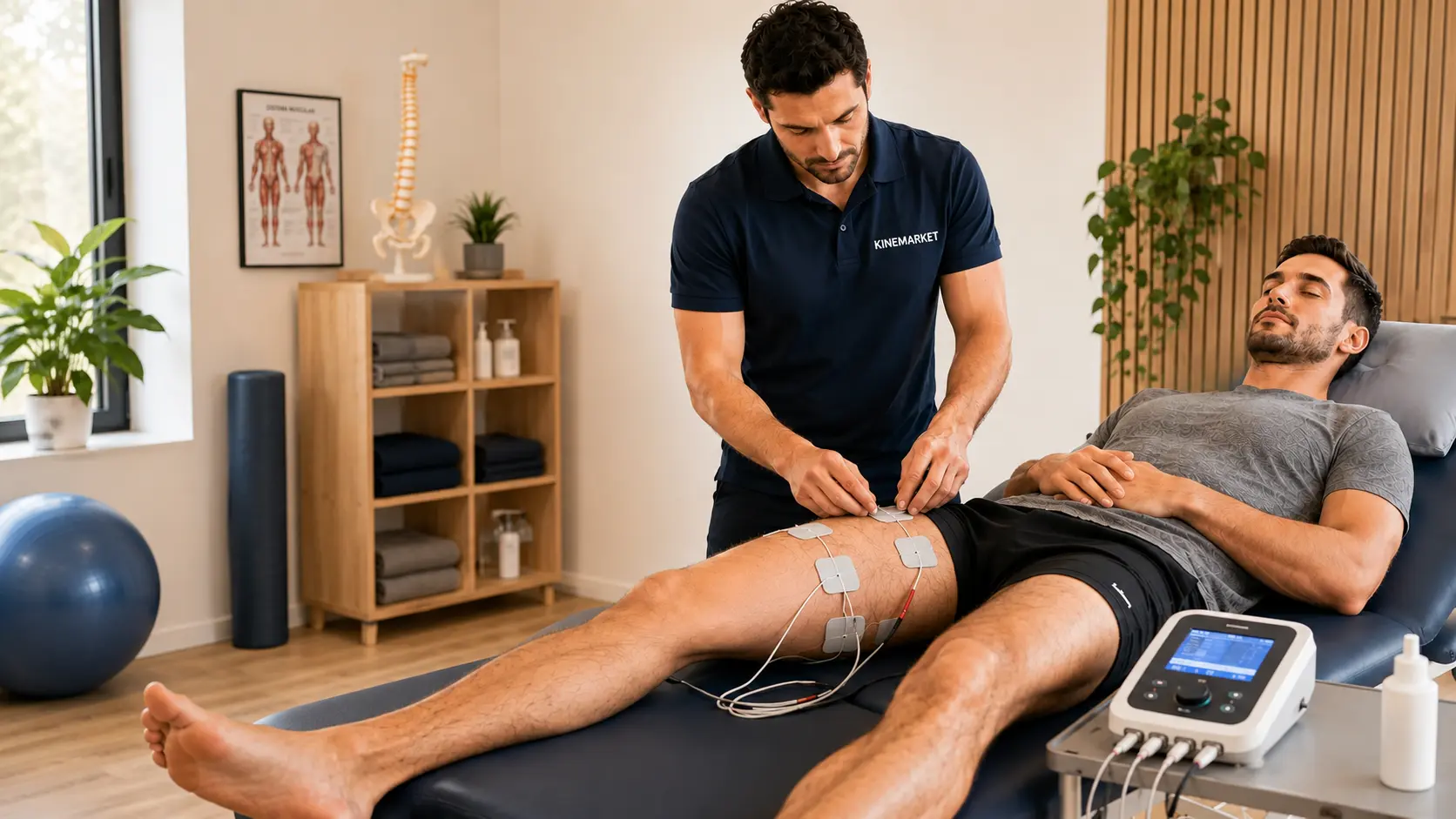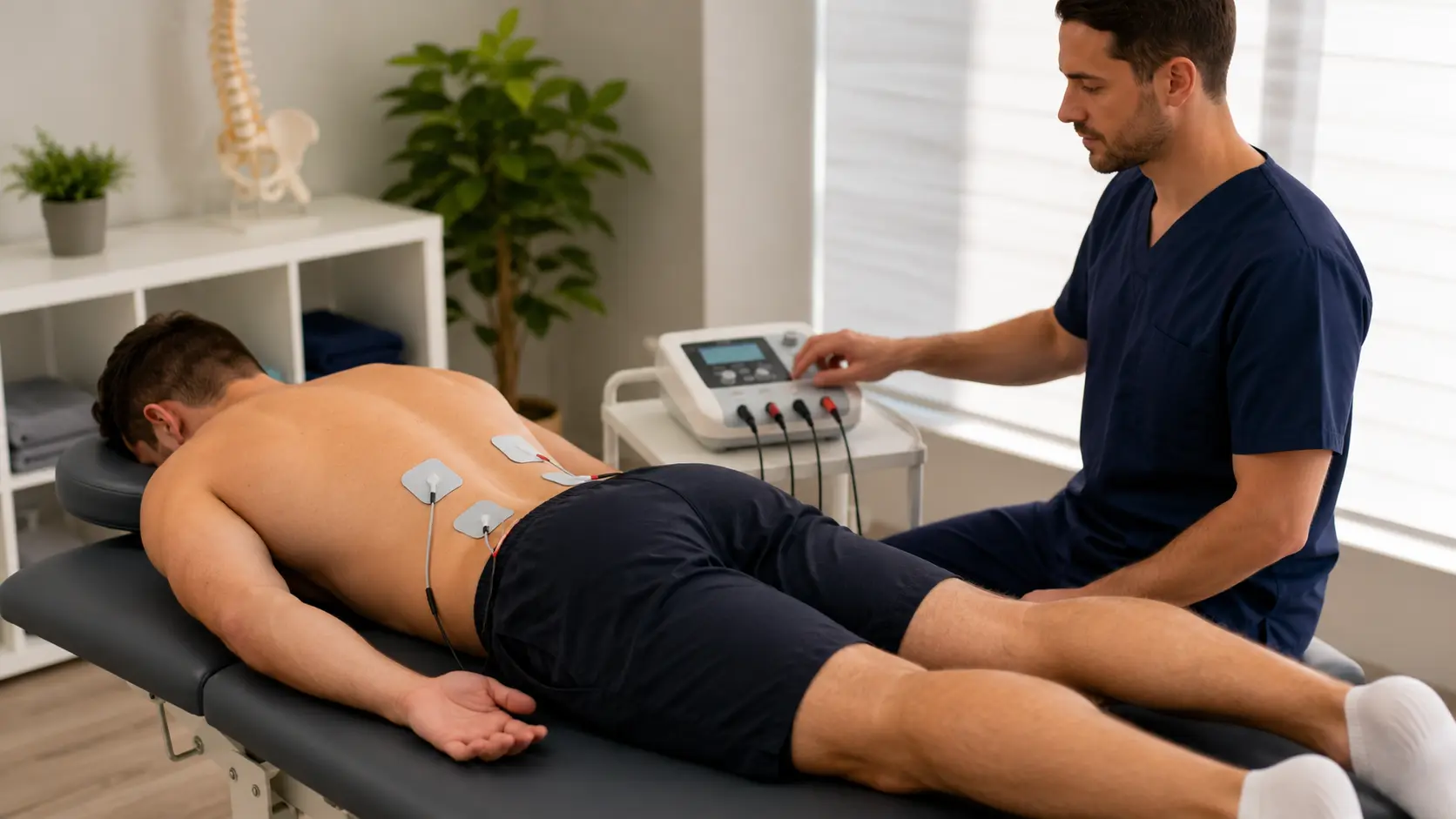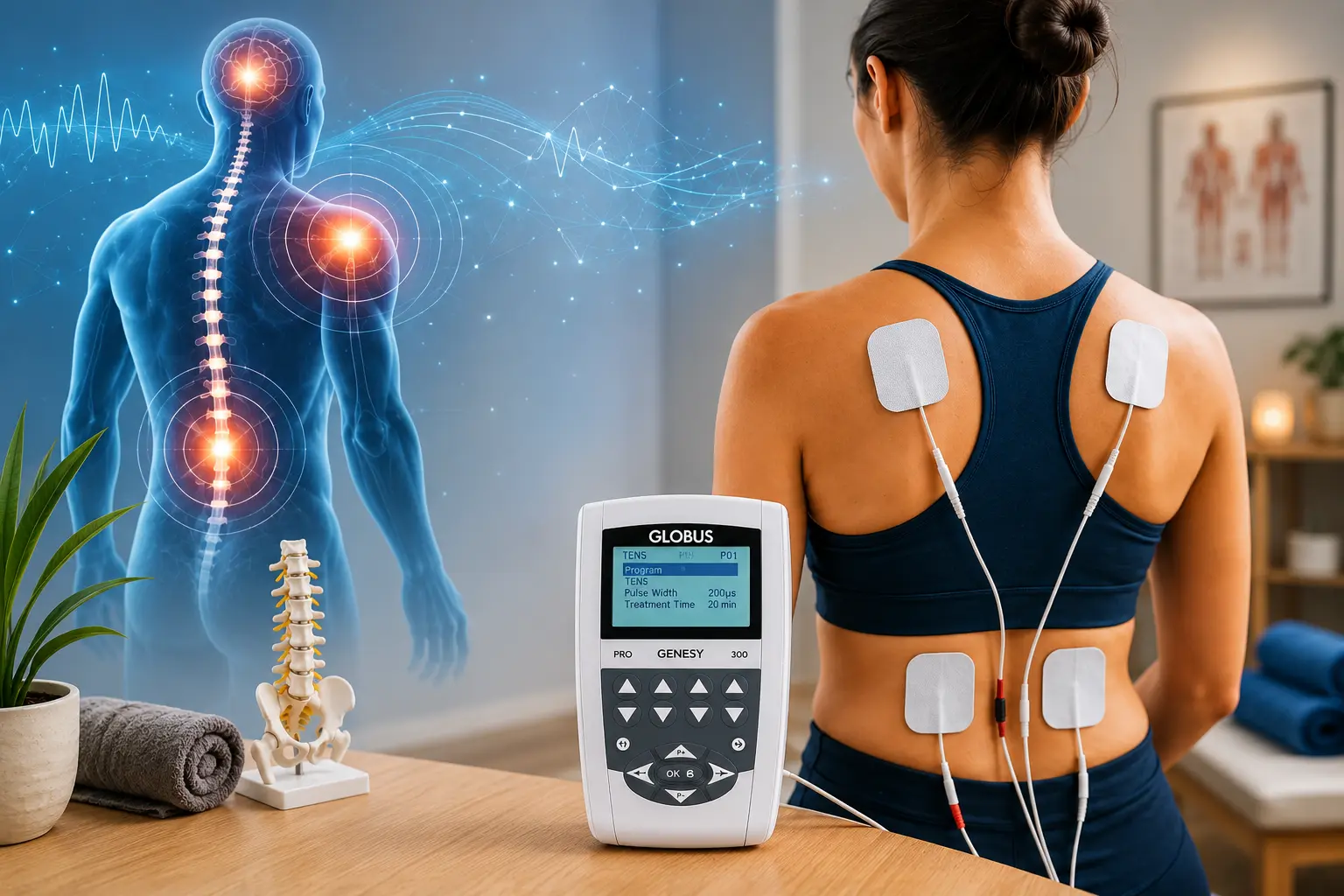
Transcutaneous electrical nerve stimulation (TENS) delivers electrical pulses through electrodes stuck to the skin in order to modulate the pain signal. The intensity is set to a strong but comfortable sensation, never a painful one. It is a non-invasive, drug-free option, generally well tolerated, with results that vary from person to person and with the type of pain.
It is used in hospitals and clinics, and at home too with simple portable stimulators. It is a useful tool in physiotherapy, but it does not repair tissue. It may ease the symptom enough to make movement easier.
What is TENS, and what can you expect from it?
TENS is a form of electrical stimulation, delivered by a small device, designed to modulate pain signals using electrical pulses applied through electrodes that stick to the skin over the affected area. It is not invasive and it has nothing to do with electroshock. It acts on the sensory nerves, modulating how your nervous system takes in painful information. Used properly it should not produce pain or burning, although excessive intensity, poor electrode contact or sessions that run too long can damage the skin.
What it does not do is treat the cause. If you have a disc herniation, osteoarthritis or a tendinopathy, TENS is not going to repair that tissue. It is an adjunct, normally used inside a broader treatment plan with exercise, manual physiotherapy and pain education. It fits well if you are after temporary relief that lets you move more easily and get on with your rehabilitation. That relief is the bridge that lets you do the work, not the destination.
What is the difference between TENS and EMS?
TENS acts on the sensory nerve to modulate pain; electrical muscle stimulation (EMS) stimulates the motor nerve to produce contractions for rehabilitation and strengthening. A common mistake is using EMS and expecting the pain to go, or applying TENS and expecting it to build muscle.

How does TENS work?
Two mechanisms are proposed, and how much each contributes varies with the protocol and the person. It partly closes the spinal "gate" through which pain signals pass, and it encourages the release of the body's own painkillers. Both are plausible and extensively studied mechanisms, although how well it works clinically varies with the situation and with each patient's response.
Gate control theory of pain. Proposed by Melzack and Wall in 1965, it holds that stimulating the large, fast-conducting A-beta fibres inhibits the transmission of pain signals coming from slower fibres (A-delta and C) at the level of the spinal cord. The fast signals close the gate on pain before it reaches the brain.

Release of the body's natural painkillers. TENS may also encourage the release of endorphins and enkephalins, which extend the effect beyond the session itself. This mechanism activates descending pathways linked mainly to opioid receptors and, according to some studies, to serotonin (Amer-Cuenca et al., 2010). Antidromic collision has also been described, where the impulses travel in the opposite direction to the nociceptive signals, although it is considered a secondary mechanism.
In practice that means relief during the session and, sometimes, for a while after you take the electrodes off. Responses vary. Finding the right setup requires some adjusting, and if nothing much changes at first, review the placement and the settings within what your device manual or your physiotherapist's instructions allow before writing it off.
What does TENS feel like?
The right sensation is a strong but comfortable tingling or prickling under the electrodes, quite unlike the discomfort you are trying to settle. It should never hurt or burn. That tingling confirms that the stimulation is being felt under the electrodes. It does not by itself confirm that the placement is right or that relief will follow, but it is the sensation to aim for.
Some people notice relief within minutes; others notice little or none. Individual responses vary.
The warning signs are clear enough: a sharp jabbing sensation, burning, an involuntary muscle contraction when you were not looking for one, or badly irritated skin. If any of them appear, stop the session and remove the electrodes. Check the skin, the contact and the device instructions before using it again, and if the discomfort persists, seek advice.
Which TENS settings do you need to adjust?
Four settings describe and adjust the stimulus: intensity, pulse width, frequency and the type of modulation.
| Setting | What it adjusts | What to aim for |
|---|---|---|
| Amplitude or intensity (mA) | The strength of the stimulus. | Turn it up to a clear, comfortable tingling, never a painful one. |
| Pulse width (μs) | Which fibres are recruited. | Together with the intensity, the waveform and where the electrodes sit, it influences which nerves are recruited and how the stimulation feels. Do not infer depth or effectiveness from the pulse width alone. Use the values the programme sets or the ones your device manual and physiotherapist specify. |
| Frequency (Hz) | The pattern of the sensation. | The literature distinguishes high and low ranges, with thresholds that vary between authors, devices and programmes. High ranges produce a continuous tingling and low ranges more rhythmic sensations. Do not choose it in isolation from pulse width, intensity, the intended indication and the device manual. |
| Modulation | How the pulses are grouped. | Continuous, modulated or burst formats. No mode is universally superior for every kind of pain, so use the programme the manufacturer intended. |
Use the programmes built into the stimulator and follow the guidance from the manufacturer and from your physiotherapist. One habit worth building is to note down which settings worked, so you can repeat them instead of starting from scratch.
How do the TENS modes differ?
The traditional classifications distinguish four modes: conventional or sensory TENS, low-frequency or acupuncture-like TENS, brief intense TENS, and burst stimulation. The names and the ranges vary between devices and studies, and no single mode works best across every kind of pain. Select a programme the manufacturer intended for the way you are using the device, and follow its manual or your physiotherapist's instructions.
Conventional or sensory (high frequency): a strong but comfortable sensation, never a painful one, which is the dose the trials work with.
AL-TENS or motor (low frequency, acupuncture-like): long pulses that produce light contractions. It is associated with relief that takes longer to arrive.
Brief intense: high frequencies at high intensity for short applications, with a minimal contraction, and only where the programme, the instructions and professional advice provide for it. It is used for short applications.
Burst: delivers the pulses grouped into low-frequency trains. Follow your device's programme and instructions to set it up.

Which kinds of pain is TENS used for?
TENS is used above all in localised, persistent musculoskeletal pain, although the certainty and the size of the effect vary with the presentation: low back pain, neck pain, painful shoulder, sciatica, muscle tightness, sports injuries and tendinopathies.
Chronic pain: arthritis and fibromyalgia. In fibromyalgia, recent reviews suggest that TENS may reduce pain, particularly when combined with therapeutic exercise, although it has not been shown to be superior to exercise on its own (Megía García et al., 2019).
Postoperative pain and pain associated with cancer: it can be considered as support in selected cases and always under clinical supervision, with results varying by presentation.
Other uses: the literature also describes TENS for period pain and for some neuropathic pain presentations, although responses vary and the indication should be individualised.
One distinction changes how it is applied. Localised pain (it hurts exactly where you point) and referred pain (running down the leg, up into the neck) require different electrode placements. With referred pain, the placement varies with the presentation and the device, so follow the manufacturer's diagram or a professional's instructions, and do not place the electrodes over the front of the neck or in any arrangement that sends the current across the chest.
In every case, TENS sits inside a broader treatment plan; it does not replace other treatments. And there are situations where you should not rely on it alone. If the pain is getting steadily worse, if you notice loss of strength or a marked change in sensation, if you have a fever alongside it, or if the pain appeared with no clear cause, a professional diagnosis comes first.
Where do the TENS electrodes go?
Place the electrodes around the painful area or along the path of the nerve involved, spaced apart and arranged so that the current crosses the area. On most modern devices polarity does not matter; what counts is the position and good contact with the skin.
Three rules that nearly always work:
- Place the electrodes around the pain, not necessarily directly on top of it.
- Keep them apart from each other, not stuck side by side.
- Arrange them so that the current crosses the painful area.
Practical examples by area:
- Low back pain and sciatica: one electrode on each side of the lower back, spaced apart rather than side by side. If the pain refers into the buttock or the back of the thigh, add another pair there.
- Neck and shoulder: around the painful area, always avoiding the front of the neck, the carotid region and any arrangement that sends the current across the chest. With neck pain it is better to have a physiotherapist decide the placement.
- Tennis elbow: around the elbow.
- Knee: either side of the kneecap, or in an above-and-below arrangement, never over wounds or irritated skin.
- Widespread pain such as fibromyalgia: the regions treated and the electrode arrangement depend on the presentation, the device and the protocol, so this one is set by a professional rather than chosen at home.
Placement diagrams are specific to each model and each indication, so your device manual overrides any general example. If there is no improvement after several sessions, review the placement before you keep increasing the intensity.

How long is a TENS session, and how often can it be repeated?
The duration depends on the programme, on the device manual and on your physiotherapist's instructions. If you repeat applications through the day, let the skin rest in between and check its condition before putting the electrodes back on.
During the session you may get accommodation, a fading of the initial sensation. If that happens, check the electrode contact and adjust the intensity only within what the device instructions allow. In most cases you are not looking for muscle contractions; the exception is AL-TENS, where light contractions are allowed.
When should TENS not be used?
The list that follows sets out the usual contraindications and precautions. TENS stimulators are medical devices, and the manufacturer is required to supply the unit's own warnings, precautions and contraindications with it. Those instructions override any general list and are essential reading. Do not use TENS if you have a pacemaker, an implantable defibrillator or another electronic implant unless the team that manages the implant and the device instructions both confirm it is appropriate. It is contraindicated over broken or infected skin, over areas with active tumours or suspicious lesions unless a doctor specifically advises otherwise, and over the head and the front of the neck (the carotid sinus). Avoid any placement that sends the current across the chest. The risk lies in the path of the current, not in simple proximity to the heart.
Precautions that require assessment first: epilepsy (under professional supervision, avoiding the head and neck), significant heart conditions, serious circulatory disorders including venous thrombosis, marked loss of sensation, children, and pain with no clear diagnosis. In pregnancy, TENS should only be used on the advice of a healthcare professional, avoiding the abdomen, the pelvis and the lower back unless specifically directed.
Situations that need professional judgement: severe acute pain, significant inflammation, chronic wounds, or non-electronic metal implants. Do not place ordinary home-use electrodes on broken, infected or irritated skin, or over open wounds. Specialist electrical-stimulation protocols for wound care are separate clinical interventions, not instructions for self-treatment.
Side effects and warning signs. The most common side effect is skin irritation from the adhesive or from sessions that run too long. Rotate where you apply the pads and check the condition of the skin between uses. Stop immediately if you get worsening pain, dizziness, persistent burning or a strong skin reaction, remove the electrodes and seek advice before using the unit again.
What does the scientific evidence say about TENS?
The largest review published to date found, with moderate certainty, that TENS reduces pain intensity during stimulation and immediately afterwards compared with placebo, with no signal of serious adverse effects in the studies included. Even so, results vary with the condition treated and with the individual response (Johnson et al., 2022). That does not replace the device warnings, and it does not rule out skin injury from incorrect use. The effect can begin within the first few minutes and give temporary relief that, in some patients, lasts several hours.
Results differ a great deal by presentation. In chronic low back pain, for instance, the reviews that informed the World Health Organization guideline describe brief, small reductions in pain on very low certainty evidence, and other work finds no meaningful difference against massage, acupuncture or placebo (Verville et al., 2023). That spread comes down to differences in study design, in the settings used and in the characteristics of the patients.
Part of the improvement observed may be down to the placebo effect. If TENS stops being useful for you, discuss it with a professional.
Taken together, that points to treating TENS as a complementary treatment, one normally used alongside exercise, manual physiotherapy, pain education and, where needed, medication; whether it adds useful relief varies by presentation, and on its own it does not always add meaningful benefit (Barcia-Mejía et al., 2020).
Which TENS unit should you buy?
Choose by the number of channels and by the modes you will actually use. One channel drives one electrode pair, and two allow two independently controlled pairs, subject to the programme and the device instructions. Bear the hidden cost in mind as well, because electrodes are consumables and the real cost of the unit includes its replacements.
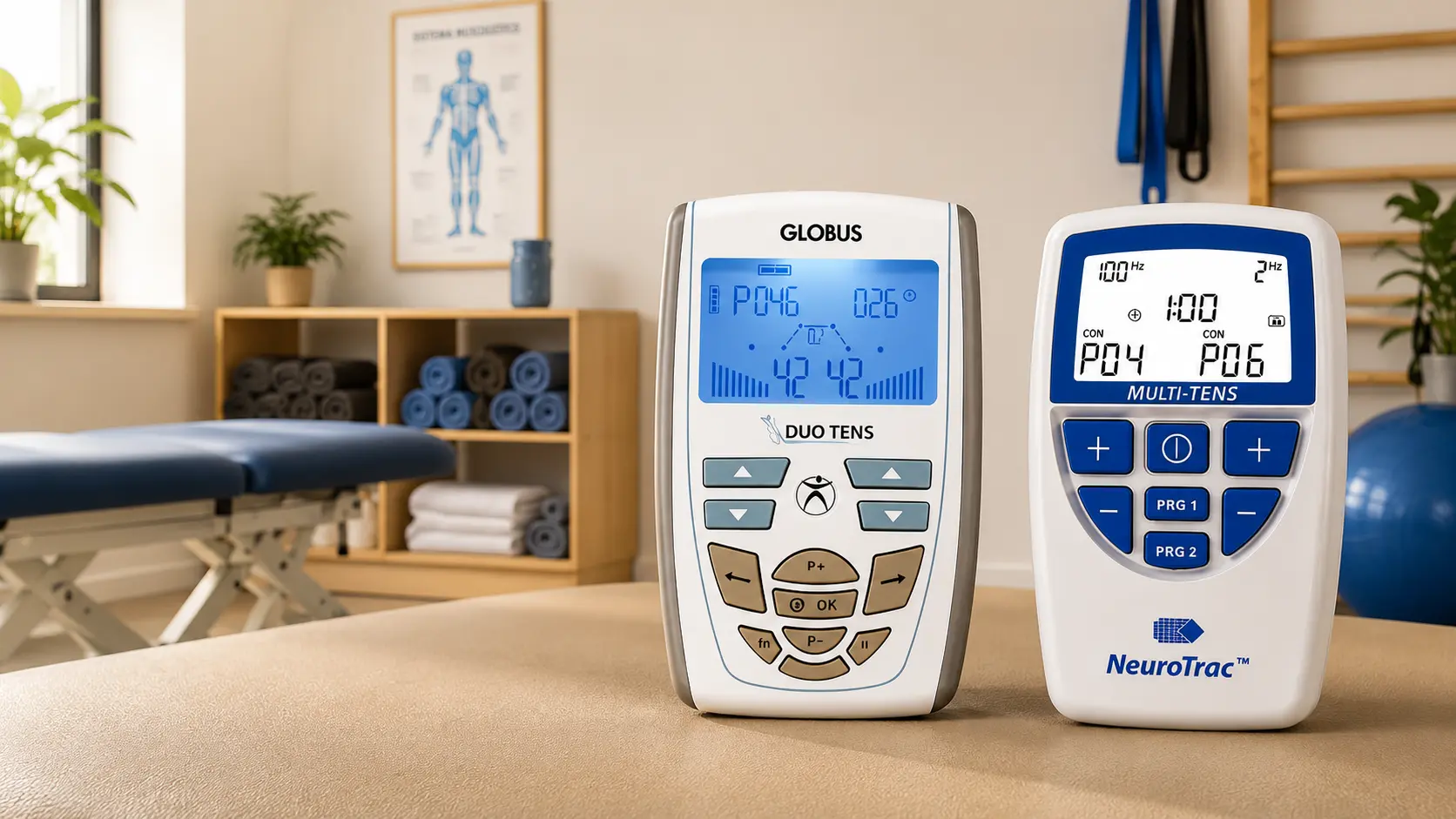
At Kinemarket you will find stimulators and consumables, and the full buying criteria (channels, manual parameter control, conformity, consumables, warranty and service) are set out, applied to two specific ranges, in our comparison of Globus and NeuroTrac. If you are buying for a clinic, the essential-equipment list places the unit alongside the rest of the kit.

Frequently asked questions about TENS
Can I combine TENS with painkillers?
TENS is used as a complementary treatment and can be used alongside prescribed medication (Barcia-Mejía et al., 2020). Any change to your medication is decided by whoever prescribed it.
Why has TENS stopped working for me?
Check the mechanical things first: the battery, the condition of the electrodes, the contact with the skin, the placement and the intensity, and also whether the pain itself has changed. If it still does not respond, review the approach with your physiotherapist rather than forcing the settings on your own.
Sources and references
These are some of the reviews and studies we drew on for this article:
- Melzack R, Wall PD (1965). Pain mechanisms: a new theory. Science, 150(3699), 971–979. Gate control theory of pain, the basis of the analgesic effect of TENS.
- Johnson MI, Paley CA, Jones G, Mulvey MR, Wittkopf PG (2022). Efficacy and safety of transcutaneous electrical nerve stimulation (TENS) for acute and chronic pain in adults: a systematic review and meta-analysis of 381 studies (meta-TENS study). BMJ Open, 12(2), e051073. Moderate certainty of pain reduction during and after stimulation, with no serious adverse effects.
- Verville L, et al. (2023). Benefits and harms of transcutaneous electrical nerve stimulation (TENS) for chronic primary low back pain in adults (systematic review for a WHO guideline). Journal of Occupational Rehabilitation. Chronic primary low back pain: short-lived analgesia of small magnitude, graded very low certainty.
- Amer-Cuenca JJ, Goicoechea C, Lisón JF (2010). ¿Qué respuesta fisiológica desencadena la aplicación de la técnica de estimulación nerviosa eléctrica transcutánea? Revista de la Sociedad Española del Dolor, 17. Neurophysiological mechanisms of TENS and the role of opioid receptors.
- Megía García Á, Serrano-Muñoz D, Bravo-Esteban E, Avendaño-Coy J, Gómez-Soriano J (2019). Efectos analgésicos de la estimulación eléctrica nerviosa transcutánea en pacientes con fibromialgia: una revisión sistemática. Atención Primaria, 51. TENS reduces pain in fibromyalgia, particularly combined with therapeutic exercise.
- Barcia-Mejía C, González-González Y, Da Cuña-Carrera I, Alonso-Calvete A (2020). Estimulación nerviosa transcutánea en el manejo del dolor crónico: una revisión sistemática. Archivos de Neurociencias, 25. Mixed evidence: as an adjunct it does not always add meaningful benefit.