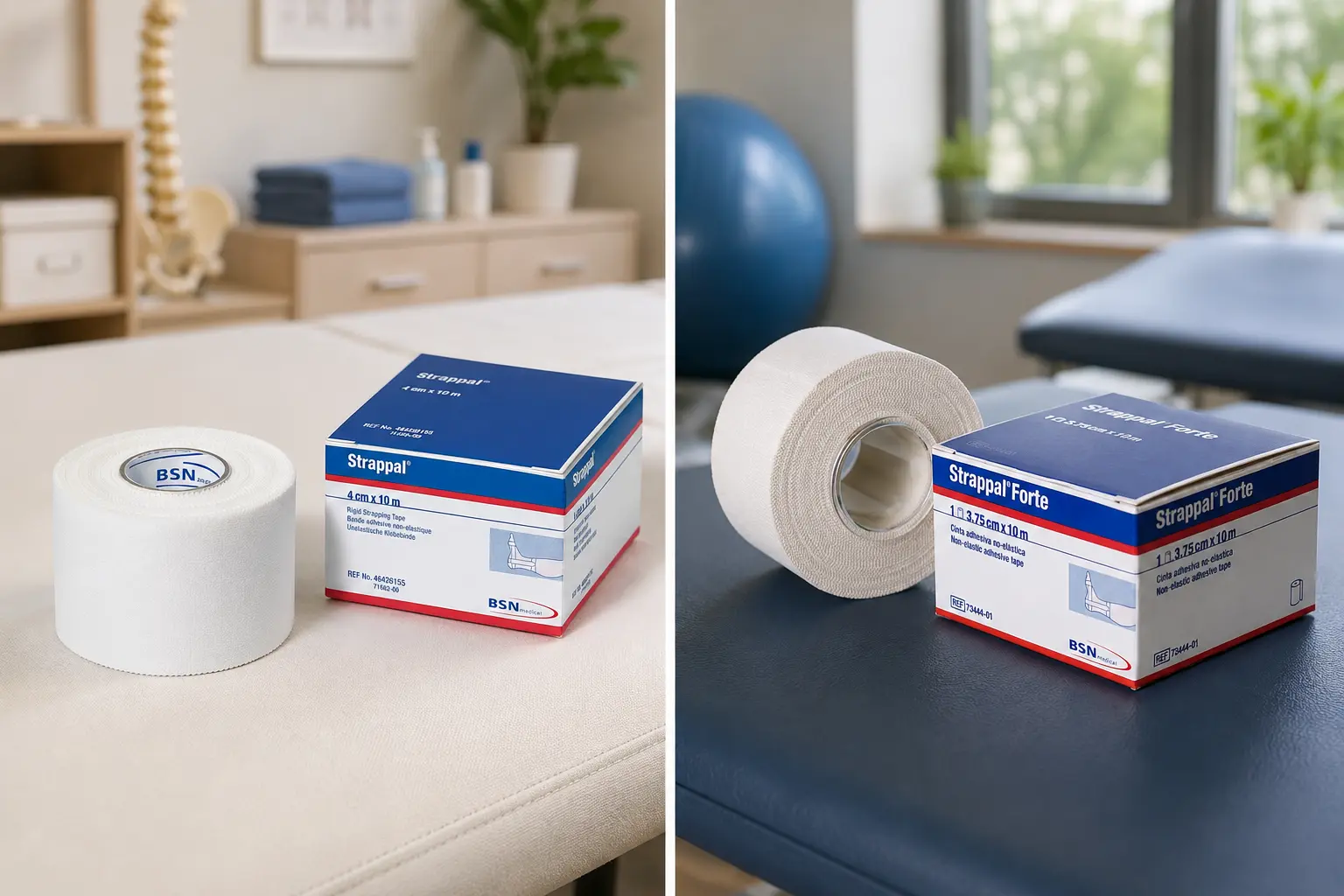
Strappal is a rigid zinc oxide tape used for functional taping. It stabilises the joint and restricts specific movements without immobilising it completely. It is made by BSN medical and comes in two versions, Strappal and Strappal Forte, which share neither the same backing nor the same adhesive.
Below we set out what the manufacturer states about each one, where they genuinely differ and when each makes sense in the clinic. We stock both at Kinemarket, and this guide draws on the manufacturer's technical documentation and the published evidence.
What Strappal is and who makes it
Strappal is one of the classic tapes in functional taping, the technique that uses non-elastic tape to selectively block the range of movement that hurts or puts the injury at risk. The brand belongs to BSN medical, formed in 2001 as a joint venture between Beiersdorf and Smith & Nephew, and part of the Swedish group Essity since 3 April 2017.1 It sits in BSN's orthopaedics and physiotherapy catalogue alongside names you will probably recognise, such as Leukotape, Tensospray and Tensoplast.
Standard Strappal: the manufacturer's specifications
Standard Strappal is a non-elastic tape with a viscose backing and a zinc oxide adhesive mass that contains no rubber. The adhesive is latex-free and the product is not manufactured with natural rubber latex, although the technical specifications do declare colophony, a well-known contact sensitiser.2 A latex-free tape can still cause skin reactions, so that detail is worth bearing in mind with patients who have a history of contact dermatitis.
The formulation is also free of phthalates. The tape tears by hand thanks to its serrated edge, which also stops it fraying, and it allows radiological examination without removing the strapping.2
On sizes, Strappal comes in 10 m rolls in widths of 2.5, 4 and 5 cm, and the intended application is short-term. How long it actually stays put depends on the technique, the skin and the area, and the technical specifications declare no water resistance for this version.2 You will find shops describing standard Strappal as water-repellent cotton. That construction belongs to the Forte, not to the standard tape.
Strappal Forte: what changes compared with the standard tape
Strappal Forte is a water-repellent cotton fabric with a zinc oxide and rubber adhesive, particularly high in tensile strength, non-elastic, and with a higher declared adhesive power than the standard tape. That change of adhesive matters in clinic, because the Forte contains natural rubber latex and can cause allergic reactions.3
The manufacturer publishes the same construction for Leukotape Classic, the product in its catalogue that distributors identify with the Forte. It has a woven cotton backing and an adhesive mass of natural and synthetic rubber, and it is water-resistant.4
| Strappal | Strappal Forte | |
|---|---|---|
| Backing | Viscose | Water-repellent cotton |
| Adhesive | Zinc oxide, rubber-free | Zinc oxide with rubber |
| Latex | Latex-free | Contains natural rubber latex |
| Other declared allergens | Colophony | Check the product packaging |
| Water resistance | Not declared | Water-repellent |
| Formats at Kinemarket | 4 cm x 10 m, single roll or 24-pack | 3.75 cm x 10 m |
What is Strappal used for in clinic?
Strappal is indicated for treating and preventing muscle, ligament and joint injuries, for selective immobilisation and for sports trauma, with strains and sprains as the typical case. The manufacturer also lists rigid joint strapping, orthopaedic uses and continuous adhesive traction.2 In practice you will see it mostly on the ankle, and also on the knee, wrist and fingers.
What does the evidence say?
A clinical guideline on ankle sprains concludes that, after an acute lateral ligament rupture, the patient benefits most from tape or a brace combined with an exercise programme (Vuurberg et al., 2018). The same guideline treats braces as an effective option for preventing recurrence. The evidence-based question bank run by the Servicio Murciano de Salud points in the same direction. In grade I and II sprains, functional treatment comes out ahead of strict immobilisation (Preevid, 2004). The differences do lose significance, though, once the lower-quality trials are excluded. Beyond the ankle, the Valencia trial of low-Dye taping for plantar fasciitis also used a Strappal bandage. If you work a lot with athletes, or you are nursing an injury yourself, our sports injuries guide fills in that context.
When to choose each version
The standard tape suits patients with sensitive skin or a latex allergy, with the colophony caveat in mind. The Forte is the one to reach for when the strapping has to hold up against sweat, moisture or heavy adhesive demands, and latex is not a concern.
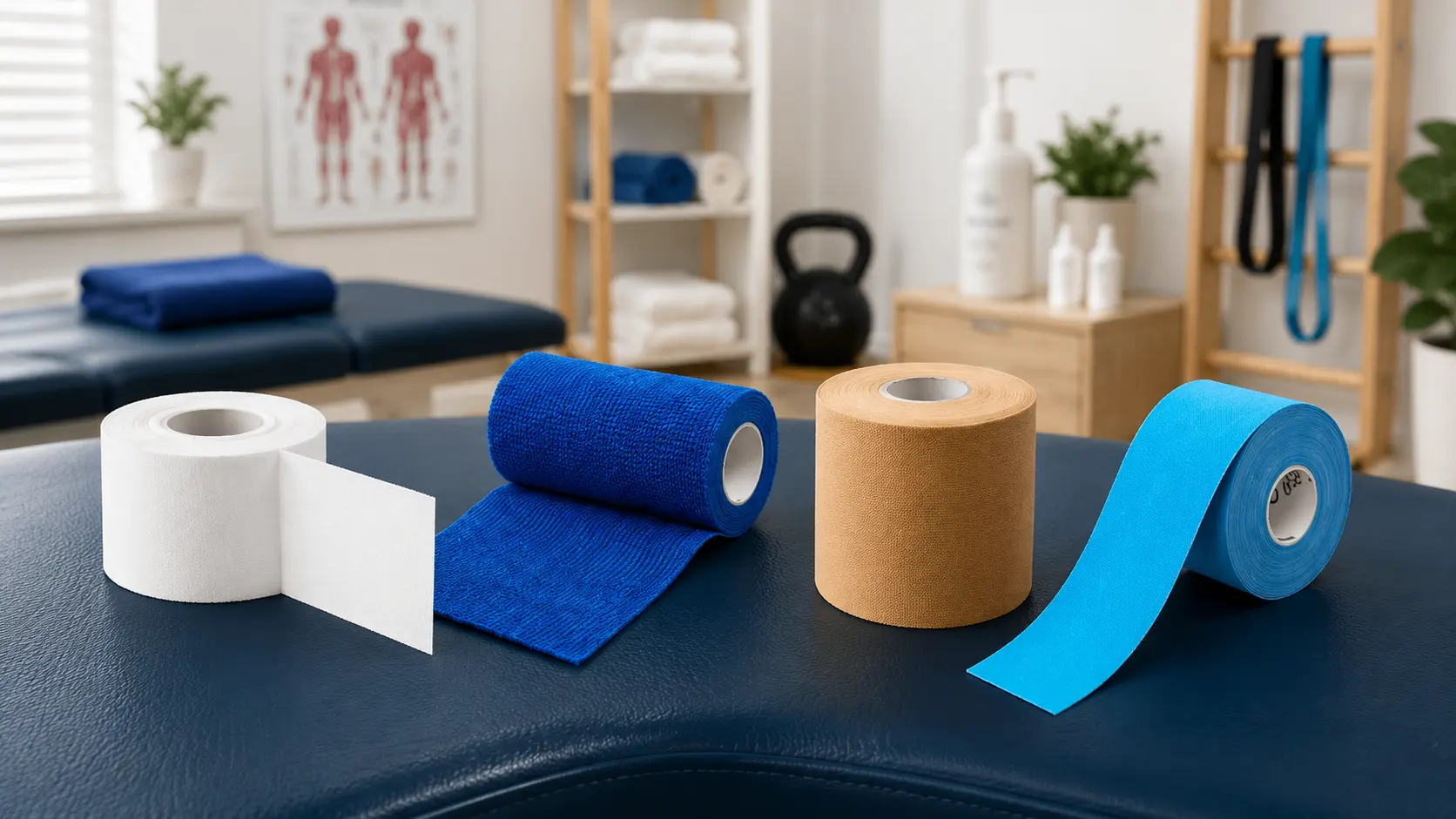
Two technique precautions, without turning this into a tutorial: rigid tape is not applied in a complete circular pattern, because it can act as a tourniquet, and on sensitive skin or in strappings meant to last more than a day it is worth putting underwrap underneath. How underwrap, cohesive bandage and rigid tape fit together in a single application is covered in our comparison of underwrap, cohesive bandage and rigid strapping. And where a fracture, a severe sprain or a skin lesion is suspected, tape is not a standalone answer. Those situations call for proper assessment.

Available formats
These are the formats we carry, depending on what you need:
- To try the tape or restock in small quantities: Strappal Tape 4 cm x 10 m as a single roll.
- For a clinic getting through it regularly: the 24-pack of 4 cm Strappal Tape, the same box format the manufacturer uses.
- For maximum adhesion in sweat or damp conditions: Strappal Forte 3.75 cm x 10 m.
- The rest of the strapping and bandaging range, from underwrap to cohesive bandages, is in our bandages collection.
Professional alternatives and companion products
Within BSN medical's own catalogue, Leukotape Classic shares the Forte's construction, cotton with a rubber adhesive and water resistance, and adds the option of coloured rolls. As a lower-cost non-elastic alternative there is the Functional Sporttape 3.8 cm, one of the store's best-selling formats.
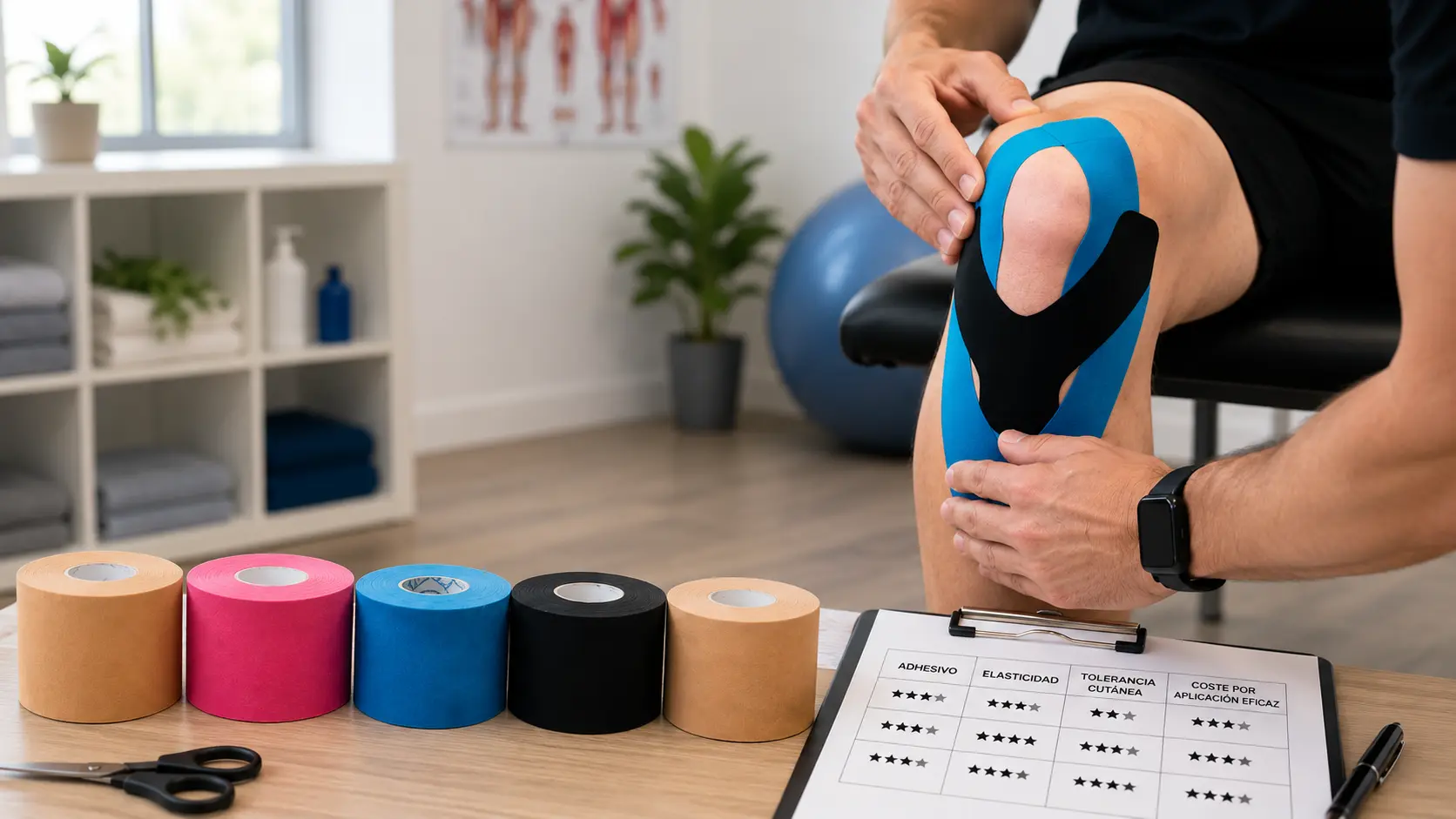
Kinesiology tape is a separate category. Because it’s elastic, it accompanies movement rather than blocking it, which is why it falls short when the aim is to restrict a specific range. If that approach interests you, our kinesiology taping guide explains how it works, and our guide to choosing kinesiology tape sets out the buying criteria for your practice.
Frequently asked questions about Strappal
What is Strappal tape?
Strappal is a non-elastic zinc oxide tape made by BSN medical for functional taping. It is used to stabilise joints and limit specific movements in injury prevention and recovery, particularly in sport.
What sizes does Strappal come in?
The rolls are always 10 m long, in widths of 2.5, 4 and 5 cm for the standard tape and 3.75 cm for the Forte. At Kinemarket, we carry the 4 cm standard tape as a single roll and as a 24-pack, plus the 3.75 cm Forte.
What is Strappal used for?
For rigid functional taping: stabilising the ankle, knee, wrist or fingers, preventing injuries in sport, and supporting recovery from muscle and ligament injuries through selective immobilisation.
How do Strappal and Strappal Forte differ?
The standard tape has a viscose backing and a latex-free zinc oxide adhesive. The Forte has water-repellent cotton and a zinc oxide adhesive with rubber, with more declared adhesive power. The comparison table sets out the differences side by side.
Does Strappal contain latex?
Standard Strappal does not. Its adhesive is latex-free, though it does contain colophony, which can also cause sensitisation. Strappal Forte does contain natural rubber latex. Always check the packaging of the specific product you are using.
Is Strappal the same as kinesiology tape?
No. Strappal is a rigid tape that restricts movement, whereas kinesiology tape is elastic and can be used alongside it. They are complementary categories with different aims, not interchangeable products.
How long can a Strappal strapping stay on?
The manufacturer describes the application as short-term, without giving a fixed figure. How long it lasts depends on the technique, the skin and the area, and the strapping should come off sooner if pain, swelling, or changes in distal colour or sensation appear, or if it starts lifting.
What goes under Strappal to protect the skin?
Foam underwrap, the classic pre-tape layer. It goes between the skin and the tape when the skin is sensitive, or the strapping is going to stay on for more than a day. Our comparison of underwrap, cohesive bandage and rigid strapping explains how they combine in a single application.
Sources and references
These are the manufacturer's specifications and the references we drew on for this guide:
- Essity. Annual and Sustainability Report 2017, acquisitions: completion of the BSN medical purchase on 3 April 2017.
- Essity / BSN medical. Strappal technical specifications in German and in French: latex-free and phthalate-free adhesive, colophony, viscose backing, sizes and indications.
- BSN medical. Strappal Forte distribution documentation, ref. 3200 (accessed August 2026): water-repellent cotton, zinc oxide and rubber adhesive, natural rubber latex content. No public manufacturer data sheet is available.
- Essity / BSN medical. Leukotape Classic technical specifications (in French): woven cotton with a natural and synthetic rubber adhesive, water-resistant.
- Vuurberg G, Hoorntje A, Wink LM, et al. (2018). Diagnosis, treatment and prevention of ankle sprains: update of an evidence-based clinical guideline. British Journal of Sports Medicine, 52(15), 956.
- Preevid, Servicio Murciano de Salud (2004). ¿Es más efectivo el vendaje funcional vs. la inmovilización en el esguince de tobillo grado I-II?