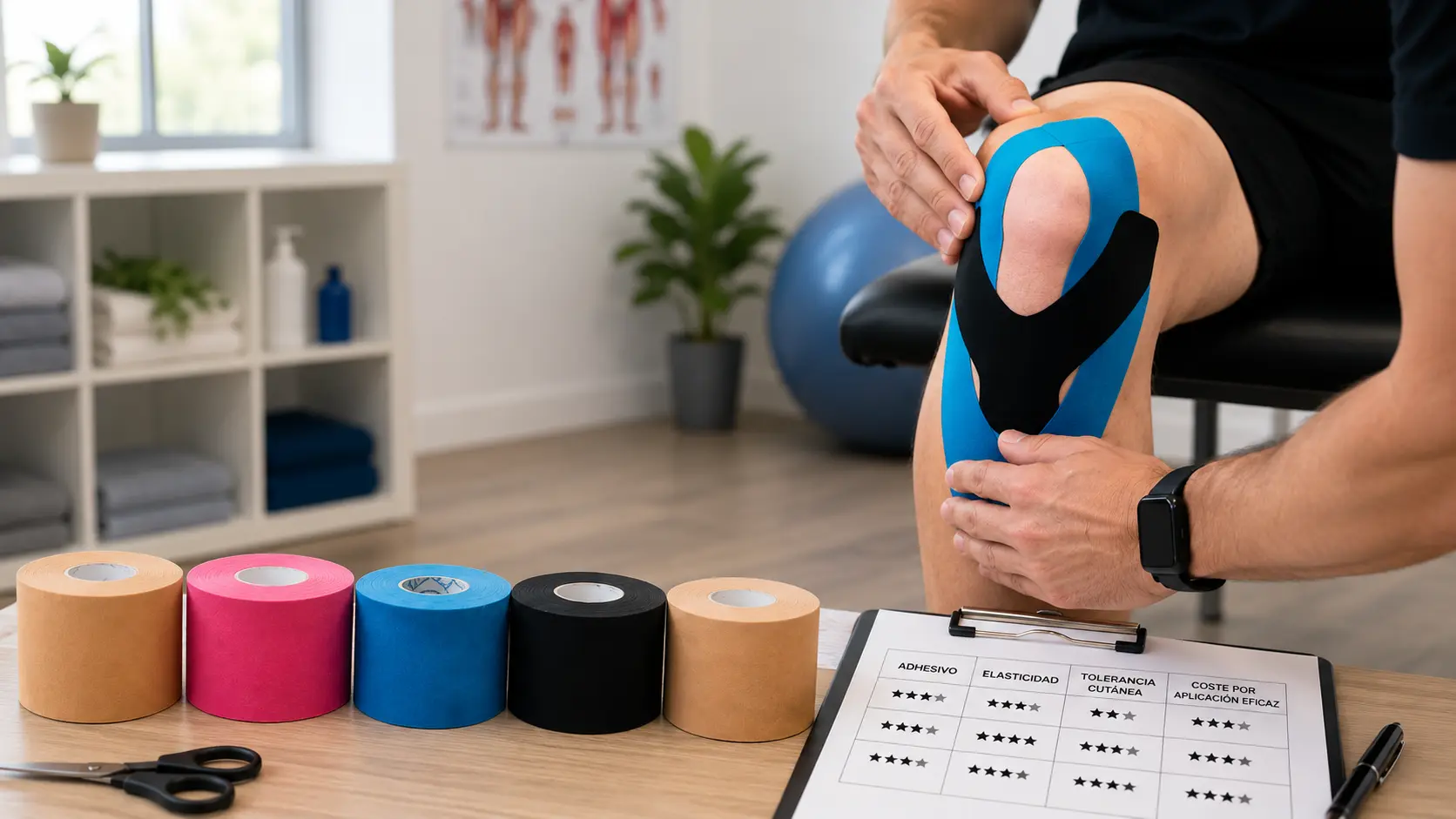
Kinesiology taping, also called kinesiology tape or kinesio tape, is an elastic strip applied to the skin to influence the sense of support, pain or movement, without restricting joint mobility the way a traditional rigid strapping tape would. It was developed by Kenzo Kase in the 1970s, and today it is a common sight in both rehabilitation and sport.
Ask whether it works and the answers range from "it changed my life" to "it is pure placebo". The evidence points to possible immediate or short-term effects in some conditions, but the overall certainty is very low and the clinical relevance is not stable. If it is used, it should be as a complement, and only for as long as it delivers an observable functional improvement. Here is what is known and what is not, without overstatement.
How is kinesiology taping supposed to work?
The most widely held hypotheses point to two pathways: a cutaneous and proprioceptive stimulus, and small mechanical changes at the surface of the skin.
Cutaneous and proprioceptive stimulation. The tape stays in constant contact with the skin, which could increase the sensory information reaching the nervous system. In theory, that extra input would help the body "place itself" better in space and regulate muscle tension or the perception of pain (Varela-Miranda et al., 2022).
Superficial mechanical changes. Some applications produce small visible folds in the skin once the taped part returns from a lengthened position. These are commonly called convolutions. Claims that they improve local circulation or reduce pressure on the pain receptors beneath the skin remain proposed mechanisms rather than established effects.
In a clinical setting, it is best applied or prescribed by a physiotherapist or another qualified professional, particularly where there is an injury, persistent pain or an existing condition. On the direction of the taping (from origin to insertion or the other way round), it is worth being honest. It reflects a theoretical convention more than a well-supported rule. The idea that one direction facilitates a muscle while the other inhibits it comes from the original theory, but the studies that have measured it report conflicting results.
The existence of a proposed mechanism does not guarantee clinical effectiveness. A physiologically plausible process is not the same as a demonstrated therapeutic result.
What is kinesiology tape made of?
Conventional kinesiology tape ranges use a cotton or viscose backing with elastic fibres, which gives stretch along the length of the strip and virtually none across it, together with an acrylic adhesive that is activated by heat. That combination is what sets kinesiology tape apart from rigid strapping. It follows the joint as it moves instead of restricting it.
How much it stretches depends on the product, not on the category. Manufacturers do not express elasticity in the same way, since some publish the added elongation and others the final length, so figures from different brands are not comparable with one another. Check it on the data sheet for the specific product. How to read those figures, and the rest of the variables (fabric, adhesive, format and durability), is covered in our guide to choosing kinesiology tape.
Checks before applying:
- Clean, dry skin with no creams or oils
- Trim the hair if it is thick
- Avoid very reactive skin without testing a small area first
- Take care in areas of constant friction
- Choose a product the manufacturer declares to be hypoallergenic

What real benefits does kinesiology taping have?
The effects described are limited and short-lived, and they vary with the condition being treated (Muñoz López et al., 2016). Some benefit is most often described on three fronts.
Short-term pain relief. In some cases it can help reduce discomfort for hours or days and make movement easier during rehabilitation. It does not cure the injury, but it makes the process more bearable.
Better function and mobility in some cases. Some patients report a greater range of movement and better tolerance of it. Results vary. Some people notice a clear difference and others barely perceive a change, depending on the type and location of the injury and on individual factors.
Support and movement guidance. Some people describe a sense of support or greater confidence when they move. That experience can be useful during movement re-education, but on its own it does not demonstrate a specific effect of the tape.
These benefits are complementary. The tape never replaces the core treatment, which is based on exercise, progressive loading and professional assessment.
What is kinesiology taping used for in the clinic and in sport?
Kinesiology taping has a clear niche, which is when you want support without losing mobility.
Musculoskeletal pain and overload: a tight neck after hours at the computer, a loaded lower back at the end of a long day, a sore shoulder from repetitive training, or knee discomfort going up and down stairs. It may reduce pain temporarily in some presentations and make movement easier during active rehabilitation.
Proprioceptive support after sprains or mild instability: in some protocols it is used as a sensory cue after a sprain or where there is a sense of instability (Muñoz-Barrenechea et al., 2019). The effect varies and it does not replace rehabilitation or a stabilisation that has been indicated. Unlike traditional strapping, it generally allows substantially more movement.
Managing swelling and superficial bruising: fan-shaped techniques are used with the aim of supporting superficial oedema management. The evidence is scarce and of low quality, and comes mainly from particular postoperative or acute settings, so it does not establish a general benefit across every kind of swelling (Hörmann et al., 2020). The mainstay of treating swelling is still compression and specific bandaging, not the tape.
More specialised uses: in neurological rehabilitation, some professionals use it as an adjunct to facilitate movement patterns. These applications require specific training and individual clinical judgement.
If the aim is to immobilise or limit movement, kinesiology tape is not the right choice.

When should kinesiology tape not be applied?
Kinesiology tape tends to be well tolerated in most cases, but not on every skin and not in every situation. The product instructions are the primary source for adhesive and skin-related contraindications. The health situations below need clinical assessment because of the underlying condition, not because every tape carries the same universal list.
Situations in which it should NOT be applied:
- Open wounds, burns or broken skin: do not apply the tape over them. The adhesive can traumatise the area when it goes on or comes off, and every product must be used in line with its own instructions.
- Previous reactions to medical adhesives: if you have had contact dermatitis from sticking plasters, kinesiology tape can trigger a similar response.
- Confirmed or suspected deep vein thrombosis: do not apply the tape unless a doctor has advised it. Any local intervention needs to be assessed in the clinical context because of the risk associated with the clot.
- Active cancer in the area of application: do not apply the tape without prior assessment and coordination with the responsible medical team.
- Decompensated heart or kidney failure: any technique intended to encourage fluid return should be assessed beforehand by a healthcare professional.
Precautions that require professional assessment. Atopic skin, psoriasis or active eczema can flare up. Very fragile skin, common in older people and in those being treated with corticosteroids, is easily damaged when the adhesive is removed. On anticoagulants there may be a greater risk of bruising or bleeding when the tape comes off. In diabetes or where sensation is altered, the skin needs checking with particular care and the decision depends on the condition of the skin and on the vascular picture.
Adverse effects and what to do. The most frequent problem is skin irritation, meaning itching, redness or small blisters. The skin can also tear superficially if the tape is removed abruptly. If a reaction appears, remove the tape immediately and do not apply another strip on top. Watch how it develops over 24 to 48 hours and seek advice if the redness persists or blisters appear.
Which myths about kinesiology taping are worth questioning?
Three widely repeated ideas do not hold up: that the colour changes the effect, that a good application will reduce the swelling of any injury, and that the tape can replace rehabilitation.
Myth 1: "The colour changes the therapeutic effect." Colour has not been shown to change the therapeutic effect of kinesiology tape (Cavaleri et al., 2018), so choose it for preference or visibility. Where those attributions come from, and how to read the mechanical differences measured in the laboratory, we cover in the guide to kinesiology tape colours.
Myth 2: "If you apply it properly, it will always reduce swelling or correct posture." It helps to separate the subjective sense of relief from measurable structural change. The tape may reduce the perception of swelling, or give a sensory cue that encourages a more comfortable posture, but there is no evidence that it alters the structure of a tissue, repositions bones or objectively reduces deep swelling.
Myth 3: "It can replace exercise or rehabilitation." This is the most problematic one. Kinesiology taping does not strengthen muscles, restore lost ranges of movement or correct dysfunctional patterns. When it helps, it is usually because it makes load or movement easier to tolerate during rehabilitation. It is a facilitator, not a substitute.

What does the scientific evidence say about kinesiology taping?
After more than two decades of research, the verdict is neither a yes nor a no. Where effects do appear they are small and short-lived, and the overall certainty remains very low. One qualification about the quality of that literature is worth adding. A large 2026 overview of systematic reviews concludes that the evidence on clinical effects is very uncertain, and rated 78% of the reviews it appraised as critically low in methodological quality (Mo et al., 2026), so the conclusions should be read condition by condition rather than as a global verdict. The systematic reviews agree on a pattern. When kinesiology tape shows positive effects, these tend to be small and concentrated in the first few hours or days (Parreira et al., 2014). The most promising results are seen in musculoskeletal pain and joint mobility, especially where the tape is used alongside other interventions. Medium- and long-term effects are inconsistent or simply absent. More recent reviews hold to this reading, namely modest improvements in pain and function in the short term, always as a complement and not as a standalone intervention (Tran et al., 2023).
Three factors explain why the controversy persists:
- Methodological heterogeneity: studies vary enormously in the type of patients, the areas treated, the application techniques and the outcome measures, which makes comparing conclusions unreliable.
- Risk of bias: many trials have small samples, short follow-up periods or undeclared conflicts of interest.
- The placebo problem: it is almost impossible to "blind" the patient, because anyone wearing the tape knows they are wearing it, and expectations influence the perception of pain.
The practical recommendation for the clinic is to use kinesiology taping as a complementary tool where it makes function easier or improves tolerance of movement, and to drop it from the plan if you see no functional benefit after several applications.
How do you apply kinesiology tape step by step?
A safe application comes down to four stages: ruling out situations that call for assessment first, preparing the skin, applying the tape with the anchors under no tension, and removing it without damaging the skin.
Before you start. If you have severe pain, loss of strength, persistent tingling, marked swelling or a significant recent injury, make a healthcare assessment your priority before applying any tape. If you have sensitive skin or a history of adhesive allergies, test the tape on a small area of skin and wait 24 to 48 hours.
Preparing the skin. Clean and completely dry the area. The adhesive does not tolerate creams, oils or sweat residue. Trim the hair if it is thick, without shaving close. Round off the corners of the tape, because right angles peel away sooner. And avoid touching the adhesive with your fingers, handling the tape by the backing paper or by the ends.
Application. Application schools and product manuals differ, so the measurements below reflect what is commonly taught rather than a standard of the category, and they have to be reconciled with the product instructions and the technique you were trained in. The first and last 3 to 5 centimetres are applied without stretching. These are the anchors and they should lie completely relaxed on the skin. Tension is applied only to the middle of the strip, and how much depends on the application method you follow. The percentages in circulation (of the order of 15% to 50%) come from particular schools and manuals rather than being a rule of the category, so stay with the one you were taught and with the product instructions. Rub afterwards with moderate pressure for 5 to 10 seconds, because the friction generates the heat that activates the acrylic adhesive. Check that no wrinkles are left pinching the skin, and avoid complete circular applications, which compromise circulation. In areas that crease, such as the elbow, the armpit or the back of the knee, reduce the tension.
Everyday use and removal. You can shower as normal, then pat the tape dry gently with a towel, without rubbing it or using a hairdryer on a high setting. It usually stays on for 3 to 5 days, varying with the area, the skin type and your activity. It is time to remove it if there is persistent itching, peeling edges that rub, a visible loss of elasticity or any skin reaction. The best moment is during a shower, because warm water and soap soften the adhesive; if you do it dry, apply oil and leave it to work for a minute. Peel slowly and parallel to the skin, never pulling upwards, holding the adjacent skin with your other hand. Moisturise the area afterwards and wait 24 to 48 hours before reapplying if there is mild redness.
Cutting techniques. Clinics use different cuts depending on the therapeutic aim, the type of injury and the area:
- I-strip: simple applications for support or guidance in one direction.
- Y-strip: common for "following" a muscle belly or surrounding an area without covering it completely.
- X-strip: useful when you want to spread the stimulus around a central point.
- Fan cut: common for swelling or superficial bruising, aimed at helping drainage.
- Mesh cut: used in certain specific applications depending on the case and on clinical judgement.
Tailor every application. If you want an optimal placement in terms of tension, direction and skin response, it is best carried out by a professional.

Which kinesiology tape should you buy?
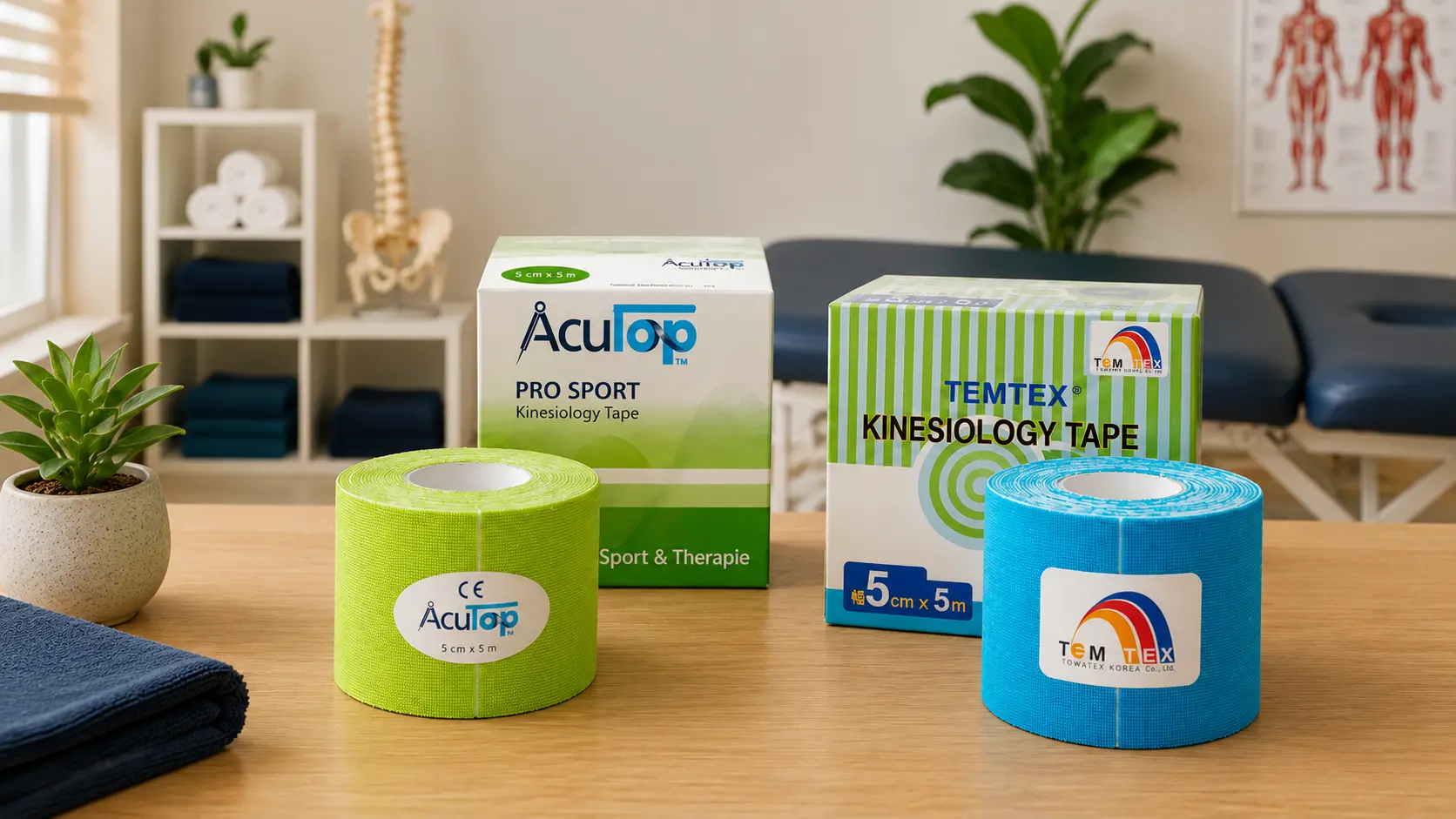
Products are not interchangeable, and what is worth comparing is verifiable: composition, type of adhesive, instructions for use, traceability of the manufacturer, the durability it advertises and the widths available. At Kinemarket you will find kinesiology tapes in cotton and in viscose, in standard rolls and in long formats. To decide by criteria (fabric, adhesive, elasticity, format and durability) there is our guide to choosing kinesiology tape, and if you are weighing up the two brands seen most often in clinic, our comparison of AcuTop and Temtex measures them against each other.

Frequently asked questions about kinesiology taping
Does kinesiology taping work, or is it placebo?
The answer is not absolute. Possible small, short-term effects on pain or mobility have been observed, but the certainty is very low and their clinical relevance is unclear. Blinding is difficult, so the specific effect cannot be fully separated from that of expectation and context. That does not justify presenting it as a main treatment. The sensible approach is to use it when it improves function or tolerance of movement.
Can kinesiology tape be applied over a tattoo or very dark skin?
A fully healed tattoo and skin tone are not, on their own, contraindications. What matters is the condition of the skin. Do not apply the tape over a recent tattoo, irritation, a wound or any skin disorder, and check how the adhesive is tolerated.
Sources and references
- Parreira PDC, Costa LCM, Hespanhol LC, Lopes AD, Costa LOP (2014). Current evidence does not support the use of Kinesio Taping in clinical practice: a systematic review. Journal of Physiotherapy, 60(1), 31-39.
- Tran L, Makram AM, Makram OM, Elfaituri MK, Morsy S, Ghozy S, et al. (2023). Efficacy of Kinesio Taping Compared to Other Treatment Modalities in Musculoskeletal Disorders: A Systematic Review and Meta-Analysis. Research in Sports Medicine.
- Muñoz López R, et al. (2016). Kinesiotaping. Evidencia actual. Revista de la Sociedad Andaluza de Traumatología y Ortopedia, 33, 23-29.
- Varela-Miranda M, Justo-Cousiño LA, González-González Y, Alonso-Calvete A (2022). Efecto del vendaje neuromuscular sobre la propiocepción y el control postural. Revisión sistemática. Archivos de Neurociencias.
- Muñoz-Barrenechea IA, Garrido-Beroíza MA, Achiardi O, Serón P, Marzuca-Nassr GN (2019). Revisión sistemática de la efectividad funcional del vendaje neuromuscular en sujetos con inestabilidad de tobillo. Medwave.
- Hörmann J, Vach W, Jakob M, Seghers S, Saxer F (2020). Kinesiotaping for postoperative oedema: what is the evidence? A systematic review. BMC Sports Science, Medicine and Rehabilitation.
- Mo Q, Deng Z, Zheng J, Wu T, Hu F, Xu S, Zou J, Zheng X (2026). Effectiveness and clinical relevance of kinesio taping in musculoskeletal disorders: an overview of systematic reviews and evidence mapping. BMJ Evidence-Based Medicine. An overview of 128 systematic reviews (73 published and 55 registered but not yet published), covering 310 trials and 15,812 participants: 78% of the reviews appraised proved to be of critically low methodological quality, and the authors conclude that the evidence on clinical effects is very uncertain, with unclear clinical relevance.
- Cavaleri R, Thapa T, Beckenkamp PR, Chipchase L (2018). The influence of kinesiology tape colour on performance and corticomotor activity in healthy adults: a randomised crossover controlled trial. BMC Sports Science, Medicine and Rehabilitation.