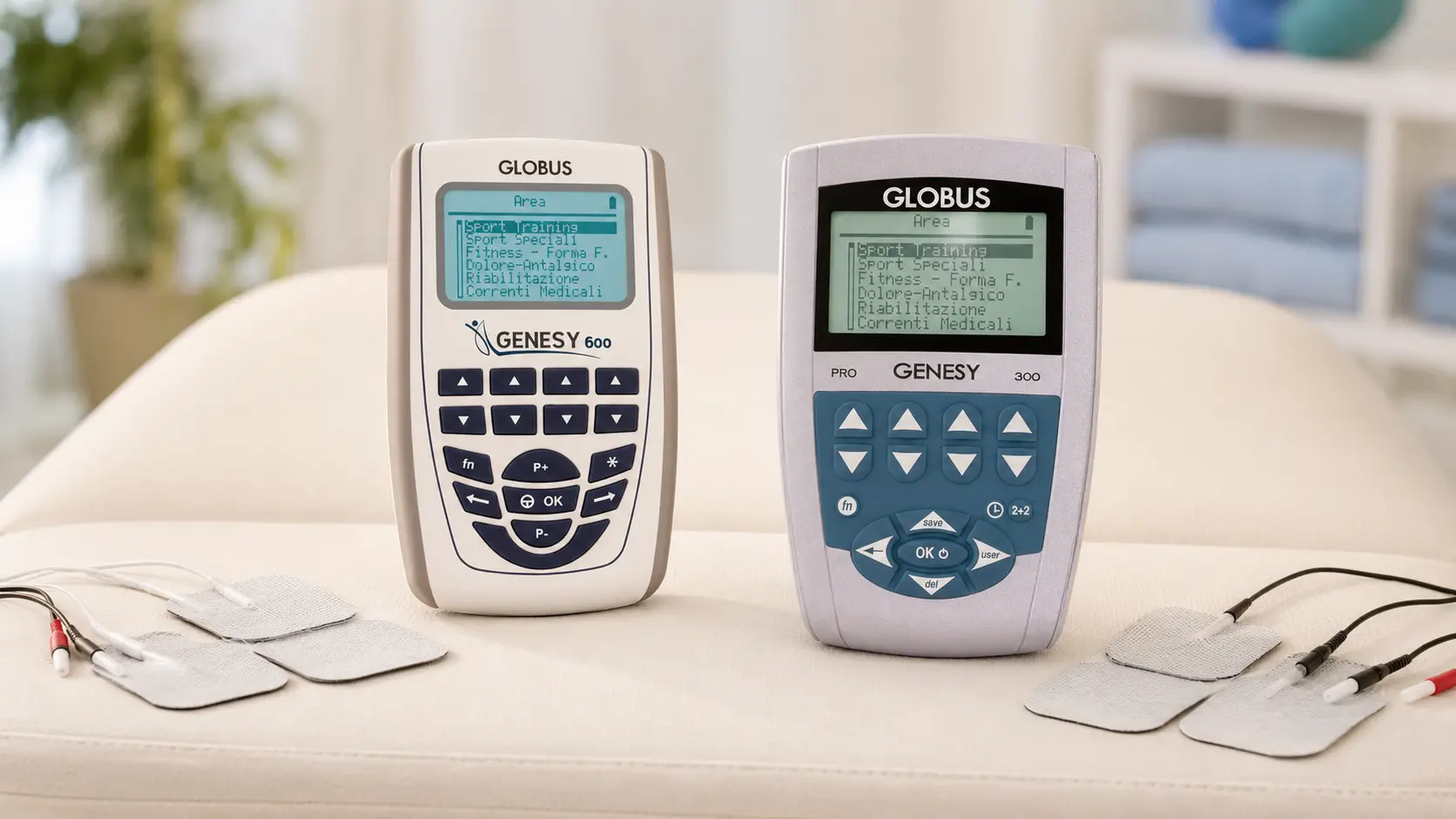
The Globus Genesy 600 and the Globus Genesy 300 Pro are four-channel professional stimulators with the same dimensions and the same published electrical specifications. The one documented difference of substance is the programme catalogue. The Genesy 600 carries 149 programmes and the Genesy 300 Pro 91, according to the manufacturer's official technical data sheets.
If you are weighing the two up while equipping your practice, here is exactly where those 58 extra programmes sit and which kinds of practice they pay off for.
Quick verdict
The Genesy 600 adds 58 programmes over the 300 Pro, and they fall into five blocks only: sport, rehabilitation, denervated muscle, and the two 3S and Action Now features. The published data sheets give both units the same programme counts in the pain, microcurrent, fitness, incontinence and iontophoresis categories.
- Choose the Genesy 600 if you need the programmes the manufacturer intends for denervated muscle, a wider sport catalogue, the 3S sequences, the Action Now feature or the five additional rehabilitation programmes. Those are the five blocks where the 300 Pro either falls short or lists nothing at all.
- Choose the Genesy 300 Pro if your work is concentrated in pain relief, microcurrent, iontophoresis and incontinence. The two data sheets give identical counts across those four categories, so the extra outlay on the 600 buys no additional programmes there.
Two notes before we start. Kinemarket sells both models, and this is a desk-based comparison of specifications and catalogue prices, built from Globus's official technical data sheets and the product data sheets. It is not a clinical trial or a performance test of our own. And CE marking means the product has been through the conformity assessment procedure that applies to it and meets the corresponding legal requirements. It is not a comparative certification and it does not demonstrate that one model produces better clinical results than the other.
At a glance
| Criterion | Genesy 300 Pro | Genesy 600 |
|---|---|---|
| Channels | 4 independent (8 electrodes) | 4 independent (8 electrodes) |
| Programmes | 91 | 149 |
| Frequency | 0.3 to 150 Hz | 0.3 to 150 Hz |
| Pulse width | 40 to 450 µs | 40 to 450 µs |
| Intensity | 0 to 120 mA per channel | 0 to 120 mA per channel |
| Preset programmes for denervated muscle | Not listed | 3: triangular, trapezoidal and rectangular |
| Features the Genesy 600 lists and the 300 Pro does not | None | 3S Serial Sequential Stimulation (12) and Action Now (7) |
| Sport programmes | 22 | 53 |
| Rehabilitation programmes | 6 | 11 |
| Pain, microcurrent, fitness, incontinence, iontophoresis | 20 / 12 / 29 / 1 / 1 | 20 / 12 / 29 / 1 / 1 |
| Display and format | 2.6″ · 100 × 160 × 35 mm · 440 g | 2.6″ · 100 × 160 × 35 mm · 450 g |
| Class stated on the distribution data sheet | IIa | IIa |
| Indicative price* | ~€399 | ~€599 |
*Indicative prices from Kinemarket's Spain/EU catalogue, checked on 6 August 2026, shown in euros with Spanish VAT included; tax treatment and delivery costs vary by destination. The catalogue and promotions change, and depending on the season either model may be on special offer.
What do the two Genesy units share?
The Genesy 600 and the Genesy 300 Pro share their channels, frequency, pulse width, intensity, display size and dimensions, with identical figures on both technical data sheets. The legal manufacturer of both units is Domino S.r.l. (Codognè, Veneto), which appears at the foot of each sheet; Globus is the brand. The standard equipment matches as well: a bag, four electrode cables, two cables for microcurrent and iontophoresis, four square electrodes, four rectangular ones, a charger and a manual.
The main operating features are common to both units too. Both data sheets list Multi User, Programmable, Stim Lock, Last 10, Favorites, Syncro Stim, My Trainer, Auto Stim, Work Time and 2+2 working, which runs two different programmes over two treatment areas at once. Using it on two patients at the same time also depends on what the model's manual permits and on your practice's hygiene protocol.
Where does the 58-programme difference sit?
The Genesy 600's 58 additional programmes fall into five blocks. There are 31 in sport, 12 in 3S sequential stimulation, 7 in Action Now, 5 in rehabilitation and 3 for denervated muscle. Outside those blocks, the category counts are identical.
Sport (22 against 53). This is the block that grows most and it accounts for more than half the gap. Both models carry the usual core (capillarisation, warm-up, active and post-competition recovery, maximum strength, strength endurance and explosive strength, reactivity, hypertrophy), and the Genesy 600 assigns 31 more programmes to the category. The data sheet does not print the full list of 53, so compare by category rather than programme by programme.
Denervated muscle (0 against 3). This is the substantive clinical difference. The Genesy 600 carries triangular, trapezoidal and rectangular currents, which the manufacturer associates with low, medium and high levels of denervation respectively. The 300 Pro does not list them. If you need those three programmes, the Genesy 600 is the only one of the two that offers them.
3S sequential stimulation (0 against 12). The 3S programmes delay the activation of channels 3 and 4 relative to channels 1 and 2. According to the data sheet, this allows muscle to be stimulated along a kinetic chain by activating the different groups at separate moments.
Action Now (0 against 7). Seven parameter combinations intended to pair and synchronise electrical stimulation with a voluntary action by the patient. The wording repays careful reading. The data sheet describes synchronisation with a voluntary movement, not triggering from the patient's own muscle signal. Neither data sheet mentions EMG biofeedback.
Rehabilitation (6 against 11). The data sheet assigns five more programmes to the Genesy 600. They include upper and lower limb hemiplegia, ankle and leg rehabilitation, and muscle spasm. That published list also carries several labels that cannot be reconciled unambiguously with the stated subtotal of 11, so again, keep the comparison at category level.
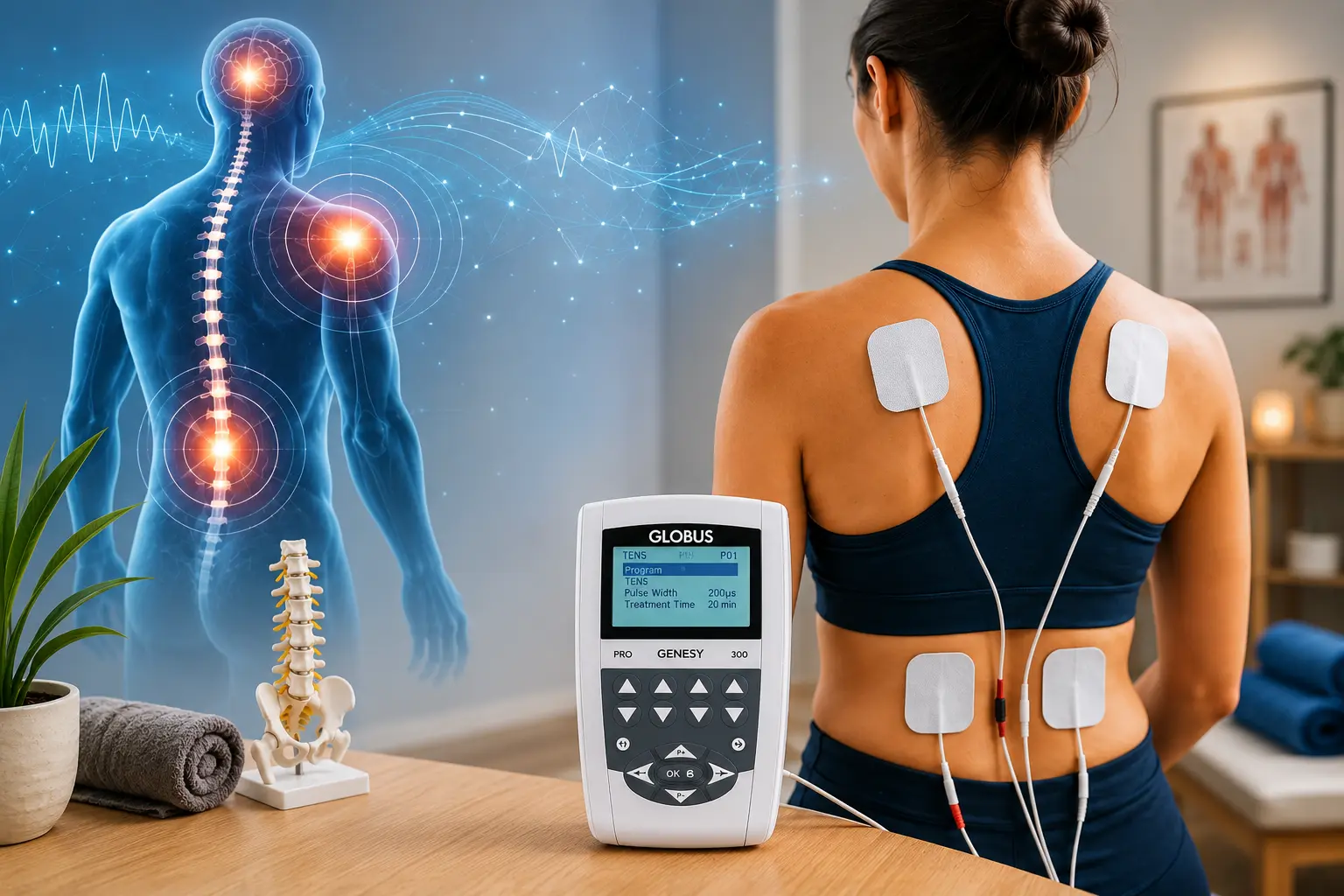
The pain and microcurrent blocks deserve a separate mention, because the published counts match on both models. Both data sheets list the same 20 pain programmes, including the four modes of TENS for pain relief (conventional, modulated, low frequency and endorphinic), and the same 12 microcurrent programmes. Iontophoresis and incontinence run to one programme each on both models.

The 58 programmes the Genesy 600 adds, top to bottom: sport (+31), 3S sequential stimulation (+12), Action Now (+7), rehabilitation (+5) and denervated muscle (+3).
How do you choose between the Genesy 600 and the Genesy 300 Pro?
Four checks settle it, and none of them turns on the total number of programmes.
- Do you treat denervated muscle? If so, the Genesy 600 is the only one of the two that lists those programmes, and that requirement rules the 300 Pro out within this comparison. If not, you have just eliminated the Genesy 600's strongest argument.
- Do you need the wider sport catalogue, the 3S sequences, Action Now or the additional rehabilitation programmes? If one of them answers a real need in your practice, that is the concrete reason to consider the 600. If none does and the 300 Pro's programmes cover what you actually do, including general muscle stimulation work, the 300 Pro is the more economical of the two.
- How much of your diary is pain relief? If most of your sessions involve pain, microcurrent or iontophoresis, you get the same counts on both data sheets. The 300 Pro then covers the same ground at a lower price, and the difference can fund other things in the practice.
- Do you want headroom for work you do not do yet? If your current needs are fully covered by the 300 Pro, the 600 can still be justified by that functional headroom, provided you genuinely expect to use its extra blocks. This is a practice-planning decision, not an argument about clinical effectiveness.
Two more checks apply to any stimulator. The distribution data sheets state Class IIa for both units, a class that does not appear in the official technical data sheets we reviewed. Where the EU conformity assessment procedure requires notified-body involvement, the body's identification number accompanies the CE mark.
Qualifying legacy Class IIa devices may also continue to be placed on the EU market until 31 December 2028, subject to the conditions in article 120 of Regulation (EU) 2017/745. For the unit you are sent, check the declaration of conformity, the applicable certificate and the labelling to establish which regime applies, and confirm that the accompanying information is supplied in the official language or languages required by the member state where the device is made available.
Kinemarket stocks both models, the Globus Genesy 300 Pro and the Globus Genesy 600. Both data sheets list self-adhesive electrodes in the same formats, and whether a replacement fits depends on the connector type and the unit's specifications. Compatible consumables are available, such as disposable TENS electrodes with cables, and the rest of the range sits under electrotherapy equipment. Build the expected cost of consumables into your comparison, particularly if you anticipate heavy use.

If you have not settled on a brand yet, the Globus and NeuroTrac comparison takes the decision one step further back, and our article on types of electrotherapy and their uses runs through which current does what.
Frequently asked questions
How many channels does the Globus Genesy 300 Pro have?
Four independent channels and 8 electrodes, the same as the Genesy 600. The manufacturer's official technical data sheet heads it as a 4-channel electrotherapy unit and sets it out in the specifications. The point is worth making, because the lower price suggests a 2-channel device.
Is the Genesy 600 worth the price difference?
It comes down to one thing. Will you use at least one of the five blocks the 600 adds, namely denervated muscle, the wider sport catalogue, the 3S sequences, Action Now and the five extra rehabilitation programmes? If a single one of them matches your practice, the extra outlay buys something specific. If none does, you are paying for programmes you do not expect to use.
Do the Genesy 600 or the 300 Pro offer EMG biofeedback?
Not according to their technical data sheets. The 600's Action Now feature synchronises stimulation with a voluntary action by the patient, which is not stimulation triggered by the muscle's EMG signal. If you need EMG biofeedback, the search does not end with these two models.
Do the same electrodes and accessories fit both Genesy units?
The data sheets describe the same standard equipment, with four electrode cables and two for microcurrent and iontophoresis, and self-adhesive electrodes in square and rectangular formats. Kinemarket's product pages list those as 50 × 50 mm and 50 × 90 mm. Before reusing accessories or ordering replacements, confirm the connector type and the unit's specifications.
Does CE marking mean the Genesy 600 is a better unit than the 300 Pro?
No. CE marking does not compare the two models and it does not demonstrate that either produces better clinical results. To verify conformity for a specific unit, check its declaration of conformity and, where applicable, the notified body certificate.
Sources
- Globus Corporation, the brand's official site: official Genesy 300 Pro page and official Genesy 600 page. Checked in August 2026.
- Official technical data sheets in PDF from Domino S.r.l. (manufacturer of the Globus range): Genesy 300 Pro (4 channels, 91 programmes, breakdown by area and programme list) and Genesy 600 (4 channels, 149 programmes, breakdown by area, description of 3S and Action Now). Revision En_05_2022; the channels, electrical specifications, per-block counts and standard equipment all come from these.
- Regulation (EU) 2017/745 on medical devices, consolidated text on EUR-Lex, version of 1 January 2026, article 10(11) (information accompanying the device in the official language or languages determined by the member state), article 19 (EU declaration of conformity), article 20(5) (the notified body's identification number follows the CE marking where applicable) and article 120, which sets 31 December 2028 as the end of the transitional arrangements applying to Class IIa devices.
- Distribution product data sheets for both models, checked on 6 August 2026, for the warranty and catalogue prices. The Class IIa designation comes from those distribution sheets and does not appear in the official May 2022 technical data sheets reviewed for this comparison, so it is cited as distribution information rather than as manufacturer confirmation. Where the official technical data sheet and the distribution documentation disagree on a figure, the former prevails.