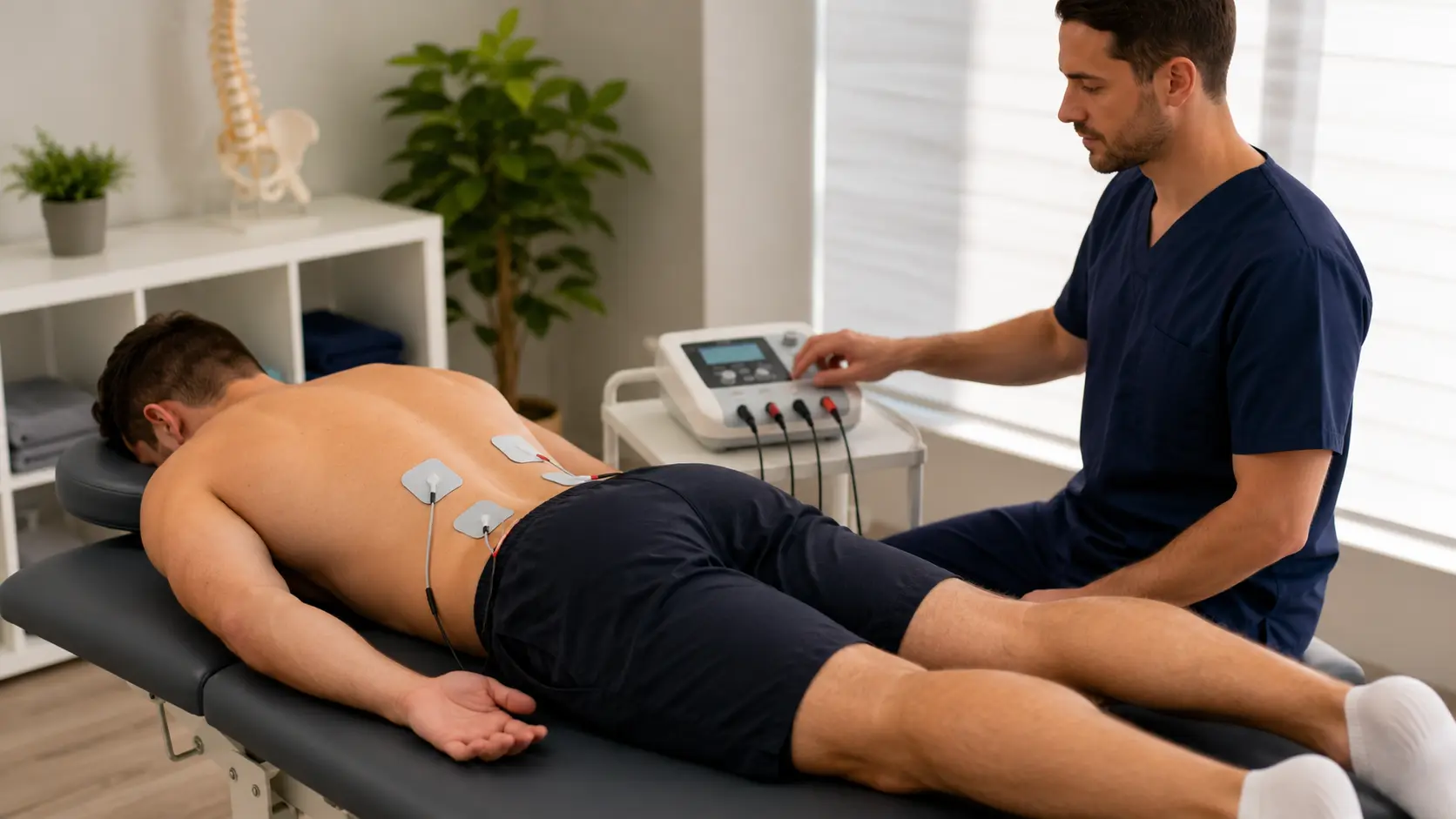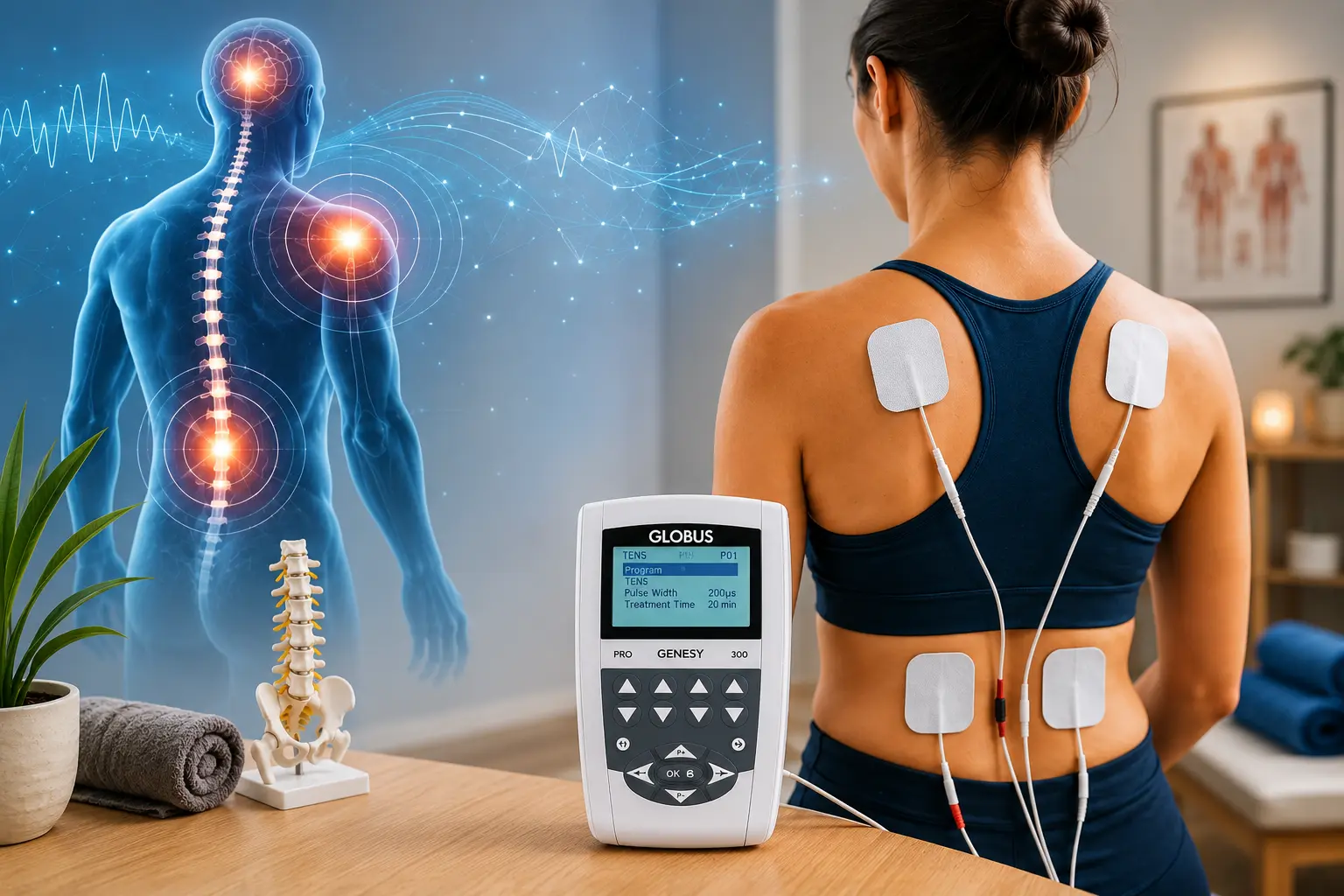
Electrical muscle stimulation (EMS) applies electrical impulses through the skin to produce an involuntary muscle contraction. It is not a shortcut. In healthy adults, with training volume matched, a meta-analysis of nineteen studies found no statistically significant difference in strength gains compared with conventional training (Happ and Behringer, 2022). An absence of a significant difference is not the same as demonstrated equivalence, so that result does not make EMS a universal replacement for voluntary exercise. It is useful for activating inhibited muscles and for complementing strength work when loading is limited, and combined units may also include TENS programmes for modulating pain.
We sell electrical stimulation equipment and consumables, so it is worth saying so at the outset. This guide summarises what the published reviews and consensus documents say, not our own testing and not individual clinical advice. Where the evidence is weak or limited to one population, we say so.
What is electrical muscle stimulation, and how does it work?
The current from the stimulator mimics the signals your nervous system sends to the muscles. As it crosses the skin it depolarises the motor nerves that innervate the muscle and produces a contraction. Not because the brain has ordered it, but because an external signal has activated that pathway from outside.
Being clear about what it is not matters just as much:
- It does not replace active movement. EMS produces a contraction, but it is no substitute for voluntary training or motor-control work, and it does not train technique or coordination either.
- It is not a complete rehabilitation plan on its own. It can form part of a rehabilitation plan, always under professional judgement, where there is a condition to treat.
- It is neither "electric shock" nor cosmetic magic. The currents are designed for a controlled contraction, not for painful jolts or for burning off fat without effort.
Depending on the goal, electrical stimulation is used in different settings: rehabilitation (rebuilding strength after an injury), pain control (TENS rather than classic EMS), sport (potentiation or recovery) and aesthetics, where the muscle stimulus on its own tends to produce limited cosmetic change.
In a motor EMS programme you are looking for a clear, palpable and tolerable contraction throughout the whole session. If there is only a tingle, check whether the programme you have selected is genuinely a motor one or whether you are in a TENS mode. The signal is not infallible, because some low-frequency TENS modes, and TENS applied at motor intensity, produce light contractions on purpose.
TENS, EMS or FES? Which modality to choose for your goal
Each form of electrotherapy is designed for a different purpose. TENS for pain, EMS for the muscle, FES for restoring a specific function. Knowing them apart stops you buying the wrong equipment or selecting the wrong programme.
TENS: transcutaneous electrical nerve stimulation, aimed at pain relief. Its modes, parameters, electrode placement and safe use are covered in our guide to TENS for pain relief.
EMS/NMES: the muscle is the target. The current depolarises the motor nerves to generate mechanical work. Applications: restoring tone after immobilisation, countering atrophy, building strength as a complement to training, and pelvic-floor re-education. Some programmes include analgesic phases, although that is not the main purpose of the equipment.
FES: function in clinical settings. Functional electrical stimulation synchronises the contraction with a specific task, for example lifting the toes during walking, helping the hand to open, or assisting pedalling. It is used mainly in neurological rehabilitation, on a specific indication and after professional assessment.
The golden rule: diagnosis and goal first, device second. Many machines combine modes, but that does not mean they are equally good for everything. Each programme has different parameters because it is chasing a different effect.
When should you avoid electrical stimulation?
Check with a professional before you start if you have an electronic implant, you are pregnant, you have epilepsy, cardiovascular disease, an active oncological diagnosis, skin lesions where the electrodes would go, or altered sensation in the area. Contraindications also depend on the modality and on the device. A local patch device does not raise the same questions as a whole-body suit.
Local application with adhesive electrodes (patch TENS and EMS). We have not identified a recent consensus specific to local EMS equivalent to the whole-body document, so your main reference should be the device's instructions for use and the judgement of a professional who knows your case. Ask for advice before you start if any of the following applies to you:
- A pacemaker, an implantable cardioverter-defibrillator (ICD) or another electronic implant
- Pregnancy (avoid the abdomen and lower back in particular)
- Epilepsy or another neurological condition
- Relevant cardiovascular disease, venous thrombosis or circulatory disorders
- An active oncological diagnosis, or tumours in the area you want to treat
- Open wounds, burns, eczema or dermatitis where the electrodes would go
- Areas with altered sensation, where you would not feel that the current is too strong
On placement, do not position the electrodes so that the current crosses the chest, and avoid the front of the neck (the carotid sinus). If you have a cardiac condition or an electronic implant, check the manual and speak to a professional before using the device.
Common effects that are not a cause for alarm: mild redness may appear under the electrodes, which normally settles fairly quickly, along with delayed muscle soreness the next day, above all during the first few applications.
The serious risk: rhabdomyolysis. Excessive intensity can cause significant muscle damage that releases myoglobin into the bloodstream and may put the kidneys under strain. The review by Stöllberger and Finsterer (2019) gathered nine published cases after whole-body electrical stimulation and noted that they arose preferentially after the very first application. In Spain, a case was described of a trained 33-year-old woman who used a gluteal electrode garment for the first time while running on a treadmill for thirty minutes. Her creatine kinase peaked at 64,150 U/L and she made a full recovery (Guillén Astete et al., 2015). That was a local device rather than a whole-body suit, and its authors advise against using electrical stimulation during active exercise, because the two together can generate enough tension to damage muscle fibres even in a well-conditioned person. These are isolated cases and do not allow an incidence to be calculated, but they indicate fairly consistently where the risk sits, which is the first intense exposure in someone who is not accustomed to it.
Warning signs (stop and seek urgent advice): disproportionate pain, extreme weakness that does not improve, dark urine the colour of tea or cola.
A practical rule for a local device: start gently, progress session by session, and during the first sessions avoid combining an unfamiliar or high-intensity session with hard voluntary exercise of the same muscle unless the device instructions and your physiotherapist's protocol provide for it. The published local-device evidence is mainly isolated case reports, so treat this as prudence rather than a universal prohibition. Supervised whole-body EMS is a different setting, where light exercise during the stimulus is part of the method.
One note to avoid confusion. The whole-body consensus deals with commercial, non-medical use in healthy people, which is why it places neurological conditions among the absolute contraindications. Electrical stimulation applied within neurological rehabilitation, such as FES, is a different matter, prescribed and supervised by a healthcare professional.
What is EMS used for in rehabilitation?
EMS helps to activate the muscles when voluntary movement is still limited, which is one of its better-studied uses. After weeks immobilised by a fracture or surgery, atrophy sets in quickly, and the current makes it possible to generate a contraction before the patient can produce one unaided.
Cases where it adds clinical value:
- Atrophy from immobilisation: it lets you activate the fibres when voluntary movement is not yet possible.
- Post-surgical recovery: it "wakes up" muscles that pain or swelling has inhibited.
- Muscle re-education: it helps re-establish the neuromuscular connection where there is muscle inhibition or difficulty in recovering voluntary activation.
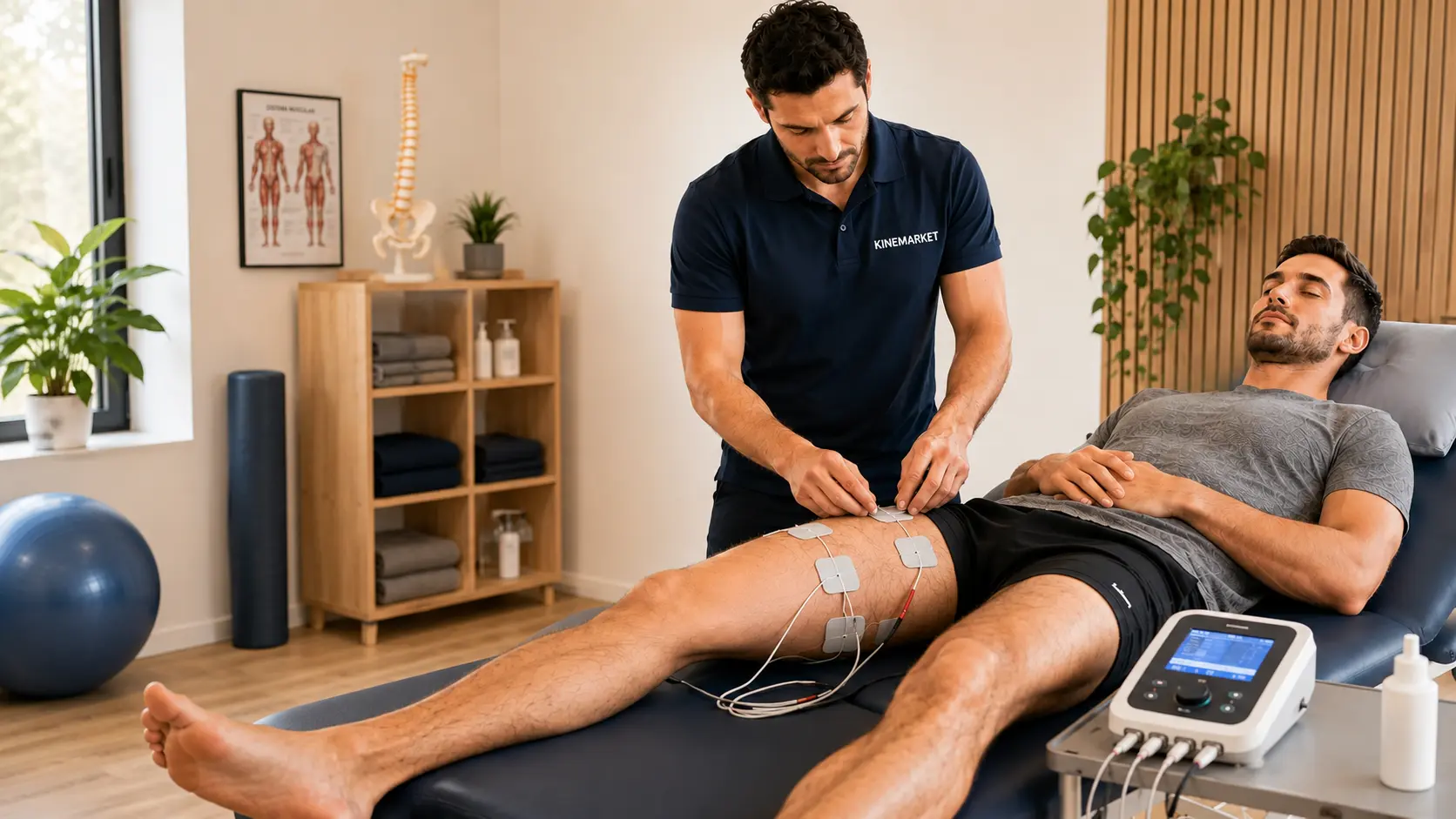
The knee is one of the best-studied settings, because the quadriceps is quickly inhibited after joint injuries and that perpetuates weakness and pain. The meta-analysis by Peng and colleagues (2021), which pooled nine randomised trials and 691 patients who had undergone total knee replacement, found improvements in quadriceps strength at every time point measured, along with effects on pain and function in the medium term. Its own authors ask for caution. In all nine trials the electrical stimulation was added to conventional rehabilitation and never replaced it, several outcomes did not reach the minimal clinically important difference, no benefit was seen for range of movement, and their stated conclusion is that the clinical benefit "remains to be confirmed".
The Spanish review by Castillo-Lozano (2015) on functional knee rehabilitation collected the parameters most often used, a symmetrical biphasic current, a frequency of around 40 Hz, a pulse width of 261 ± 132 microseconds and the highest intensity the patient can tolerate, with work and rest times varying widely between protocols. The author holds that combining electrical stimulation with supervised exercise is necessary for functional gains, and identifies poor application as a frequent cause of poor results. That is an expert observation within a narrative review rather than a tally of failures.
The practical reading is that EMS works as a complement to active work rather than a substitute for it. Sessions spent on the sofa, with no other stimulus, give limited results. If you are in rehabilitation, the supervision of a physiotherapist is key to adjusting parameters and progression, and if pain or swelling increases, review the placement and the intensity, and seek advice if it persists.
Does EMS work in sport?
EMS earns its place in sport when you cannot load as you did before, whether after an injury that limits your usual training, during a deload phase, or as an occasional complementary session. If your knee will not tolerate heavy squats but you need to keep the quadriceps active, this is where it comes in.
Realistic goals in a sporting context:
- Pre-training activation: some units include pre-activation programmes, although their usefulness depends on the protocol and they do not replace an active warm-up.
- Active recovery after effort: some programmes are used for recovery or for a sense of flushing out, although their effects depend on the protocol and on the individual response.
- Localised work: when you want an extra stimulus in a specific muscle without overloading joints that are already fatigued.
What you should not expect is a faster route. The authors of the meta-analysis cited at the start found no statistically significant difference between the two methods once volume was matched (Happ and Behringer, 2022). That result does not demonstrate equivalence, and it cannot be extended to other populations, goals or protocols. Our reading for a sporting context is narrower, because equal strength gains are not the whole picture. Electrical stimulation carries a different risk profile from voluntary exercise, so we treat it as a way to sustain the work when loading is limited rather than as a routine replacement for it.
Nor does it improve sporting technique, intermuscular coordination or specific movement patterns on its own. You can have a quadriceps that responds well to electrical stimulation and still fall short on the technical movement.
On periodisation, not every day and not at maximum intensity from the start. Begin at moderate intensities and gauge your tolerance before increasing them. The specific stimulation frequency and session length are set by the programme the manufacturer intends for the goal you are pursuing, or by your physiotherapist's guidance, rather than by a general rule. If you work with patients, document the individual response, meaning perceived fatigue, residual discomfort and functional progress, and adjust on that information.

Does EMS work for toning or losing weight?
EMS can increase muscle mass and strength, but it does not remove localised fat and it does not act on skin firmness. The meta-analysis by Kemmler and colleagues (2021) on whole-body electrical stimulation in non-athletic adults pooled sixteen studies and 897 participants, and found large, statistically significant effects on muscle mass and on leg and trunk strength. The effect on fat mass, by contrast, did not reach statistical significance.
The practical reading is straightforward. The contraction produced by the current generates a genuine mechanical stimulus and the muscle can adapt, while losing fat still depends on a sustained energy deficit. You can strengthen the rectus abdominis and still see no definition if the layer of fat stays in place. One caveat on scope matters here. That evidence comes from whole-body systems, which stimulate far more muscle mass per session than adhesive electrodes over a single area, so these whole-body results do not allow the effect of local electrodes on one area to be estimated, in either size or direction.
It may be worth considering where conventional loading is temporarily limited, though the body-composition evidence above comes from whole-body systems and does not quantify what local adhesive electrodes achieve. Visible changes are gradual and depend above all on what you do outside the sessions, so steer clear of promises of the "toned stomach in X sessions" kind.
Where do the electrodes go?
The position of the electrodes decides which fibres receive the current and how efficiently, and it is exactly where Castillo-Lozano places the most common errors of day-to-day practice. Three rules prevent most of them:
Rule 1: clean, dry skin. The adhesive needs direct contact. Creams, oils or sweat create a barrier that reduces conduction. If there is a lot of hair, trim it rather than shave it closely, to avoid irritation.
Rule 2: placement to match the goal. Aim for the belly of the muscle or its ends, depending on the programme, and try to sit one electrode over the motor point. Do not place the electrodes directly over wounds.
Rule 3: symmetry and full contact. An electrode lifting at its corners concentrates the current in a small area, which causes discomfort. Press the whole surface down and check that the edges stay stuck.
Common mistakes:
- Worn electrodes: they lose adhesion and conductivity. Replace them when they no longer stick well.
- Cream or oil before applying: the adhesive does not tolerate greasy residue.
- Turning the intensity up to "compensate" for poor placement: it creates discomfort without improving the result.
- Electrodes that are too small, or too close together, for the muscle you are trying to activate.
If you work in a clinic, document the placement and the parameters of each session. Reproducibility allows you to compare responses and adjust progression objectively.

What is a first session of electrical stimulation like?
A first session at home comes down to six steps: check the contraindications, set the goal, prepare the skin, place the electrodes, raise the intensity from zero to the right sensation, and look at the skin afterwards.
- Check, and set the goal. Go back over the list of contraindications in this article. If any of them applies to you, do not continue without a professional assessment. Then select a motor programme that matches the goal you are after, whether that is activating, strengthening or supporting the recovery of a muscle.
- Prepare the skin and the kit. Clean the area with soap and water and dry it, remove creams, oils or sweat residue, and check that the adhesive gel is in good condition with no edges peeling.
- Place the electrodes over the belly of the muscle or at its ends, according to the programme and the device manual, and press the whole surface down until the edges stay stuck.
- Raise the intensity from zero. You are looking for a visible contraction that is tolerable throughout the session. If you feel jabbing or burning, stop the application and remove the electrodes. Check the skin, the contact, the placement and the device instructions before using it again.
- Respect the duration of the programme. That duration is set by the programme you have selected, and many devices fix it at the factory. If the programme does not set it and the manual offers no guidance, do not improvise. Check the device instructions or ask a professional. When you finish, switch the device off, remove the electrodes carefully and store them with their protective plastic.
- Look at the skin afterwards. Clean the area gently and do not apply irritant products to skin that is red or sore. Delayed soreness can appear, above all during the first few applications. What is not normal: disproportionate pain, extreme weakness, or intense redness that worsens, blisters or does not settle.
What should you do after an electrical stimulation session?
Watch how your body responds, look after the skin of the treated area, and do not increase the duration, the frequency or the intensity on your own to speed up results. Aftercare matters most in the first few sessions, which is when unexpected reactions appear.
How often to use it. For local EMS there is no universal schedule. Intensity, duration and the ratio of contraction to rest depend on the goal (post-surgical inhibition, preventing atrophy, strengthening, sport), on the muscle treated, on the device and on your tolerance. Follow the programme the manufacturer intends for that goal, or the guidance of the professional supervising the application.
Rest and recovery. An EMS session represents a muscular load, but how much recovery it needs depends on the programme and its intensity. After a local application, match what you do next to how you respond and to the device's instructions.
Looking after the skin. After removing the electrodes, clean the area gently to take off any gel residue and watch for redness or tenderness. These effects are usually mild and temporary, but if they persist, seek advice before the next session. If the treated area feels more sensitive than usual, leave longer before repeating.
If you have any doubts about the effect of the technique, muscle soreness or any unexpected reaction, speak to the specialist supervising your training or treatment.
What changes with whole-body electrical stimulation (WB-EMS)?
WB-EMS stimulates much of the musculature at once through a suit or vest, which is why its screening and its dosing are a good deal stricter than those of a patch device. It has a consensus of its own, and its figures do not transfer to a local device.
The German consensus revised in 2024 by von Stengel and colleagues deals exclusively with non-medical WB-EMS and expressly leaves out studies of local EMS. It classifies as absolute contraindications, among others, acute illness and infection, recent surgery in the area to be stimulated, stents or bypasses fitted within the last six months, untreated hypertension, pregnancy, electrical implants and pacemakers, arrhythmias, severe bleeding disorders, neurological disease and epilepsy. As relative contraindications, meaning situations that call for prior medical approval without ruling the technique out, it lists diabetes, tumours and cancer, kidney disease and cardiovascular disease, among others (von Stengel et al., 2024). Two changes in that revision are worth underlining. Diabetes and cancer both moved from absolute in 2019 to relative in 2024. If you fall into any of those groups, the decision belongs to your doctor.
The international consensus by Kemmler and colleagues (2023) adds the application guidance: screening documented in writing before the first session and reviewed at least every six months; a first session at moderate intensity, equivalent to a "4" on the Borg CR10 scale; one instructor per user in medical WB-EMS, with one instructor per two users the accepted limit in non-medical sessions; one session a week during the first 8 to 10 weeks, and at least four days of rest after each intense session; and a scheduled intake of 250 to 500 mL of fluid before and afterwards. These are evidence-based expert recommendations rather than rules with legal force in the UK, and they let you judge whether a centre applies basic safety measures. If nobody asks you any of this before putting you in a suit, question how professional the service is.
Vigilance does not end the following day either. Creatine kinase peaks at around 72 hours, so extreme muscle pain, marked weakness that does not improve with rest, or dark urine in the following 48 to 96 hours all call for urgent medical advice.

Which stimulator should you buy?
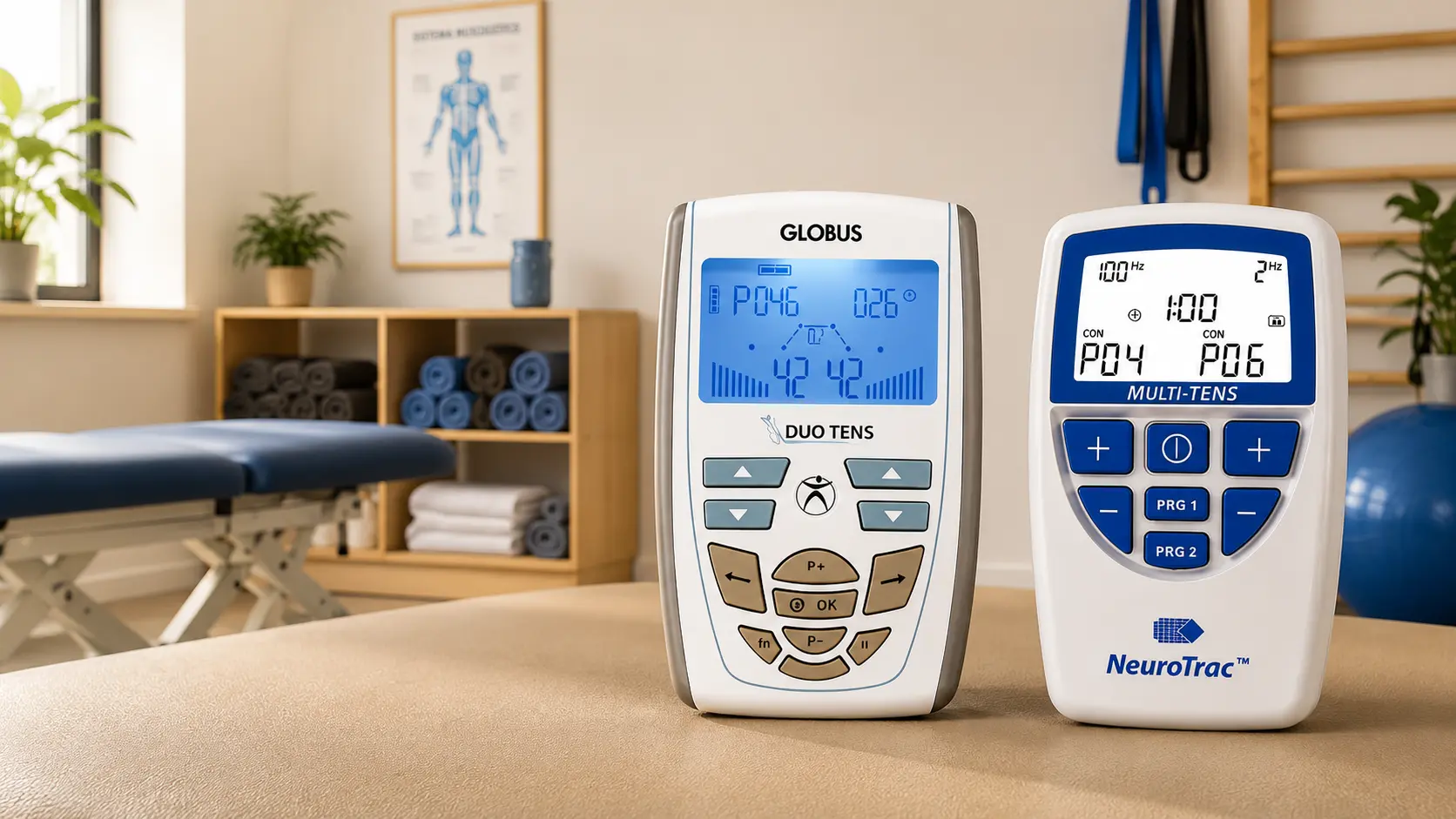
Choose by goal. A TENS mode if you are after pain relief, EMS or NMES if you want to activate or strengthen muscle, and more than two channels if you need to treat several areas at once. At Kinemarket you will find electrical stimulation equipment and spares, and what is worth checking before you buy, meaning the number of channels, conformity, manual control of the dose, consumables, technical support and the warranty, is applied to two real brands in our comparison of Globus and NeuroTrac. And if you are equipping a practice from scratch, that guide shows where this device sits against the rest of the investment.

Frequently asked questions about electrical stimulation
Does electrical stimulation hurt?
It should not. In a motor EMS programme, the sensation you are after is a rhythmic contraction, firm but tolerable. If you feel jabbing, burning or discomfort that makes you tense up, stop the application and check the intensity, the electrode placement, the condition of the skin and the device instructions. Pain is not a sign that it is working better.
How often can I use EMS?
For local EMS there is no single schedule, because it depends on the goal, the device and how well you tolerate it. Follow the manufacturer's programme for the goal you have set, or your physiotherapist's guidance, and do not lengthen or multiply the sessions on your own. Check the skin between applications. More sessions do not mean better results.
When do you see results with electrical stimulation?
Some effects are immediate, such as the sense of muscle activation after EMS or the temporary pain relief with TENS. Sustained changes can take several weeks and depend on the goal. What matters is the programme you choose, an intensity that is appropriate and tolerable in line with the manual, consistency, and combining it with active exercise where that is indicated. Without those supports, results tend to be limited.
Does electrical stimulation work for losing weight?
Not as a stand-alone strategy. Fat is lost through a sustained energy deficit, and no stimulator removes the layer of fat covering the muscle being worked. It can complement a plan that includes physical exercise and a suitable diet, but expecting weight loss from EMS sessions alone is not realistic.
Sources and references
Reviews, consensus documents and trials we drew on for this guide:
- Peng L, Wang K, Zeng Y, Wu Y, Si H, Shen B (2021). Effect of Neuromuscular Electrical Stimulation After Total Knee Arthroplasty: A Systematic Review and Meta-Analysis of Randomized Controlled Trials. Frontiers in Medicine, 8, 779019.
- Happ KA, Behringer M (2022). Neuromuscular Electrical Stimulation Training vs. Conventional Strength Training: A Systematic Review and Meta-Analysis of the Effect on Strength Development. Journal of Strength and Conditioning Research, 36(12), 3527-3540.
- Kemmler W, Shojaa M, Steele J, Berger J, Fröhlich M, Schoene D, von Stengel S, Kleinöder H, Kohl M (2021). Efficacy of Whole-Body Electromyostimulation (WB-EMS) on Body Composition and Muscle Strength in Non-athletic Adults. A Systematic Review and Meta-Analysis. Frontiers in Physiology, 12, 640657.
- Kemmler W, Fröhlich M, Ludwig O, Eifler C, von Stengel S, Willert S, Teschler M, Weissenfels A, Kleinöder H, Micke F, Wirtz N, Zinner C, Filipovic A, Wegener B, Berger J, Evangelista A, D'Ottavio S, Singh Sara JD, Lerman A, Perez de Arrilucea Le Floc'h UA, Carle-Calo A, Guitierrez A, Amaro-Gahete FJ (2023). Position statement and updated international guideline for safe and effective whole-body electromyostimulation training: the need for common sense in WB-EMS application. Frontiers in Physiology, 14, 1174103.
- von Stengel S, Fröhlich M, Ludwig O, Eifler C, Berger J, Kleinöder H, Micke F, Wegener B, Zinner C, Mooren FC, Teschler M, Filipovic A, Müller S, England K, Vatter J, Authenrieth S, Kohl M, Kemmler W (2024). Revised contraindications for the use of non-medical WB-electromyostimulation. Evidence-based German consensus recommendations. Frontiers in Sports and Active Living, 6, 1371723.
- Stöllberger C, Finsterer J (2019). Side effects of whole-body electro-myo-stimulation. Wiener Medizinische Wochenschrift, 169(7-8), 173-180.
- Castillo-Lozano R (2015). Eficacia de la estimulación eléctrica neuromuscular en la rehabilitación funcional de rodilla en soldados. Sanidad Militar, 71(4), 254-261.
- Guillén Astete CA, Zegarra Mondragón S, Medina Quiñones C (2015). Rabdomiólisis secundaria a la realización de actividad física y electroestimulación simultánea: reporte de un caso. Reumatología Clínica, 11(4), 262-263.