The 0 to 5 MRC (Oxford) scale grades a strength deficit, but there comes a point where it no longer tells one session from the next. A muscle dynamometer converts the force a muscle group exerts against the device into a number, in newtons, kilograms-force or pounds-force. At Kinemarket we distribute the microFET 2 hand-held dynamometer in two versions, with and without clinical software. This is a desk-based guide, drawn from the manufacturer's user guide, its product documentation and published studies; it is not a trial of our own. If you are equipping a physiotherapy clinic, we explain what this device measures, how to use it well and which of the two versions suits the way you work.
Quick verdict
The microFET 2 is the only dynamometer in our catalogue and is sold in two versions. The two differ only in the manufacturer's software package, which changes the format in which your results are recorded.
- Choose the version with clinical software if you will use the tracking and reporting features of the manufacturer's software.
- Choose the version without clinical software if you record values in your own clinical notes, measure occasionally and do not want to pay for a package you will not install.
At a glance: with or without software
The device, pads and carrying case are identical in both versions. What separates them is the manufacturer's software package, the need for a Windows computer and a price difference of €200. Software capabilities are as stated by the manufacturer; prices are from our catalogue.
| Criterion | microFET 2 with clinical software | microFET 2 without clinical software |
|---|---|---|
| Device and pads | Identical | Identical |
| Software package and dongle | Yes | No |
| Guided protocols, patient tracking and reports | Yes | No |
| Windows computer required | Yes | No |
| Indicative price* | €1,995 | €1,795 |
*Indicative prices from Kinemarket's Spain/EU catalogue, checked in September 2026, shown in euros with Spanish VAT included; tax treatment and delivery costs may vary by destination. Catalogue prices change, and either version may be on offer depending on the season.
What types of muscle dynamometer are there?
A grip dynamometer assesses hand grip, a hand-held dynamometer assesses muscle groups by push force, a fixed dynamometer anchors the measurement to a structure, and an isokinetic dynamometer controls the speed of movement.
Grip dynamometer. Measures hand grip strength and can be hydraulic or digital. A 12-week test-retest pilot study in patients with low back pain found that grip strength measured by dynamometry was reproducible in both hands (Dávila-Romero et al., 2016).
Hand-held dynamometer (HHD). Placed between the examiner's hand and the patient's limb, it measures the maximal isometric force of a muscle group. This is the category the microFET 2 belongs to.
Fixed or belt-stabilised. Uses a load cell anchored to a structure or secured with a strap. It reduces the influence of the examiner's own strength at the cost of some portability, and is usually reserved for assessments at a fixed testing station.
Isokinetic. Measures torque at a controlled angular velocity and is the reference standard against which hand-held dynamometers are validated.
Why use a dynamometer rather than manual muscle testing alone?
A manual grade describes weakness on an ordinal scale. Dynamometry turns it into a continuous, repeatable value that lets you compare sessions, set baselines and document change.
The ceiling of manual testing, in figures. A study of 107 inpatients assessed knee extension with manual muscle testing and with dynamometry. The sensitivity of manual muscle testing to side-to-side differences and to deficits relative to normal never exceeded 75%, and its diagnostic accuracy never exceeded 78% (Bohannon, 2005).
What the systematic review says about hand-held dynamometry. A review of 17 manuscripts covering 19 studies concludes that, compared with isokinetic dynamometry, it can be regarded as a reliable and valid instrument for assessing muscle strength in a clinical setting. The authors reach that conclusion taking into account its ease of use, portability, cost and compact size (Stark et al., 2011).
Where agreement is high. For the shoulder rotators, a meta-analysis of 13 studies found an intraclass correlation coefficient (ICC) of 0.94 for the internal rotators and 0.92 for the external rotators between hand-held and isokinetic dynamometers (Chamorro et al., 2021).
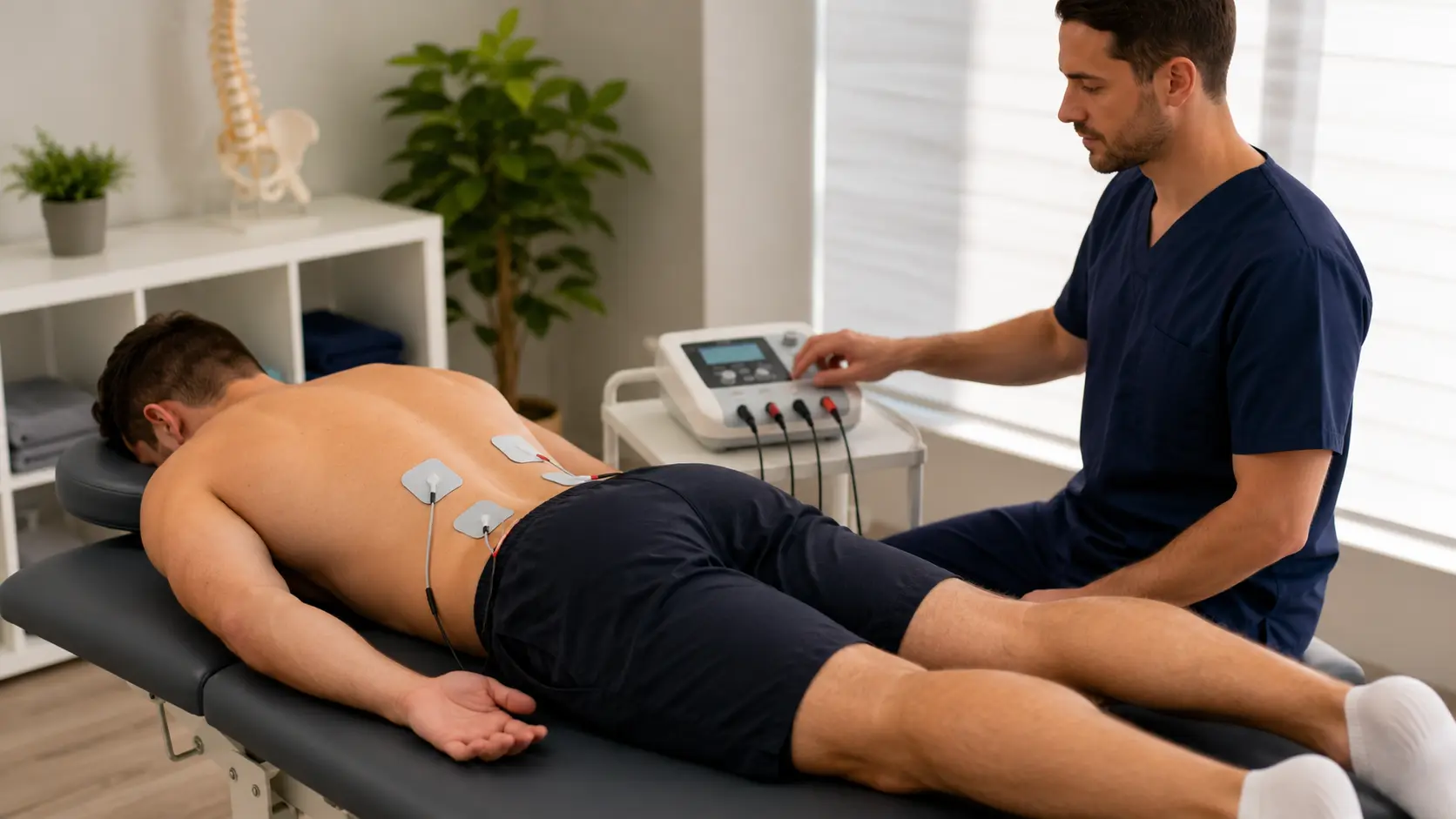
Evidence in children and adolescents. In 72 Chilean children and adolescents aged 7 to 15, hand-held dynamometry proved reliable, with inter-rater ICCs of 0.85 to 0.98 (Jorquera-Cáceres et al., 2024). A repeatable value is what lets you document changes in strength across a programme, including electrical muscle stimulation programmes.
How do you use a hand-held dynamometer?
A valid measurement depends on repeating the same protocol at every session. If the protocol changes, the recorded figure is no longer comparable and loses its clinical value.
Who can use it, and with what protocol?
User qualification. The user guide states that the device must be used by a physician or by medical personnel under the supervision of a physician, and that the user must have received sufficient training in clinical procedures. This is the manufacturer's wording in its instructions for use, not a determination under UK regulation. As a physiotherapist, check it against your own professional framework and against the documentation supplied with the unit you receive, including its conformity marking and declaration of conformity.
'Make' versus 'break' testing. The guide describes both. In a make test, the patient exerts the maximum force they can for a few seconds, over a slow count of 4. In a break test, the examiner overcomes the patient's resistance. The guide adds that the keys to a valid result are correct positioning of the patient and the device and a consistent testing method.
The manufacturer's consistency criterion. The user guide specifies that two consecutive efforts must differ by 10.0% or less for the measurement to count as valid, and by 15.0% or less for the intrinsic hand muscles. Beyond those margins, the manufacturer classes the measurement as equivocal or invalid.
When is the examiner the limiting factor?
The examiner's limit with strong muscle groups. Muscle groups stronger than the examiner are stabilised externally with a strap, and values from a hand-held dynamometer are not interchangeable with isokinetic values. The manufacturer offers a stabilising strap as an accessory, which is not part of our catalogue. A meta-analysis of 17 studies at the hip, knee and ankle, in which the microFET 2 is among the devices used in the pooled studies, found between-device ICCs ranging from 0.62 for ankle dorsiflexion to 0.94 for hip adduction. The hand-held dynamometer's limits of agreement were 33.59% for knee extension and 48.87% for plantar flexion, while the isokinetic dynamometer stayed below 15% for several movements (Chamorro et al., 2017). A study using a different belt-stabilised hand-held dynamometer found that its values did not agree with isokinetic values despite correlating with them (Martins et al., 2017).
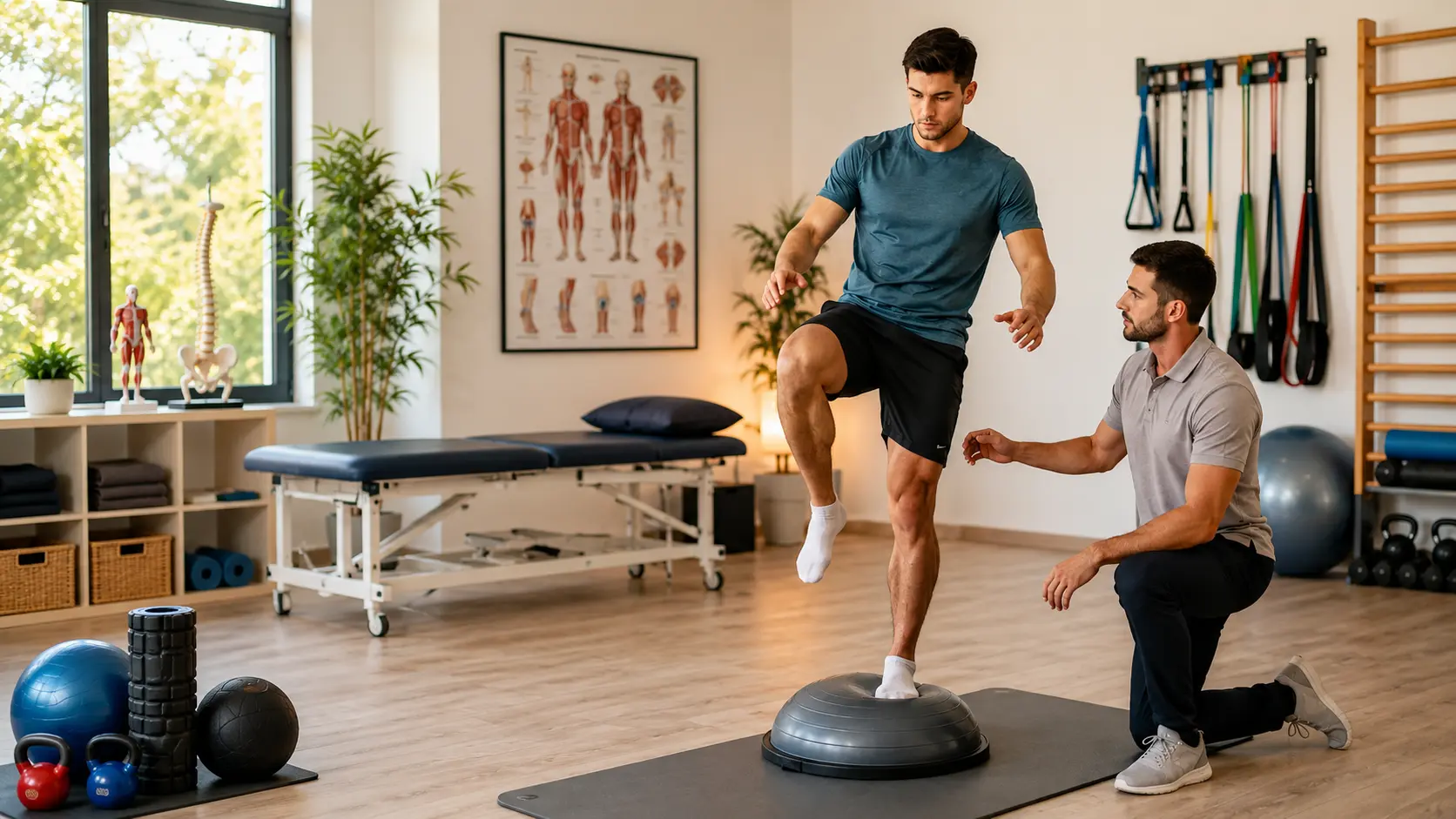
Interpreting change against measurement error. A change between sessions is interpreted against measurement error and, where one exists for that protocol and population, against the minimal detectable change (MDC). The MDC is not a universal threshold for a muscle group; it depends on the population, the protocol and the device. In 30 nursing home residents assessed with the microFET 2 itself, the intra-rater MDC was 27.64% for the elbow flexors and 81.97% for the ankle extensors (Buckinx et al., 2017; corrigendum 2022). For follow-up, keep the same examiner, position, protocol and device. You need the same standardisation when you compare the affected and unaffected sides during sports injury recovery.
What contraindications does the manufacturer list?
Manufacturer contraindications. The user guide contraindicates use on or near open wounds, in patients with severe osteoporosis, on or near burned tissue, on or near the eye, and on or near fractures.
What is the microFET 2 and what does it measure?
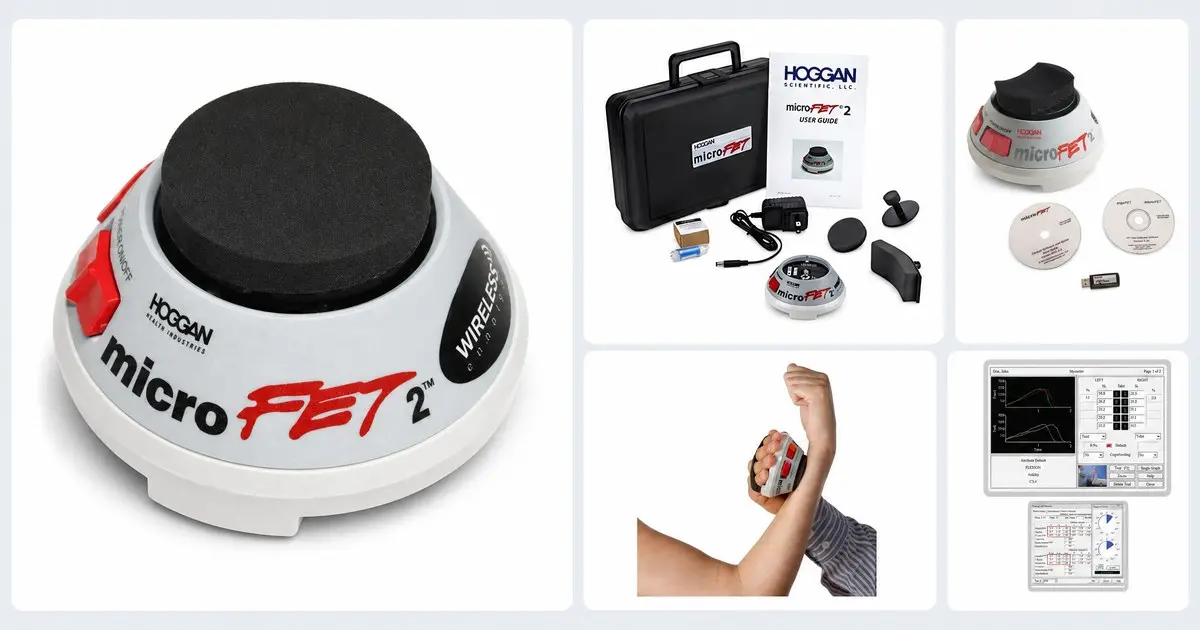
According to the user guide, the microFET 2 is a wireless-capable hand-held dynamometer that measures the peak force applied to the transducer pad, and its duration, during a muscle test. The guide states that the display shows peak force and duration; the manufacturer's product page attributes tables and graphs to the software package. It is part of our electromedicine collection.
| Specification | Value according to the manufacturer |
|---|---|
| Force range | 300 lbf (pounds-force; 136 kgf / 1,320 N) |
| Accuracy | within 1% of the reading |
| Units | pounds-force (lbf), newtons or kilograms-force |
| Thresholds | low 0.8 lbf (3.6 N) for weak muscles and finger and toe tests; high 3 lbf (12.1 N) for normal use |
| Memory | the 30 most recent tests |
| Display and values | LCD showing peak force and duration; alternative outputs for time to peak, average force, average before and after peak, and rate of force development |
| Weight | 0.36 kg (0.80 lb) without pad |
| Battery life | 90 h in non-wireless mode and 6 h in wireless mode; recharges in 3 h |
| Battery | 3.7 V rechargeable lithium-ion, user-replaceable |
| Liquid ingress protection | IPX0 |
| Supplied with | device, flat, curved and digit pads, user guide, calibration certificate, battery, USB-A to USB-C cable and carrying case |
| Warranty | 3 years from ship date |
| Expected service life | 10 years |
| Calibration | annual recalibration by technicians authorised by the manufacturer |
What evidence supports the microFET 2?
The evidence falls into three levels: studies that measured with the microFET 2 itself (reliability in older adults and use as the reference device at the shoulder), its inclusion among the devices in a meta-analysis, and reviews of hand-held dynamometry as a category.
What the evidence shows. A study of 30 healthy adults compared two hand-held dynamometers, one of them the microFET 2, against a fixed reference dynamometer. Reliability was mostly good to excellent, with coefficients of 0.70 or above, and validity at the hip and knee reached ICCs of 0.70 or above. At the ankle it was poor to good, with ICCs of 0.31 to 0.79, and the authors note that validity was particularly good for the proximal muscle groups (Mentiplay et al., 2015). A 2022 study validating a new digital dynamometer used the microFET 2 as its reference device; intra-rater ICCs of 0.95 to 0.99 covered both dynamometers tested and did not vary with examiner experience (Karagiannopoulos et al., 2022).
Which microFET 2 should you choose, with or without clinical software?
The software package is worth it if you will produce reports and track series of values. The version without software is enough if you measure occasionally.
Measurement volume. If you only reassess occasionally, recording values by hand may be enough. As the series of values grows, the software organises the data and saves time in clinic.
Documentation for patients or third parties. If you need to give a patient or a third party a formatted report, choose the version with software. If recording the numerical value in your clinical notes is enough, the version without software covers that need.
Operating system in your practice. The package requires Windows, so a Mac-only or tablet-only workstation rules out the version with software.
Budget and cost of ownership. The difference between the two versions is €200. Add the annual recalibration by authorised technicians that the user guide requires. The manufacturer publishes more than one software package, and our product page describes the clinical one. Before ordering, check how recalibration is handled and what it costs, which software package is supplied and on what licence terms.
- If you track patients over time and produce reports, choose the microFET 2 with clinical software.
- If you measure occasionally without a dedicated computer, choose the microFET 2 without clinical software.
Conclusion
Recording strength as a number gives you an objective record of each patient's progress, and the microFET 2 provides that figure with the specifications and instructions for use its manufacturer publishes. If you are completing the equipment list for setting up a private physiotherapy practice, this dynamometer lets you document strength from day one.
Frequently asked questions
Which microFET 2 pad should you use for each test?
The user guide distinguishes three pads. The flat pad is for flat surfaces, the curved pad for rounded surfaces, and the digit pad is reserved for finger and toe tests. Each one screws onto the device's threaded stud and is hand-tightened, without over-tightening, so that it is secure before you measure.
Is the microFET 2 placed directly on the patient's skin?
No. The guide says the device should be used over clothing. It also states that the device is not designed to be used while charging and should not be dropped or knocked.
What is the wireless range of the microFET 2?
The user guide gives a range of 7.6 metres (25 feet) indoors, on the 2.4 GHz band, which comfortably covers a treatment room.
What does the user guide say about the microFET 2's regulatory status?
The user guide carries the symbols for a medical device, compliance with EU MDR 2017/745, an EU authorised representative, compliance with the UK MDR 2002, a UK Responsible Person, and prescription use only. It does not state an EU or UK medical-device risk class. The 'Class II' that appears in the guide is an electrical-safety classification (Class II ME equipment while charging), not a medical-device risk class. For the specific unit you receive, check its conformity marking and declaration of conformity.
Can the microFET 2 measure grip strength?
No. The microFET 2 measures push force against its pad, not hand grip. It includes a dedicated pad for finger and toe tests. Grip strength is measured with a grip dynamometer, a different category of device that is not part of our catalogue.
Sources and references
We have taken the specifications from the manufacturer's user guide and product documentation, and the reliability figures from the published studies listed below.
- Hoggan Scientific, LLC (manufacturer). microFET 2 User Guide (IFU 01.K), the English guide for units with serial number SN 1R241W or later.
- Hoggan Scientific, LLC (manufacturer). microFET 2 product page
- Stark T, Walker B, Phillips JK, Fejer R, Beck R (2011). Hand-held dynamometry correlation with the gold standard isokinetic dynamometry: a systematic review. PM R 3(5):472-479. doi:10.1016/j.pmrj.2010.10.025
- Chamorro C, Armijo-Olivo S, De la Fuente C, Fuentes J, Chirosa LJ (2017). Absolute reliability and concurrent validity of hand held dynamometry and isokinetic dynamometry in the hip, knee and ankle joint: systematic review and meta-analysis. Open Med (Wars) 12:359-375. doi:10.1515/med-2017-0052
- Chamorro C, Arancibia M, Trigo B, Arias-Poblete L, Jerez-Mayorga D (2021). Absolute reliability and concurrent validity of hand-held dynamometry in shoulder rotator strength assessment: systematic review and meta-analysis. Int J Environ Res Public Health 18(17):9293. doi:10.3390/ijerph18179293
- Martins J, da Silva JR, da Silva MRB, Bevilaqua-Grossi D (2017). Reliability and validity of the belt-stabilized handheld dynamometer in hip- and knee-strength tests. J Athl Train 52(9):809-819. doi:10.4085/1062-6050-52.6.04
- Bohannon RW (2005). Manual muscle testing: does it meet the standards of an adequate screening test? Clin Rehabil 19(6):662-667. doi:10.1191/0269215505cr873oa
- Mentiplay BF et al. (2015). Assessment of lower limb muscle strength and power using hand-held and fixed dynamometry: a reliability and validity study. PLoS One 10(10):e0140822. doi:10.1371/journal.pone.0140822
- Buckinx F et al. (2017). Reliability of muscle strength measures obtained with a hand-held dynamometer in an elderly population. Clin Physiol Funct Imaging 37(3):332-340. doi:10.1111/cpf.12300
- Buckinx F et al. (2022). Corrigendum (corrected Tables 2 and 3 with the MDC values). Clin Physiol Funct Imaging 42(2):148-149. doi:10.1111/cpf.12744
- Karagiannopoulos C, Griech S, Leggin B (2022). Reliability and validity of the ActivForce digital dynamometer in assessing shoulder muscle force across different user experience levels. Int J Sports Phys Ther 17(4):669-676. doi:10.26603/001c.35577
- Jorquera-Cáceres I et al. (2024). Torque muscular isométrico en niñas, niños y adolescentes chilenos evaluado mediante dinamometría de mantención manual: un estudio de confiabilidad. Andes Pediatr 95(3):252-262. doi:10.32641/andespediatr.v95i3.4956
- Dávila-Romero C et al. (2016). Fiabilidad de un test de dinamometría manual en pacientes con dolor de espalda baja mediante test-retest de 12 semanas: estudio piloto. Fisioterapia 38(3):136-141. doi:10.1016/j.ft.2015.06.002