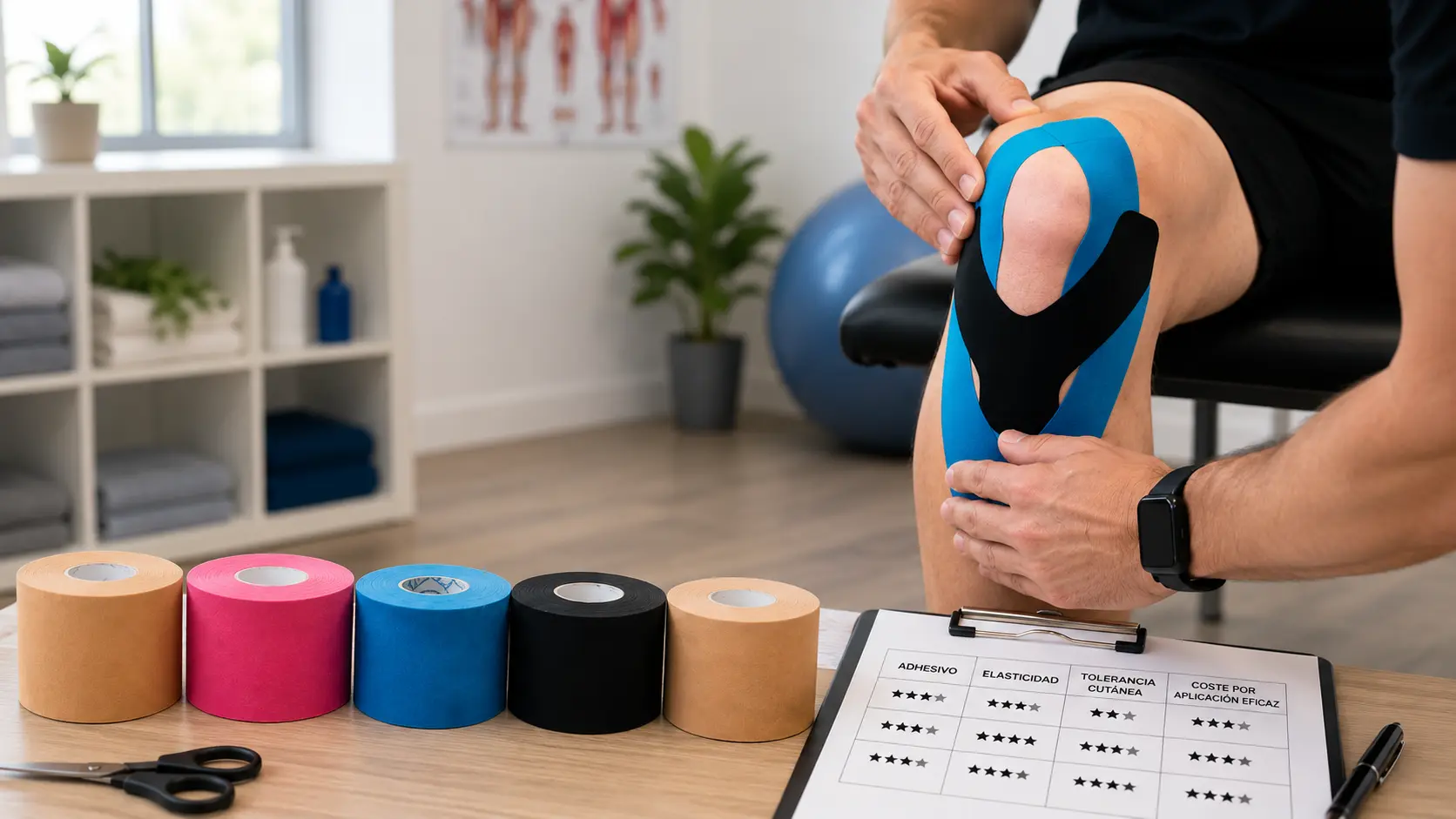
Choosing kinesiology tape comes down to five variables: material, adhesive, elasticity, format and durability. The brand name on its own does not settle the choice, because most of the tapes used in professional kinesiology taping share a similar construction: a cotton or viscose backing, an acrylic adhesive that manufacturers describe as hypoallergenic, and stretch mainly along the length.
Those five variables change the handling, the skin tolerance, the format and the conditions of use, and they fit differently with your technique, your patient mix and your workload. What does not exist is enough clinical comparison to rank the available tapes by effectiveness. We go through them one at a time so you can choose on criteria rather than on the label. We distribute several of the brands named here, so we flag which figures come from the manufacturers and where no independent comparison exists.
Cotton or viscose kinesiology tape?
Cotton is the most common backing in conventional kinesiology tape ranges. Manufacturers often describe their cotton tapes as breathable and suitable for wear over several days, which matters when the patient keeps the tape on until the next session, but actual comfort and skin tolerance vary by product and by user.
Viscose (or rayon) is made by a chemical process, so it is a man-made fibre. What it is not, despite often being called one, is a synthetic fibre. The difference lies in the raw material. Viscose starts from wood cellulose, while polyester and acrylic start from polymers obtained by chemical synthesis. Textile fibre legislation defines it as a "regenerated cellulose fibre" and lists it under a name of its own, not among the synthetics. Viscose is used in ranges aimed at sport and at demanding use.
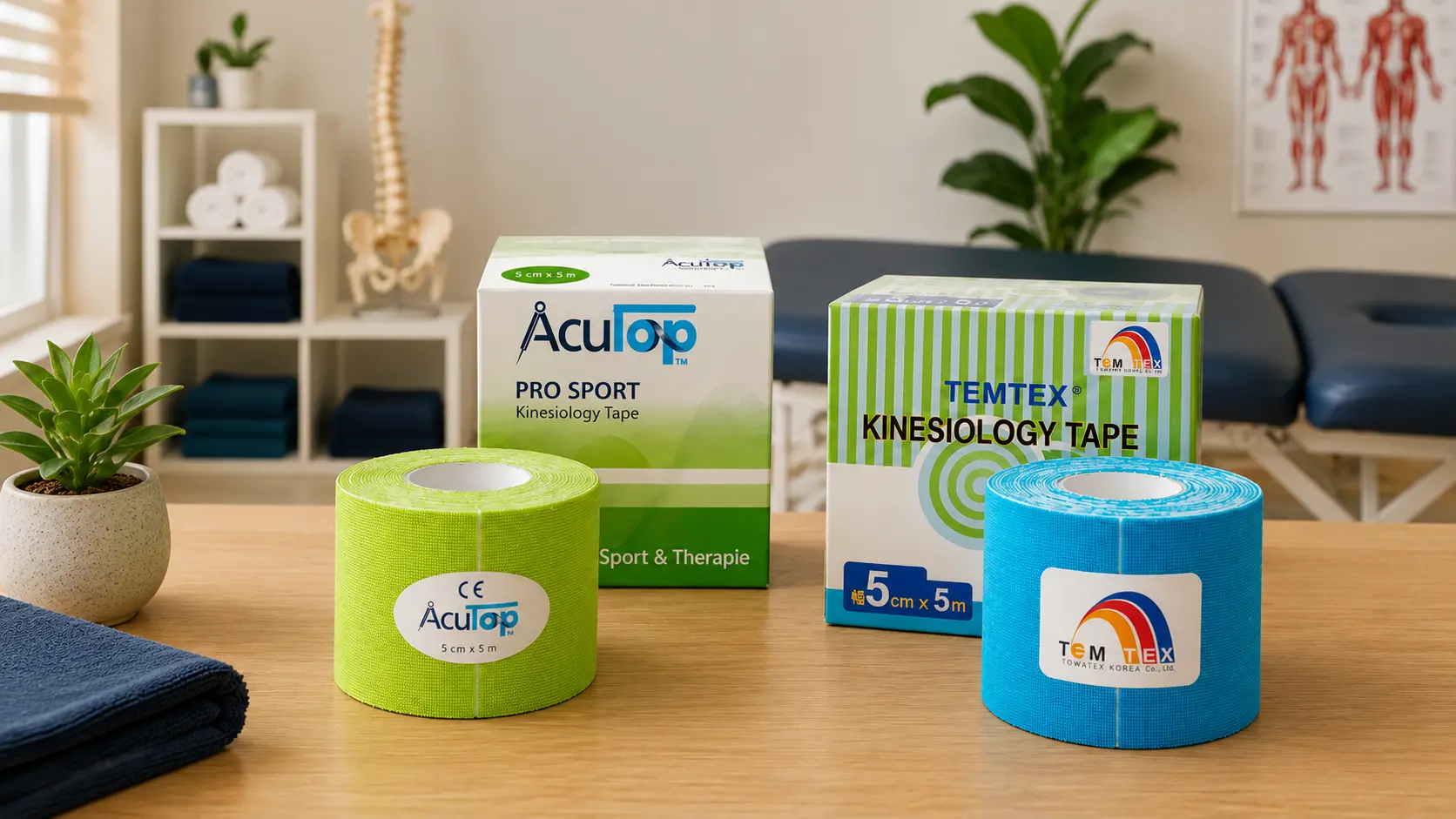
The material on its own predicts neither grip, durability nor skin tolerance. Those depend on the construction and the adhesive of each product. AcuTop, for instance, presents its Pro Sport as a rayon tape with a reinforced textile structure and adhesive, and describes the material as water-repellent. That is the manufacturer's description of one product, not evidence that every viscose tape outlasts every cotton one.
In practice, for routine kinesiology taping on skin without known sensitivities, cotton is a common choice. For sport, heavy sweating or greater friction, look at the ranges the manufacturer describes as reinforced, whether cotton or viscose, keeping the stated wear time and removal instructions in view. Many practices end up keeping both to hand.

Which kinesiology tape adhesive suits your work best?
The adhesive is one of the variables you notice most during application and removal, and it is chosen by level of grip rather than by brand: standard for general use, reinforced for exertion and sweat, gentle for delicate skin. Many professional tapes declare an acrylic adhesive, the absence of latex and activation by heat or friction, and several apply it in a wave pattern rather than covering the whole surface. AcuTop describes its Classic range that way, and so does Kinesio for its Tex Tape. These are specifications for individual products rather than a definition of the category, so check the documentation and the instructions for the one you are buying.
When comparing products, look at three things:
- Level of grip. Some ranges offer a standard version, a reinforced version for exertion and sweat, and a gentler one for delicate skin that is easier to remove. None is better than the others; each suits a different use.
- Adhesive pattern. Manufacturers that apply the adhesive in waves present it as a way of letting the skin continue to exchange air and moisture. We have found no independent comparison against a continuous adhesive.
- Composition and manufacturer claims. Check whether the manufacturer declares the product latex-free, how it describes skin tolerance, and what precautions the instructions carry. In a clinical setting you cannot know every patient's sensitivities in advance.
Even so, "hypoallergenic" is a manufacturer's claim and not a guarantee that reactions will not occur. For patients with reactive skin or a history of dermatitis, it is worth testing the tape on a small area of skin before a large application. Kinesio's own manual recommends that step on sensitive skin.
How much does kinesiology tape stretch, and in which direction?
The conventional kinesiology tapes this guide covers stretch mainly along their length and are practically rigid across the width. That is precisely the property that sets them apart from rigid strapping or a cohesive bandage, and the one that unloading and facilitation techniques rely on.
Elasticity has to be checked in the documentation for each individual product, and it is worth knowing that manufacturers do not express it in the same way. Kinesio states that its tape stretches by 40 to 60% beyond its resting length; AcuTop publishes 130 to 140% for its Premium range, which has a different composition (97% cotton); RockTape advertises 180%, although that page does not say whether the figure is the added stretch or the final length. Some figures express the added stretch and others the final length, so combining them into a single range is misleading. Some tapes also come under tension on the backing paper. Kinesio declares 10 to 15% for its products, so the patient's "zero" tension is not the tape's own zero. Check the individual product, and keep it in mind when you set the tension of your applications.
More elasticity does not mean better. The amount of stretch you need depends on the technique and on the degree of tension you apply; what matters is that you know how the tape you work with behaves and that you keep a consistent standard. If you change range, re-check your tension references over the first few applications rather than taking them for granted.
As important as how far it stretches is how well it recovers. Elastic recovery, and how well it holds up during wear, varies between products and is not summarised by a single catalogue figure. The elastic fibre, the fabric and the construction of the product all play a part. Before standardising on one tape in your practice, check how it behaves under the conditions you expect to use it in, and record any variation between batches.

Which width and format of kinesiology tape should you buy?
The standard width is 5 cm, which suits most applications. For large areas such as the back or the hamstrings, some manufacturers offer 7.5 or 10 cm widths that cover more surface with fewer strips. For fingers or fine applications, cut the 5 cm roll lengthways.
The other decision is between pre-cut and roll.
- Pre-cut tape comes ready as strips or as designs shaped for a specific area, and it cuts preparation time. It can be useful when you repeat a standardised application. In return, it usually costs more per metre and leaves less freedom to adjust each cut.
- A roll lets you choose the length and make I, Y, X or fan cuts to suit the application, adapts to any technique and usually works out cheaper per metre. For a practice that applies tape daily, it is almost always the logical option.
If you use tape in high volumes, long clinical rolls (the XXL formats, as against the standard 5 m) reduce how often you reorder and, in some ranges, the cost per metre as well. It is not automatic. On our Spain/EU catalogue prices for July 2026, shown in euros with Spanish VAT included, the AcuTop Classic XXL worked out clearly cheaper per metre than its 5 m roll, while the two budget formats came out practically level. Work it out product by product before you buy.
Those are not delivered UK prices, so compare the current cost per metre for each product after delivery, import VAT, customs duties and any carrier handling charges. For occasional use, a standard roll avoids tying up money and storage space in stock you will get through slowly.

How long does kinesiology tape last once applied?
Many standard products advertise an indicative wear time of 3 to 5 days. That is what AcuTop states for its Classic and Pro Sport ranges, and Temtex adds up to 7 in low-friction areas. These are manufacturer figures rather than guarantees, and they vary with the adhesive and the conditions of use.
It is worth setting expectations with the patient, because real durability depends on many factors that have nothing to do with the brand, such as sweating, friction from clothing, body hair, the area of the body and whether or not the patient follows the basic aftercare (not pulling at the edges, patting dry after a shower). Products the manufacturer describes as water-resistant are meant to tolerate the shower and, depending on the product, sweat or the pool, but none is permanent. If the patient needs the tape to hold through a week of training, look at a range with reinforced grip and set expectations about how long it will last.
Does the colour of kinesiology tape change the result?
Colour is not a clinical criterion. A randomised crossover trial found no differences in performance or strength attributable to the colour of the tape (Cavaleri et al., 2018), so choose it for patient preference, visibility or your practice’s internal colour coding. What each colour is said to mean, and what the evidence shows, we cover in the guide to kinesiology tape colours.
What should you check when buying kinesiology tape for a practice?
Buying for a practice adds four criteria that home use does not have: regulatory documentation, traceability between batches, how reliably the range can be restocked, and the real cost per metre. Equipping a practice is decided with those four in front of you:
- Conformity marking and documentation. If the tape is sold as a medical device, check the intended purpose, the identification of the manufacturer and, where applicable, the responsible person or authorised representative, along with the labelling, the instructions for use and the conformity marking. The rules differ within the United Kingdom. In Great Britain, devices must be registered with the MHRA, the UK conformity marking route is available but not mandatory, and validly CE-marked devices remain accepted under extended transitional arrangements; in Northern Ireland, EU rules apply, CE marking or combined CE and UKNI marking is required, and since 28 May 2026 non-custom devices are registered in EUDAMED rather than with the MHRA. Where the specific tape is a Class I device that is neither sterile nor has a measuring function, it is self-declared by the manufacturer, with no UK approved body involved. Confirm the classification and intended purpose of the product in front of you rather than assuming that everything sold as kinesiology tape is a medical device. The marking demonstrates regulatory conformity. It does not show that one tape grips better, lasts longer or is clinically superior to another.
- Traceability and consistency between batches. A professional kinesiology tape should behave the same on this order as on the next. Without a brand, a data sheet or batch identification it is harder to verify that consistency, trace where the product came from and deal with a technical problem, and that uncertainty costs you time and reapplications.
- Availability and restocking. Working with a range that is consistently in stock avoids running out of your go-to tape mid-week.
- Real cost per metre. The roll price can be misleading; what counts is the cost per metre applied, above all if tape is a daily consumable.

How to choose for your practice
There is no universal kinesiology tape; there is the one that fits each situation. As a practical summary for deciding:
- General use and normal skin → standard 5 cm cotton on a roll. The default for day-to-day work.
- Sport, sweat and water → a range the manufacturer describes as reinforced for demanding use, such as AcuTop Pro Sport in viscose.
- High daily volume → compare long rolls on real cost per metre and on how often you reorder; not all of them lower the cost per metre.
- Sensitive or reactive skin → a range with a gentle adhesive, described by the manufacturer for delicate skin, and a tolerance test beforehand.
At Kinemarket you will find kinesiology tape in cotton, viscose ranges aimed at sport, and long rolls for high consumption.
Frequently asked questions
Which brand of kinesiology tape is right for my practice?
The criteria in this guide apply to any brand, so start from the use case and the patients you treat, not the name. If you are weighing up two options that are common in clinic, our comparison of AcuTop and Temtex can help, because it looks at both closely on material, adhesive, format and cost per use.
Is kinesiology tape suitable for sensitive skin or latex allergies?
Many professional ranges are declared latex-free and describe their adhesive as hypoallergenic, and some offer a gentle-adhesive version for delicate skin. These are manufacturer declarations rather than guarantees, and on reactive skin it is worth checking tolerance before a large application.
Is a low-cost kinesiology tape good enough for professional use?
A low price does not mean a poor tape, but on its own it does not show that the product is suitable for professional use either. Before buying, check the composition, the adhesive, the intended purpose, the conformity marking where the product is sold as a medical device, the manufacturer's traceability and the documentation available. Our catalogue carries a low-cost kinesiology tape in a standard roll and in a 32-metre roll for high consumption. When a product arrives with no brand, no data sheet and no batch identification, the problem is not that it is worse by definition. It is that you cannot verify consistency between orders or deal with a problem if one arises.
Sources
This guide is based on a desk-based review of manufacturer documentation, distributor documentation and catalogue pricing, accessed July 2026. It is not a comparative trial of adhesion, elasticity or skin tolerance carried out by Kinemarket.
- Product documentation for AcuTop Classic, AcuTop Pro Sport and AcuTop Premium (composition, adhesive, latex-free status, published elasticity and stated wear time), accessed July 2026.
- Kinesio, "What makes Kinesio different": longitudinal stretch of 40 to 60% beyond resting length (a 10 inch strip reaches 14 to 16 inches) and a heat-activated acrylic adhesive applied in a wave pattern.
- Kinesio Taping Perfect Manual, 2nd edition, public sample PDF: factory tension of 10 to 15% on the backing paper, latex-free cotton backing, medical-grade acrylic adhesive sensitive to heat and pressure, and a 24-hour test on a small area for sensitive skin.
- Frequently asked questions published by RockTape (180% stretch advertised, denominator unspecified), cited only to show that elasticity figures are not comparable between brands.
- Temtex distributor documentation, reproduced on our own Temtex Kinesio Tape product page (longitudinal elasticity of 150 to 160%, 100% cotton, latex-free, heat-activated wave adhesive, and 3 to 5 days of wear, up to 7 in low-friction areas). This is a distributor source rather than primary confirmation from the manufacturer: Towatek Korea publishes its documentation as images, so it could not be cross-checked against the machine-readable text on the manufacturer's own site.
- Medicines and Healthcare products Regulatory Agency, "Regulating medical devices in the UK": registration, conformity assessment routes and marking under the UK MDR 2002, including self-declaration by the manufacturer for Class I devices other than the sterile and measuring exceptions, the continued acceptance of CE-marked devices in Great Britain under extended transitional arrangements, and the separate Northern Ireland regime.
- Regulation (EU) No 1007/2011 on textile fibre names, Annex I as it applies in the United Kingdom: viscose (25) is defined as a "regenerated cellulose fibre obtained by the viscose process", with its own entry separate from acrylic (26) and polyester (35), each of those defined as a fibre formed of linear macromolecules.
- Cavaleri R, Thapa T, Beckenkamp PR and Chipchase LS (2018). The influence of kinesiology tape colour on performance and corticomotor activity in healthy adults: randomised crossover trial, with no differences in performance or strength attributable to colour.