At Kinemarket we distribute the Air Relax PRO 4.0. This guide is based on documentation from the manufacturer and its European distributor, our catalogue prices and the published literature; it is not a clinical trial or a performance test of our own. If you are fitting out the clinic, the sections below cover what distinguishes a pneumatic compression unit designed for clinic use from one aimed at aesthetic marketing, and what documentation to ask for before paying. You may also want to review what essential equipment goes into the initial budget for a physiotherapy clinic.
Quick verdict
The most consistent evidence for pneumatic compression is in managing lymphoedema within a programme that includes bandaging, and in sports recovery the most consistent effect is a modest reduction in perceived muscle soreness. In venous leg ulcers it can be considered as an adjunct, with limited evidence.
- As a technique, it suits clinics that treat lymphoedema within decongestive therapy or work on recovery after training load.
- Do not buy it for weight loss, body reshaping or selling aesthetic results.
- In our catalogue we carry the Air Relax PRO 4.0 in three sizes. The evidence for the technique does not make it a device for both indications; its manual intends it for the temporary relief of minor muscle aches in healthy people and contraindicates use on swollen areas or where circulation is poor.
What is pneumatic compression therapy and how does it work on the leg?
Pressotherapy is a commercial term for intermittent pneumatic compression (IPC). A pump inflates independent air chambers housed in leg garments, arm garments or wraps, in sequence from distal to proximal, and that sweep moves venous blood and lymph towards the trunk.
The effect is mechanical. What the machine moves is fluid, and the idea that it "eliminates toxins" describes a mechanism that the reviewed literature does not support.
It is a mechanical agent, not a current, so its list of precautions is not carried over from electrical modalities. To understand the differences, it is worth reviewing the types of electrotherapy and their uses. Pneumatic compression is an intermittent complement to daily compression garments or bandaging; it does not replace them.
What are the benefits of pneumatic compression according to the evidence?
The evidence base varies by indication. It is more consistent in lymphoedema, where there is a randomised trial with a clear result, and weaker in sports recovery, where the published effects are trivial to moderate depending on the outcome and vary widely between studies. The studies below evaluate the technique using the equipment in each trial, not a specific commercial model, and the intended purpose of each unit is set by its manufacturer in the manual.
What is the evidence in lymphoedema?
The most relevant trial in lymphoedema found that intermittent pneumatic compression plus bandaging was not inferior to classic decongestive therapy with manual lymphatic drainage. Forner-Cordero et al. (2021) evaluated it in a randomised non-inferiority trial with 194 patients in stages II and III and a volume excess greater than 10%, treated across 20 sessions. The overall mean reduction in excess volume was 63.9%, with no significant differences between the three groups. The most frequent adverse effects were discomfort and lymphangitis, with no differences between groups.
And in breast cancer-related lymphoedema?
The literature on breast cancer-related lymphoedema is split between prevention and treatment. Shao et al. (2014), with 7 trials and 287 patients, found no significant differences between usual management with or without a pneumatic pump, and concluded that the available trials do not demonstrate the efficacy of adding it. Su et al. (2025), with 14 trials and 1,397 patients, analysed prevention and treatment; the clearest result was in prevention, with a significant reduction in incidence after surgery; for established lymphoedema the therapeutic efficacy was limited and the authors point to combined treatments.
Does it help venous leg ulcers?
For venous leg ulcer, intermittent pneumatic compression may increase healing compared with no compression, and there is limited evidence that it improves healing when added to compression bandaging. Nelson et al. (2014), in a Cochrane review of 9 trials and 489 people, found only one with low overall risk of bias. It is not clear that it can replace bandaging.
And in sports recovery?
The benefit in sports recovery is trivial to small for muscle function, trivial to moderate for pain and muscle soreness, and highly variable for markers of muscle damage. Maia et al. (2024), with 17 studies and 319 participants, note that the technique still lacks solid scientific support and that the most consistent effect is a reduction in perceived soreness. To place this within a broader guide, see recovery after training load.
How is a pneumatic compression session delivered in clinic?
In clinic, the model manual sets the duration according to the timing of the session relative to exercise, and the working pressure used in the literature is well below the unit's maximum.
- Duration. According to the manual, 15 to 30 minutes before training and 30 to 45 minutes after.
- Pressure. The protocols most used in the sports recovery literature work around 80 mmHg (Maia et al., 2024). According to the manual, the unit starts by default at 80 mmHg and is adjusted between 40 and 170 mmHg.
- Where it fits. It is integrated as part of a programme. The lymphoedema evidence comes from trial arms that included bandaging. According to the model manual, the intended purpose is temporary relief of minor muscle aches and pains and temporary increase in circulation to the treated area, in people who are in good health.
- What the patient notices. The session is usually well tolerated and produces an upward sweeping sensation, although in the lymphoedema trial cited above discomfort is among the most frequent adverse effects. According to the manual, stop the session if pain, discomfort, bruising, irritation or redness appears during or after it, and the patient should consult their doctor; with severe pain or any abnormal symptom, stop the unit and remove the garment.
When should it not be used? Contraindications listed by the manufacturer
What follows is the list published by the manufacturer in the model manual, reproduced here rather than presented as our clinical judgement. Patient screening is the responsibility of the treating professional and the unit documentation.
Do not use the unit, according to the model manual:
- inflammation, an infection, open wounds or bleeding at or near the site of application
- sensitive skin, swollen or inflamed areas, poor circulation, skin eruptions or unexplained calf or abdominal pain
- being under a doctor's care or having a condition that requires the use of a medical device
- acute pulmonary oedema
- acute thrombophlebitis
- acute congestive heart failure
- acute infections
- osteoporosis
- deep vein thrombosis
- episodes of pulmonary embolism
- wounds, lesions or tumours at or near the site
- where increased venous and lymphatic return is undesirable because of lesions or tumours at or near the site
- fractures or dislocations at or near the site
- pregnancy (the manual adds that pregnant women should consult their healthcare provider before use)
- blood clots or a tendency to form them
In addition, the manual states:
- that it is not recommended for people with heart or vascular problems
- that it is not for children, that under-18s must be accompanied by an adult and that it is not suitable below 40 kg
- that the user must be alert and awake
- that the unit is not medical treatment and is no substitute for a medical examination or diagnosis
What should you check before buying a pneumatic compression device?
If you are evaluating the investment, it is also worth reviewing the investment plan for opening a physiotherapy clinic.
- Chambers. More overlapping chambers spread pressure across more segments and make the wave more progressive.
- Compression modes. They change the shape of the wave; check there is at least one sequential distal to proximal mode and one maintenance mode.
- Pressure control. In clinic, being able to lower the pressure precisely matters more than being able to raise it. Count the adjustment levels the unit offers; the maximum alone does not tell you how fine the step is.
- Chamber selection and deflation. Switching off a chamber adapts the compression pattern, and is only used when the patient's indication and the manufacturer's instructions allow it.
- Programmable duration. This determines whether the session fits the appointment slot.
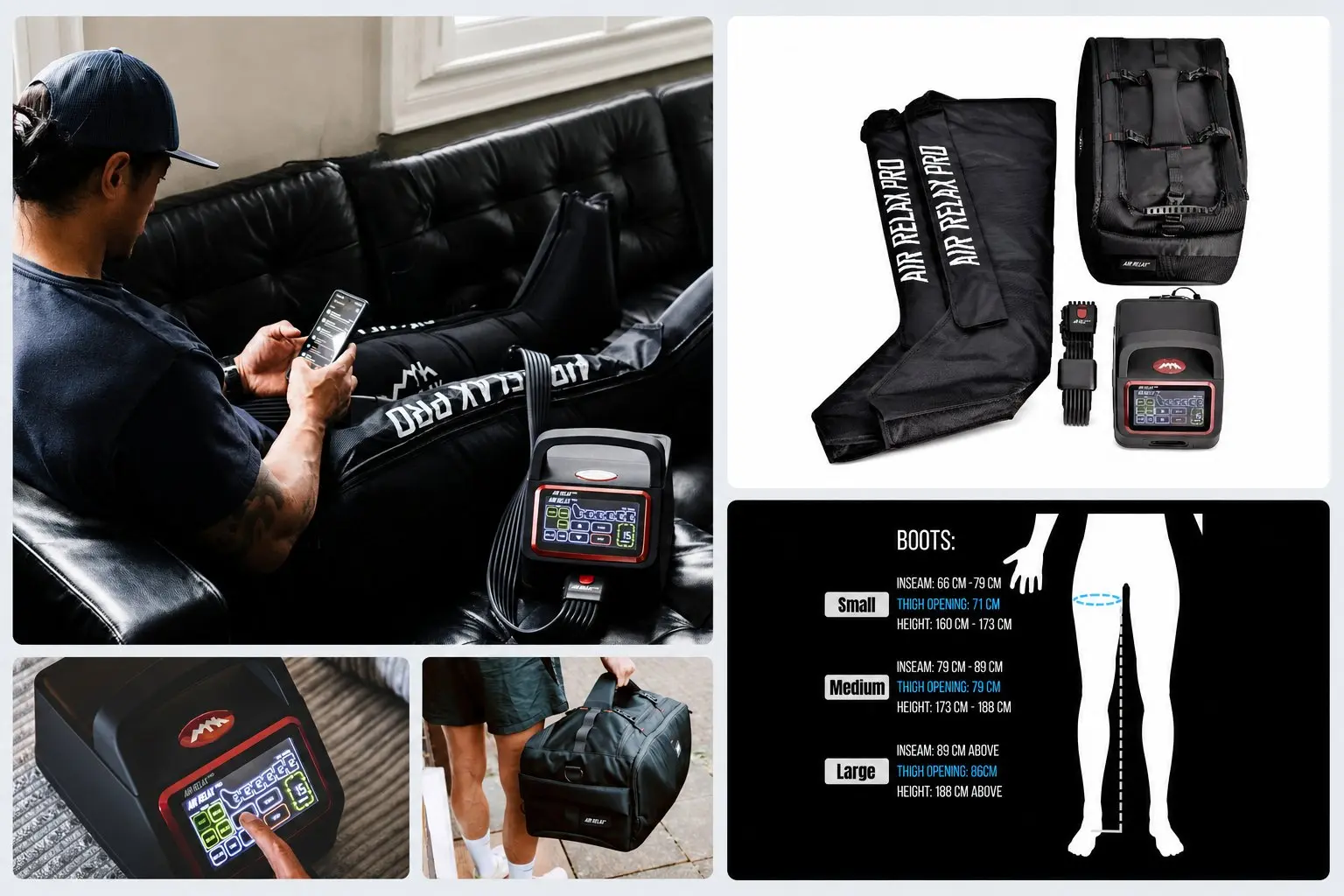
- Garment and sizes. Fit determines effective compression; check inside leg and thigh opening before the material.
- Hygiene. It is fabric that touches the skin of several patients a day; ask for the written cleaning protocol before buying.
- Voltage. Check the input voltage range and use only the manufacturer's adapter; the PRO 4.0 manual states 100 to 240 V AC, 50/60 Hz, and warns that another adapter may cause electric shock and voids the warranty.
- Warranty. The PRO 4.0 manual describes the system as intended for consumer home use and warns that commercial use will cause premature breakdown of the system; before buying it for the clinic, ask the distributor in writing what warranty covers professional use.
- Documentation. Ask for the model's declaration of conformity and check its conformity marking. In Great Britain, MHRA guidance sets out which conformity markings are accepted and when third-party conformity assessment is required. Northern Ireland follows EU rules.
What are the specifications of the device we distribute?
The Air Relax PRO 4.0 is the only pneumatic compression unit we distribute. The specifications come from the model manual, except for the garment, sizes and warranty, which are published by Air Relax Europe, its distributor for Europe; the price is from our catalogue.
| Feature | Value |
|---|---|
| Chambers | 6 |
| Modes | Sequential, Progressive, Drain and Overlay |
| Pressure | 40 to 170 mmHg (14 levels) |
| Chamber selection and deflation | Yes |
| Programmable session duration | 5 to 95 minutes |
| Garment | 200 denier nylon |
| Interface | Touchscreen |
| Voltage | 100 to 240 V AC, 50/60 Hz |
| Warranty offered by Air Relax Europe | 3 years |
| Sizes | S, M and L |
| Guide price | €1,189.90 |
According to the manufacturer, Sequential fills the chambers one by one from distal to proximal; Progressive advances as a wave with up to three chambers at a time; Drain performs a directional sweep towards the trunk; Overlay inflates all chambers at once, holds and releases.
Prices from Kinemarket's Spain/EU catalogue, checked on 23 September 2026, shown in euros with Spanish VAT included; tax treatment and delivery costs may vary by destination. The catalogue changes and, depending on the season, the unit may be on offer. It is worth checking the specifications against the documentation supplied with your unit. You can view the European distributor's product page and the Air Relax PRO 4.0 details in the catalogue.
Which size should you choose, and which clinic does it suit?
The three sizes cost the same, so the real buying decision is the size.
The table is the one published by Air Relax Europe. The model manual states that inside leg gives a more accurate result than height and that, between two sizes, the longer leg garment should be chosen.
| Size | Inside leg | Thigh opening | Reference height |
|---|---|---|---|
| S | 66 to 79 cm | 69 cm | up to 173 cm |
| M | 79 to 89 cm | 69 cm | 173 to 188 cm |
| L | 89 cm and over | 69 cm | 188 cm and over |
- Sports-focused practice. Choose the size by the inside leg of your tallest regular user.
- Practice treating patients with oedema or lymphoedema. The PRO 4.0 manual does not declare oedema or lymphoedema as indications and contraindicates, among other situations, swollen or inflamed areas and poor circulation; for that clinic profile, look for a unit whose intended purpose and documentation expressly cover the indication.
At Kinemarket you can find the Air Relax PRO 4.0 in the three sizes. The same collection has more recovery equipment for the treatment room.
Conclusion
A pneumatic compression unit is an adjunct within a programme; before buying one, check that the purpose stated in its manual covers your patients. The decision is driven by fine pressure control, the chambers, garment fit and a practical hygiene protocol between patients. Check the patient's inside leg to choose the size and achieve the fit the manufacturer intends.
Frequently asked questions
How long does a pneumatic compression session last, and how many can you do in a day?
The model manual recommends 15 to 30 minutes before training and 30 to 45 minutes after, and does not state a maximum number of sessions per day; the programmable range of 5 to 95 minutes is a capability of the unit, distinct from the recommended protocol.
Does pressotherapy help with weight loss or cellulite?
We have not identified evidence that intermittent pneumatic compression on its own produces weight loss, fat loss or removal of cellulite. The outcomes measured by the studies cited in this guide are oedema, lymphoedema, venous ulcer healing and perceived soreness after exercise.
What pressure in mmHg is used in a pneumatic compression session?
In sports recovery, the reviewed protocols usually work around 80 mmHg (Maia et al., 2024). That value is modulated according to patient tolerance and the indication, and the maximum figure advertised on a product page describes the unit's ceiling.
Can leg garments be used on the arms?
No. The model manual provides a separate garment for the leg, the arm and the hips (the shorts garment), each with its own size guide, and advises against exceeding 100 mmHg (Level 10) with the arm garment or the shorts garment.
How do you clean a pneumatic compression device between patients?
According to the manual, the control unit and hose are cleaned with a soft, slightly damp cloth, without immersing the unit or letting liquid collect on it. The garments are wiped on the surface inside and out with a soft, slightly damp cloth, dried with a soft towel and left to air-dry completely before the next use, with no machine washing, bleach, dry cleaning, ironing or tumble-drying. The garment is not sterile and the manual recommends a layer of clothing between the garment and the skin. The manual does not include a disinfection protocol; if the clinic's schedule requires it, ask the distributor in writing which disinfectant is compatible with the garment.
Sources and references
For this guide we consulted the Air Relax model manual and its European distributor's product page, the meta-analyses, the Cochrane review and the clinical trial listed below, together with UK regulatory guidance.
- Forner-Cordero I, Muñoz-Langa J, DeMiguel-Jimeno JM, Rel-Monzó P (2021). Physical therapies in the decongestive treatment of lymphedema: a randomized, non-inferiority controlled study. Clin Rehabil 35(12):1743-1756. doi:10.1177/02692155211032651
- Maia F, Nakamura FY, Sarmento H, Marcelino R, Ribeiro J (2024). Effects of lower-limb intermittent pneumatic compression on sports recovery: a systematic review and meta-analysis. Biol Sport 41(4):263-275. doi:10.5114/biolsport.2024.133665
- Nelson EA, Hillman A, Thomas K (2014). Intermittent pneumatic compression for treating venous leg ulcers. Cochrane Database Syst Rev (5):CD001899. doi:10.1002/14651858.CD001899.pub4
- Shao Y, Qi K, Zhou QH, Zhong DS (2014). Intermittent pneumatic compression pump for breast cancer-related lymphedema: a systematic review and meta-analysis of randomized controlled trials. Oncol Res Treat 37(4):170-174. doi:10.1159/000360786
- Su L, Huang H, Tong Y, Dong L, Gu C, Zhuang S, Bai S, Jin Y (2025). Intermittent pneumatic compression devices for the prevention and treatment of breast cancer-related lymphedema: a systematic review and meta-analysis. Support Care Cancer 33:1113. doi:10.1007/s00520-025-10159-8
- Air Relax Europe (distributor of Air Relax for Europe). Product page for the PRO 4.0, accessed 23 September 2026.
- Air Relax (manufacturer). Air Relax Pro User Manual, Model AR-4.0 (MSI-MUL-AR-4.0, REV.1 [22.08.25]). PDF, accessed 23 September 2026.
- Medicines and Healthcare products Regulatory Agency (MHRA). Regulating medical devices in the UK, last updated 20 February 2026, accessed 24 September 2026.