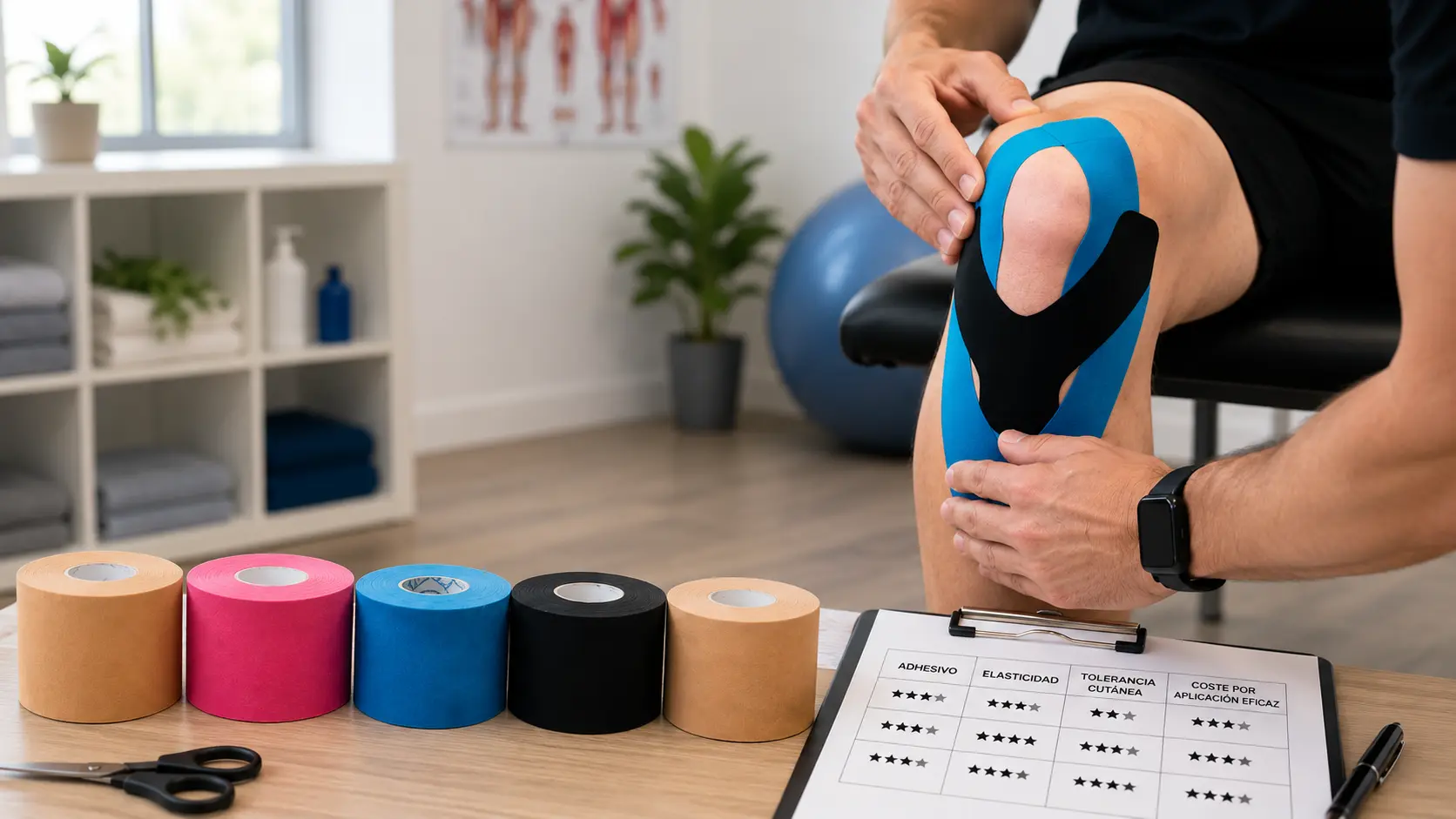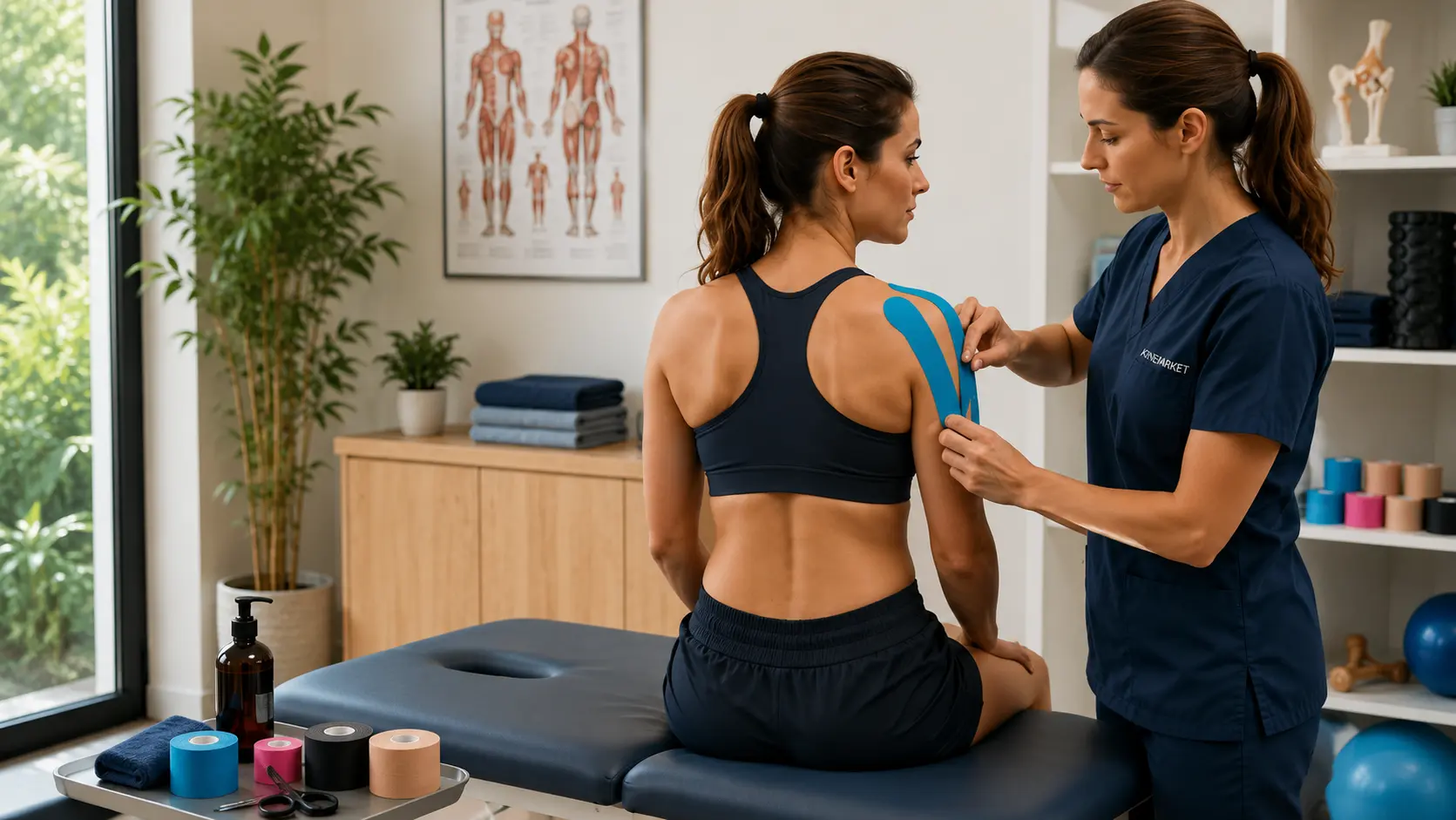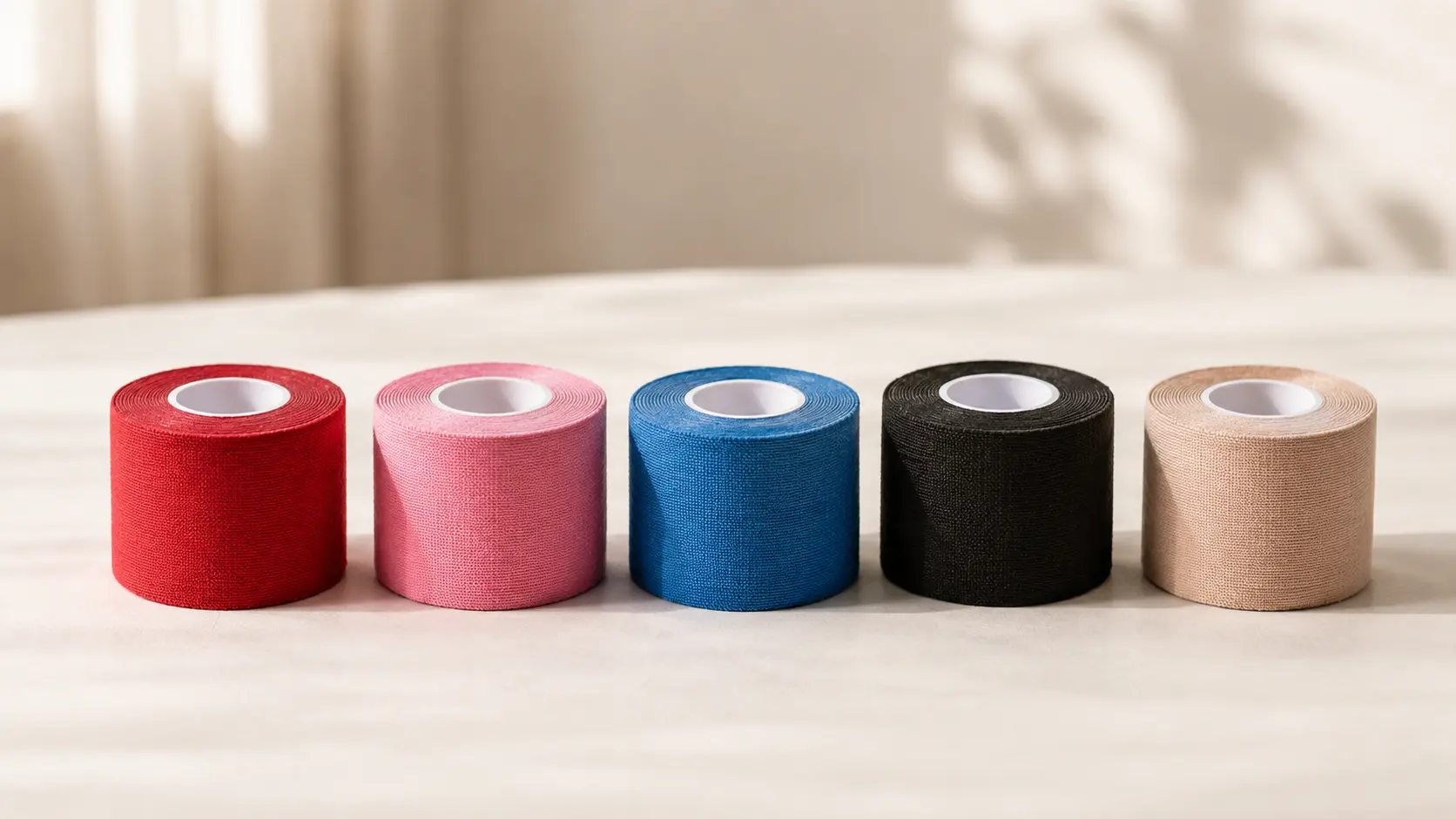
Blue to "bring swelling down", red to "activate", black to "add strength". That is the explanation doing the rounds in clinics, shops and changing rooms, and the reason some patients ask for a particular colour before you have even applied the tape.
The association has not been demonstrated. No solid clinical evidence establishes that one colour of kinesiology tape works better than another, and the direct comparative trial we have, run in healthy adults, found no difference in performance, strength or neuromuscular function between the colours tested. What the colour does change is practical: how visible the application is, what the patient prefers, and how you organise your stock. Here is what each colour is said to do, where the idea came from, and what the trial that put it to the test actually found.
What does each kinesiology tape colour mean?
Each colour is credited with an effect borrowed from colour therapy, and that is how it tends to appear in popular articles and on shop and clinic websites. Here are the main attributions you will come across, distinguishing Kinesio's own statements from unsupported claims that circulate elsewhere.
| Colour | What it is credited with | What the sources say |
|---|---|---|
| Red and pink | Heat and energy | Kinesio presents these colours as developed for colour therapy and associates red with heat and energy. No therapeutic effect attributable to colour has been demonstrated |
| Blue | Cooling and calm | Same origin. Kinesio associates blue with cooling and calm. Again, no demonstrated effect |
| Black | Strength and power; said to absorb heat and pass it to the tissue | Kinesio says black was added for athletes, after many requests, and attributes no thermal property to it. A dark surface does absorb more radiation, but no clinically relevant rise in skin temperature has been demonstrated |
| Beige | Neutral, no effect of its own | Kinesio developed beige for minimal visibility. No therapeutic property of its own has been demonstrated, as with every other colour |
Does the colour change the result of the application?
Not on the evidence available. Kinesio states that the colours in its own range show no physical or chemical difference, and the direct comparative trial we have found no difference by colour (Cavaleri et al., 2018). It was run in healthy adults and assessed neither pain nor clinical outcomes in patients. That limits how far the findings can be generalised.
That conclusion is about colour. Across musculoskeletal disorders, the overall evidence for kinesiology taping remains uncertain. A large 2026 overview found possible immediate and short-term effects on pain, with very low overall certainty (Mo et al., 2026). We go through that evidence in our guide to what kinesiology taping is for and what the evidence says.
Where does the idea of a therapeutic colour come from?
The association appears in Kinesio's own official explanation. The brand says its colours "were developed to be compatible with colour therapy", that beige was created to be seen as little as possible and black was added after many requests, and that the choice of colour "is a matter of individual preference". In the same answer it states that "there is no physical or chemical difference between the colours".
Those two statements are worth reading together. The first describes how the colour range is positioned in relation to colour therapy. It is not evidence of a therapeutic effect attributable to colour, and the second is a statement about the product rather than about what a colour can do. That wording may have contributed to a colour preference later being read as a therapeutic property of the product.
What exactly did the colour trial test?
The trial compared several colours and application conditions head to head. Cavaleri and colleagues assessed 32 healthy adults under five conditions (no tape, beige with tension, beige without tension, red with tension and blue with tension) in a randomised crossover design, using a validated hop test, knee extensor strength on an isokinetic dynamometer, and neuromuscular function assessed by transcranial magnetic stimulation.
Colour influenced neither performance (p = 0.669), nor quadriceps strength (p = 0.536), nor neuromuscular function (p = 0.301). The authors conclude that the application alters neither performance nor lower limb muscle function in healthy adults, whichever colour is used (Cavaleri et al., 2018).

What does choosing a colour actually change?
The differences colour makes are practical, not physiological:
- Preference and acceptance. Choosing a colour the person finds discreet or appealing may make them more willing to wear the tape. We have not identified a trial showing better adherence from choosing any particular colour.
- Internal colour coding. A practice can assign colours to body areas or types of application to keep its stock organised. That is a working convention, not a therapeutic difference.
- Discretion or visibility. Beige is generally less noticeable under clothing, while bright colours stand out more, which can suit a sports team.
One possible mechanism is expectation, and it should not be overstated. Colour may influence what a patient expects, and with it what they feel. For kinesiology taping this has not been demonstrated: Cavaleri recorded each participant's colour preference and found no effect on the measured outcomes.
What should you look at instead of the colour?
Look first at the specific product, rather than the colour or the brand alone. A laboratory study measured 380 samples from 19 brands, four colours per brand, and found statistically significant mechanical differences both between brands and between colour groups. Black recorded the lowest maximum force, tenacity and pre-stretch, and blue the highest work and pre-stretch. On percentage elongation there was no significant difference by colour (Selva et al., 2019).
Selva's design detects associations between colour and certain properties, but it demonstrates neither that the pigment causes them nor that those differences have clinical consequences. In laboratory peel tests on untanned sheepskin, no significant difference by colour was recorded either, whether dry, wet or after exposure to artificial sweat. In practice, compare the material, the adhesive, the format and the documentation of the specific product.
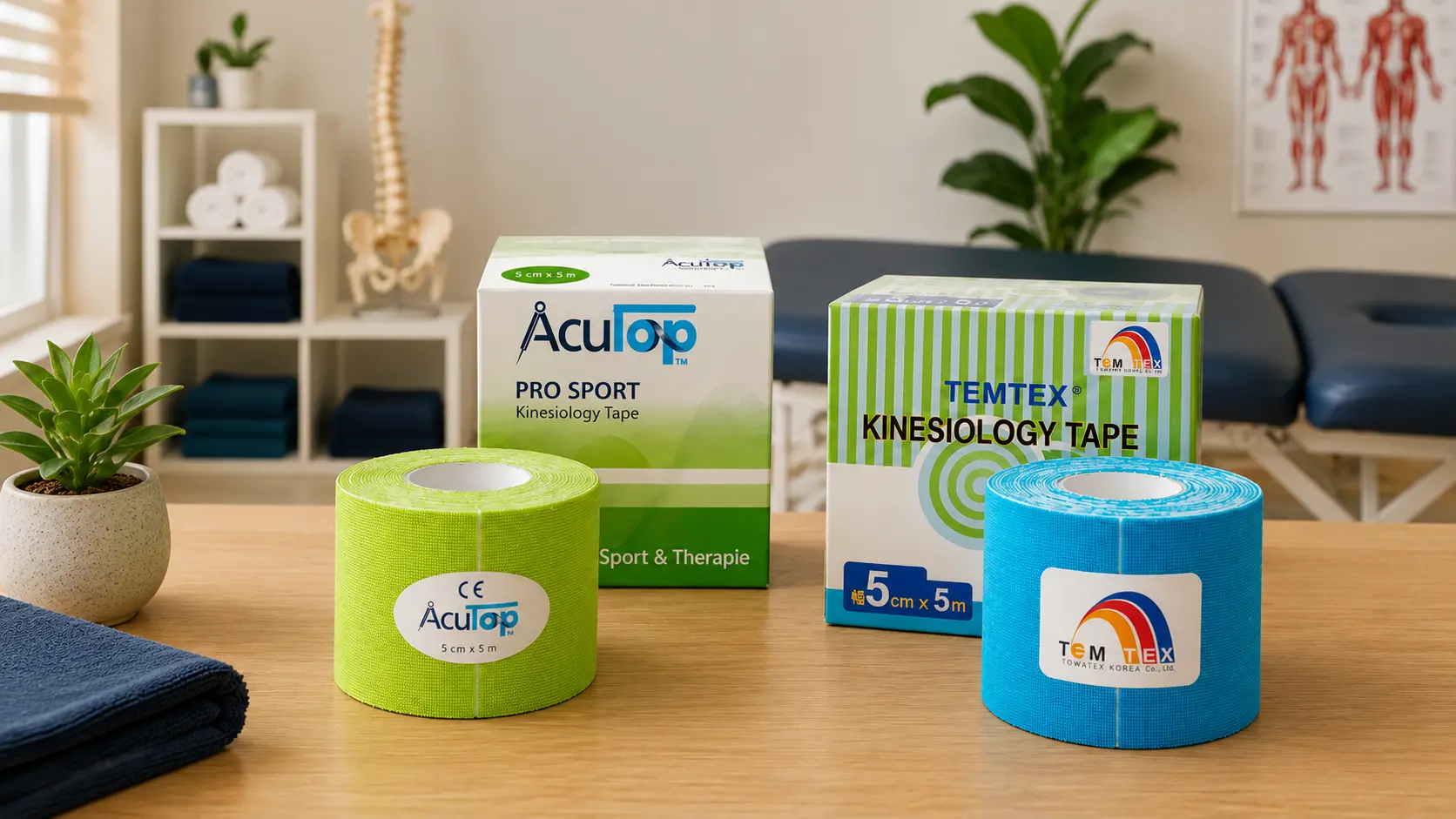
- For everyday clinic use. Choose the range based on its composition and adhesive, and the colour on patient preference. In our catalogue, the Temtex 5 cm × 5 m comes in nine colours.
- For volume and colour coding. The 35 m AcuTop Classic XXL comes in ten colours. You can find the full range in our kinesiology tape collection.
We set out the criteria that matter when buying for a physiotherapy practice in our guide to choosing kinesiology tape, and the AcuTop and Temtex comparison covers the two ranges in detail.
Frequently asked questions
Does blue kinesiology tape bring swelling down?
Not because it is blue. The idea comes from the colour association between blue and cold, not from a measurement. If you are using kinesiology taping where there is inflammation or oedema, the indication and the way the tape is applied are matters for clinical assessment. The colour adds no demonstrated anti-inflammatory effect.
Does black kinesiology tape increase strength or get warmer?
No evidence supports either claim. According to the manufacturer itself, black was added to the range at users' request, not for a thermal property. The fact that a dark surface absorbs more radiation does not demonstrate that black tape warms the skin enough to change the treatment.
Can one colour cause more skin reactions than another?
No particular colour has been shown to cause more reactions. Kinesio's own precautions concern sensitive skin, heavy sweating and removing the tape as soon as irritation appears, not colour. On reactive skin, apply a small piece of tape, leave it in place for 24 hours, and stop using it if there is an abnormal reaction such as itching, marked redness, burning or swelling (Kinesio Taping Perfect Manual, 2nd edition).
Sources and references
These are the sources we drew on to write this article:
- Kinesio Taping Association. Official frequently asked questions on Kinesio Tex and Kinesio Tape FAQs. The two pages contain complementary statements about Kinesio's own range. The first is the source for the absence of any physical or chemical difference between the colours, for colour-therapy compatibility, for beige and black, and for colour being a matter of individual preference. The second is the source for the red-and-pink and blue associations, which do not appear on the first. Checked in August 2026.
- Kinesio Taping Association International. Kinesio Taping Perfect Manual, 2nd edition (free public sample, PDF). Manufacturer precautions for sensitive skin: a test patch on a small area left for 24 hours before use. Checked in August 2026.
- Cavaleri R, Thapa T, Beckenkamp PR, Chipchase LS. The influence of kinesiology tape colour on performance and corticomotor activity in healthy adults: a randomised crossover controlled trial. BMC Sports Science, Medicine and Rehabilitation, 2018;10:17. Randomised crossover trial in 32 healthy adults across five application conditions, with a validated hop test, isokinetic dynamometry and transcranial magnetic stimulation.
- Selva F, Pardo A, Aguado X, Montava I, Gil-Santos L, Barrios C. A study of reproducibility of kinesiology tape applications: review, reliability and validity. BMC Musculoskeletal Disorders, 2019;20:153. Mechanical tests and peel tests on 380 specimens, four colours per brand. Its design does not allow the gaps observed to be traced to the pigment itself.
- Mo Q, Deng Z, Zheng J, Wu T, Hu F, Xu S, Zou J, Zheng X. Effectiveness and clinical relevance of kinesio taping in musculoskeletal disorders: an overview of systematic reviews and evidence mapping. BMJ Evidence-Based Medicine, 2026. An overview of 128 reviews or review projects, of which 73 are published systematic reviews and 55 registered but not yet published, covering 310 unique trials and 15,812 participants; 78% of the reviews appraised were of critically low methodological quality. This is the overall source on the effectiveness of kinesiology taping in musculoskeletal disorders.